Advertisements
Advertisements
प्रश्न
State True or False:
"Wavelength of red light is close to 700 nm.”
पर्याय
True
False
Advertisements
उत्तर
This statement is True.
APPEARS IN
संबंधित प्रश्न
In the following diagram, the path of a ray of light passing through a glass prism is shown:
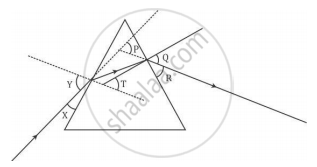
In this diagram the angle of incidence, the angle of emergence and the angle of deviation respectively are (select the correct option):
(A) X, R and T
(B) Y, Q and T
(C) X, Q and P
(D) Y, Q and P
Describe an activity to show that colours of white light splitted by a glass prism can be recombined to get white light by another identical glass prism. Also draw ray diagram to show the recombination of the spectrum of white light.
Study the following ray diagram:
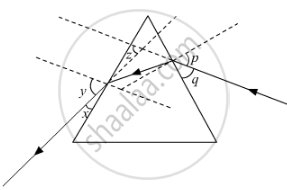
In this diagram, the angle of incidence, the angle of emergence and the angle of deviation respectively have been represented by
(A) y, p, z
(B) x, q, z
(C) p, y, z
(D) p, z, y
When a ray of light enters a prism, it bends ______ the normal; as it leaves the prism, it bends ______ the normal.
What happens when a ray of ordinary light is passed through a triangular glass prism?
Which is refracted most by a prism : red light or violet light? Explain why?
Why do you not see a spectrum of colours when light passes through a flat pane of glass?
The property of splitting of white light into its seven constituent colours is known as
When a white light ray falls on a prism, the ray at its first surface suffers ______.
If white light is used in same way what change is expected in the emergent beam?
State two uses of ultraviolet radiation.
Write the range of wavelength of the infrared spectrum.
In the diagram, a narrow beam of white light is incident on a right-angled isosceles prism. The critical angle of the material of prism for the yellow colour of white light is 45°. Complete the diagram to show the path of blue, yellow, and red colours of white light till they emerge out of the prism.
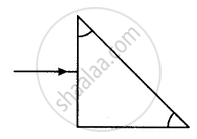
Write an Explanation.
Critical angle
State the correct sequence (1-7) of colours in the spectrum formed by the prisms A and B, shown in the following figure.
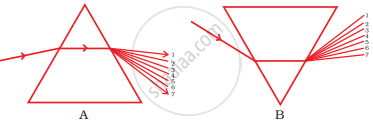
What is a rainbow?
The dispersive powers of flint glass and crown glass are 0.053 and 0.034, respectively and their mean refractive indices are 1.68 and 1.53 for white light. Calculate the angle of the flint glass prism required to form an achromatic combination with a crown glass prism of refracting angle 4°:
A prism of refractive index `sqrt2` and refracting angle A produces minimum deviation δm of a ray on one face at an angle of incidence 45°, The values of A and δm are, respectively ______.
State the colour which bends:
- The most.
- The least while passing through a glass prism.
