Advertisements
Advertisements
प्रश्न
Look at the table given below and write a short paragraph based on it in about 120 words :
The following table shows irregular rainfall causing low groundwater level in Nashik district, and Talukawise its worst hit villages.
| Drop in water level | Talukas | |||
| 0 to 1 meter | Nashik, Igatpuri, Niphad, Chandwad, Kalwan, Deola, Tryambakeshwar | |||
| 1 to 2 meters | Sinnar, Yeola, Nandgaon, Satana, Malegaon | |||
| Worst Hit Areas | ||||
| Talukas | Situation over coming months | |||
| Oct.-Dec. | Jan-Mar. | Apr.-June | Total | |
| Igatpuri | 01 | 06 | 49 | 56 |
| Malegaon | 31 | 54 | 37 | 122 |
| Nandgaon | 08 | 17 | 37 | 62 |
| Niphad | 01 | 04 | 47 | 52 |
| Source: Times of India, Nashik Times, City Edn. Date: Oct. 18, 2018 |
||||
Advertisements
उत्तर
Erratic Rainfall pulls down Groundwater Levels
According to The Times of India, Nashik Times, City Edition dated October 18, 2018, irregular rainfall has led to a drastic drop in groundwater level in 12 talukas in Nashik district. There is a drop in the water level of up to one metre in Nashik, Igatpuri, Niphad, Chandwad, Kalwan, Deola and Trimbakeshwar talukas. Worse off are the talukas of Sinnar, Yeola, Nandgaon, Satana and Malegaon, with a drop of 1 to 2 metres in groundwater level. The situation over the coming months is grim, with many villages being affected. The worst hit is Malegaon taluka, With 122 villages facing problems, followed by Nandgaon taluka with 62 villages and Igatpuri taluka with 56 villages. Niphad taluka is not far behind with 52 villages likely to be hit by water shortage.
APPEARS IN
संबंधित प्रश्न
A1. Information Transfer (Non-verbal to verbal)
'Transfer the following information into a paragraph form.
Manuscripts collected from both students and teachers.
↓
Throughly screened, necessary additions, alterations. omissions are made.
↓
Preparing a rough draft
↓
Manuscripts along with a dummy sent to the printer
↓
Proof correction
↓
Sent for final printing
OR
A2. Here are some tips about keeping healthy as given in a Science magazine. Read and
write in the form of Do's and Don'ts (table):
You must include vegetables and fruits in your diet and drink a lot of water. You should avoid junk food and aerated water. You shouldn't sit for long period of time. Rather you should exercise regularly. You shouldn't ignore the importance of good breathing habits. Try breathing deeply whenever you think of it. See to it that you leep for at least 7 hour a day. In fact, you should avoid irregular timings.
A1.Books have the power to inspire and do many more things. Observe the web diagram and convert the information into a paragraph. Add a few more points to the given information:

A2. Read the given information and fill the table provided:
Acclaimed in Indian classics as the Kalpavriksha, the all giving tree the coconut palm grows in several states in India. The coconut palm is member of the plant family Arecaceae popularly known as palm family. It flourishes on sandy soils requiring high humidity abundant sunlight and high rainfall for optimal growth. All parts of the palm are used in some way or another in the daily life of the people. Coconut water provides a refreshing and nutritious drink. The firm kernel that line the inside is high in calories and the white milk extracted from it is used in many different ways. Oil extracted from dried mature coconuts is used as cooking oil. The leaves are braided to make thatched roof and mats. The mid ribs of the leaves are dried and tied together to make brooms. The coconut shell and husk are good sources of efficient fuel. During religious ceremonies married women are often presented with a coconut along with a few grains of rice as a symbol of fertility and prosperity.
| Name : | |
| Scientific name : | |
| Place where grown : | |
| Climate required : | |
| Uses : | |
| (a) Liquid | |
| (b) Kernel | |
| (c) Leaves | |
| (d) Shell | |
| Symbolises : |
Read the following tree diagram about 'Morphemes' and write a short paragraph on it.

Read the following Intros of news items. Choose any ONE of them and write the headline, the dateline and a short continuing paragraph for it.
(i) A shortage of onions in Maharashtra has surged prices by 30 percent. It forced the authorities to import onions from abroad.
(ii) The birth anniversary of the late President Dr. S. Radhakrishnan was celebrated yesterday in Saraswati Kanya Pathshala as Teacher's Day.
Study carefully the following pie-chart about the Income Sources of a City Budget and write a short continuing paragraph based on it in about 120 words :

Read the following extract and complete the table given below :
Computer Assisted Language Leaming (CALL) materials come in two main formats: CD/DVD RO Ms and Web-based. Some are tailored to the content to be used in the classrooms whereas others can be used independently. CALL materials allow you to work at your own pace.
Multimedia materials offer you the opportunity to take part in other computer-assisted activities, such as text-based gap-filling, multiple-choice and text reconstruction activities. Language teachers often develop such text-based CALL activities to accompany a particular course. CALL materials can be regularly updated.
Because CALL learning activity types are usually designed from a template, they can sometimes be repetitive.
A major advantage of CALL materials is that they offer instant feedback on your spoken or written performance. However, such feedback can be limited. If you are more interested in creating your own responses or elaborating on your ideas, you may find this type of Facebook frustrating. Web-based CALL materials can offer more variety through the use of hyperlinks, but feedback is still limited.
Just as representations of the cultures of the target language offered by courses using books; audio and videotapes can perpetuate stereotypes.
| Computer Assisted Language Learning Material | ||
| Formats | Advantages | Disadvantages |
| ------------and Web-based | (a) content tailored for classroom use |
(i) ------- |
| (b) ----------- | (ii) limited feedback | |
| (c) ----------- | (iii) --------- | |
| (d) offer opportunity to take part in other computer-assisted activities | (iv)-------- | |
| (e) ----------- | ||
| (f) ----------- | ||
| (g) offer variety | ||
Read the following extract and complete the tree – diagram given below:


Read the following extract and extend it by adding an imaginary paragraph of your own in about 120 words :
Someone was standing in the doorway. An elderly woman,
very fluffy, very pink. Her cheeks were pink, her dress was pink,
her hair was bunched up and white. She was straight out of Agatha Christie.
"Miss Marple!" I exclaimed.
''May I come in?" asked the pink lady.
"Please come in " said my mother. ''Do sit down. Do you
require a room?" '
''Not today, thank you. l'm staying with Padre Dutt. He insisted on putting me up. But I may want a room for a day or two - just for old times' sake."
"You've stayed here before."
"A long time ago. I'm Mrs Green, you know. The missing
Mrs Green. The one for whom you put up that handSome tombstone in the cemetery. I was very touched by it. And I'm glad you didn't add ' Beloved "wife of Henry Green ', because I didn't love him any more than he loved me."
Information Transfer: Non-verbal to Verbal
Information Transfer: Verbal to Non-verbal
Read the following paragraph and prepare a tree-digram using the information given in the paragraph.
Quite often it is your family and friends who are the only source of solace in times of tension and confusion. Whether it is the time of exams, results and admission, school issues or a misunderstanding with a dear friend, you will notice
that your family members might want you to share your worries with them. One great advantage about sharing problems with your family members is that they actually care about your happiness. Your problem will not go beyond the people whom you are confiding in and will ensure that you are relieved of the stress and worries besides being the source of practical solutions for your problems.The relief it brings is immense not just for you but also for them as they would be the happiest to see you relaxed and calm. This is what makes family bonding
special. Situations such as these can bring you closer to your siblings and make you realise that such oneness is unique and special.
Information Transfer :Non-verbal to Verbal
Read the information on the life history of Kalpana Chawla. On the basis of given points write two short paragraphs on her life history. Suggest a suitable title.
Kalpana Chawla : The first Indian woman in space.
Born : 1961, Karnal, a small town of Haryana.
Schooling : Tagore Bal Niketan, Karnal (1976). B.E from Punjab Engineering College, Chandigarh.
1984 : Master’s degree in Aerospace Engineering – University of Texas
1986 : Ph.D in Aerospace Engineering – University of Colorado
1995 : Picked up for the space programme by NASA.
1997 : Became the first Indian American in space
January 2003 : Went abroad her second space shuttle Columbia to study the outer atmosphere of the sun.
1st February 2003 : Space shuttle lost contact and crashed claiming Kalpana’s life with six fellow astronauts.Read the information on the life history of Kalpana Chawla. On the basis of given points write two short paragraphs on her life history. Suggest a suitable title.
Kalpana Chawla : The first Indian woman in space.
Born : 1961, Karnal, a small town of Haryana.
Schooling : Tagore Bal Niketan, Karnal (1976). B.E from Punjab Engineering College, Chandigarh.
1984 : Master’s degree in Aerospace Engineering – University of Texas
1986 : Ph.D in Aerospace Engineering – University of Colorado
1995 : Picked up for the space programme by NASA.
1997 : Became the first Indian American in space
January 2003 : Went abroad her second space shuttle Columbia to study the outer atmosphere of the sun.
1st February 2003 : Space shuttle lost contact and crashed claiming Kalpana’s life with six fellow astronauts.
Look at the following web chart and write a short paragraph based on it in about 120 words. Suggest a suitable title:

The following graph shows the number of visitors (in millions) visiting the famous Salarjung Museum in Hyderabad between 2000 and 2010 as well as the number of visitors expected to visit it in the next ten years.

The chart below shows information on the economics of the Annual
Sports Meet. Study the chart carefully.
| The Economics of the Annual Sports Meet |
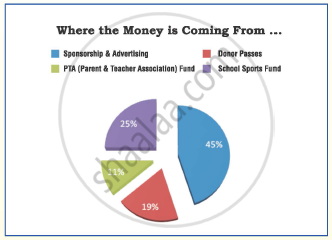
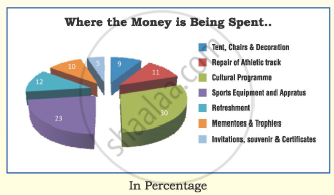
The total cost estimated of the Meet will be~ 11, 00, 000/-
No of athletes : 1250 (750 Girls+ 500 Boys; Category wise: sub-junior: 350, junior: 500 and senior: 400)
Staff on Duty : Teachers: 95 (35 men + 60 women), Support Staff 40 (21 men + 19 women), Staff on Parking and Security duty : 25 (20 men+ 5 women)
No of events : 100 ( 70 Track & Field events and 30 Jumps and Throws)
Medals : 100 Gold, 100Silver& 100Bronze
Best Athlete Trophies : Boys: 3, Girls: 3
Best House Trophies : 4( 1 for each category and 1 over all)
Suppose you are the Prin cipal of the school. Taking information from the chart, prepare an oral presentation for the Management Committee of the school. Use as many expressions of comparison as you can. You have been given some examples.
Look at the graph and the paragraph below which provides an interpretation of the data given in the graph.
Graph to show number of whales caught in Antarctic (1985-2010)

As whalers reduced catching of the large/r whales, they switched to smaller species. This is evident when we compare figures for the Antarctic catch of the larger sei whale with those for small minke whale. In 1985, fifteen times as many sei whales as minke whales were caught. By 1995, catches of both the species were virtually the same (9000). By the 2000, the situation had reversed and the number of minke whales killed more than doubled as compared to sei whales (6000). The graph shows that while the sei catch was reduced by 95% between 1985 and 2010, over the same period the minke whale catch was eight times greater. If these trends continue, the situation for the smaller species will be as bad as it used to be for the larger ones.
Discuss with a partner:
1. What expressions have been used for comparing the data? Underline them.
2. Does the analysis identify the main trends? Has any projection or guess been made based on the available data?
3. Can you spot a sentence that summarizes the data or draws a conclusion based on it?
4. Has the analysis been supported with figures from the given data?
5. Is there any unnecessary repetition?
6. How many times has the verb 'be' in its different forms been used? Some useful expressions :
|
{much ,many, far ,slightly, a little} |
more, greater,higher, less, lower, further, farther |
|
{half, twice, ten times, (etc.)} |
as { adj. adv.} as |
|
10 percent 150 percent |
{more less } than |
| almost the same ____ as | |
| as {adj adv.} as |
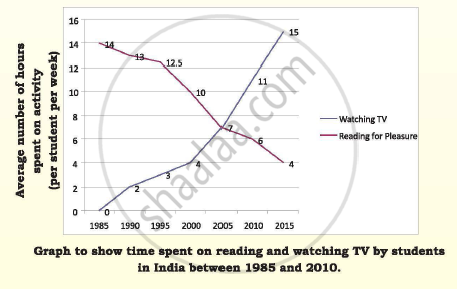
The graph below describes the average number of hours spent by students aged 11-15 years on two activities (per student per week) in India between 1985 and 2010 and gives projections for 2015. Study the information carefully and then write a paragraph interpreting the data. Include the following:
• A comparison of the trends in the two activities
• A comparison of the situation in 1985
• A comparison of the situation between 1985 and 2010
• Predictions for the future
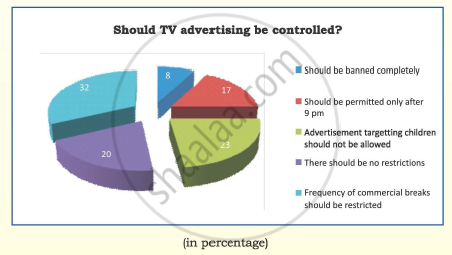
A school carried out two surveys in Class X. Look at the pie charts below and write short summaries of the results as in the model above.
____________________________________________________________________
____________________________________________________________________
____________________________________________________________________
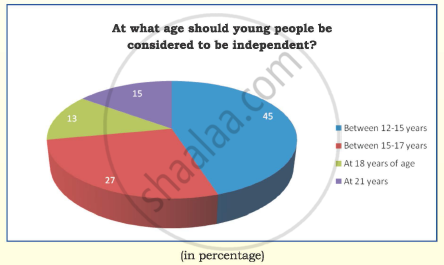
____________________________________________________________________
____________________________________________________________________
____________________________________________________________________
Observe the following table and transfer the information into a paragraph:
Statewise Distribution of Urban and Rural Population in India:
| States | Population in Millions | |
| Rural | Urban | |
| Maharashtra | 560 | 410 |
| Gujarat | 320 | 190 |
| Madhya Pradesh | 440 | 160 |
| Chhattisgarh | 170 | 40 |
| Andhra Pradesh | 550 | 210 |
| Karnataka | 350 | 180 |
Read the following extract and complete the table given below about 'Types of Diseases':
Health is defined as not simply the absence of disease. It involves a state of feeling well, both in body and in mind.
The diseases may be classified into the following types, Some diseases are present at birth. They are called congenital diseases. They may develop during pregnancy or are inherited, Some of them may be caused by environmental factors. Examples of congenital diseases are Down's syndrome, sickle cell anaemia, cystic fibrosis, haemophilia, etc.
Some diseases are acquired by humans themselves and hence are called Self-Inflicted or Acquired diseases. Examples of acquired diseases are coronary heart diseases, hypertension.
Some diseases are transmitted from one person to another. They are called as Communicable or Infectious diseases. They are caused by biological agents, Examples of communicable diseases are Cholera, Typhoid, Measles, Malaria, etc.
Non- communicable diseases are caused by exogenous factors like physical, chemical, nutritional deficiencies. The examples are Kwashiorkor, Pellagra, Scurvy, and Rickets, etc.
Title
| Sr.No. | Types | Causes |
Examples |
| 1. | Congenital |
o develop during pregnancy o environmental factors |
|
| 2. | Self-Inflicted Acquired | Coronary heart disease. hypertension | |
| 3. | By biological agents | Cholera, typhoid, measles, malaria | |
| 4. | Non-communicable diseases | Kwashiorkor, Pellagra, Scurvy, and Rickets |
Extend the given extract by adding an imaginary paragraph of your own (about 120 words)
A couple of days later, I was walking around the camp, around the barracks, near the barbed-wire fence where the guards could not easily see. I was alone.
On the other side of the fence, I spotted someone: a little girl with light, almost luminous curls. She was half-hidden behind a birch tree.
I glanced around to make sure no one saw me. I called to her softly in German. 'Do you have something to eat?'
She didn't understand.
I inched closer to the fence and repeated the question in polish. She stepped forward. I was thin and gaunt, with rags wrapped around my feet, but the girl looked unafraid. In her eyes, I saw life.
She pulled an apple from her woollen jacket and threw it over the fence.
I grabbed the fruit and, as I started to run away, I heard her say faintly, 'I'II see you tomorrow."
Read the following tree-diagram and prepare a short paragraph regarding 'Soil Erosion'.

Read the following passage and complete the table
Dialect is a form of a language spoken in one area which may be different from other forms of the same language. Each language has dialects which change every few kilometers. India is a multi-lingual country. Each state follows its own language as official language. For example, Marathi is the official language of Maharashtra, while Ahirani, Wharadi, Konkani and Malwani are its dialects. Several languages in India are spoken but do not have any script. In Karnataka, Kannada is the official language. Tulu is spoken in Karnataka but has no script. In England, English is the official language while Scottish, spoken in Scotland and Welsh spoken in Wales are dialects of English.
| State | Official language | Dialects | Spoken/ Without script |
| Maharashtra | Marathi | ||
| Karnataka | |||
| England |
Read the following text and present the information in a tabular form:
Raja Ram Mohan Roy was a zealous social worker holding modern and progressive views. He firmly stood against social bigotry, conservation, and superstition and advocated English and Western Education for his fellowmen. He knew many languages viz English, Persian, Arabic, Latin, French, and even Hebrew. He was born in 1772 in West Bengal. He joined East India Company in 1805. The title ‘Raja’ was conferred on Ram Mohan Roy by the Mogul Emperor. In 1814 he founded the Atmiya Sabha and in 1828 the ‘Brahmo Samaj’. He abolished ‘sati’, child marriage and the purdah. He is rightly called the ‘father of Indian Renaissance’ or the ‘Father of Indian Nationalism’. He died on 27 Sept. 1833 in England.
| Name: | |
| Date of Birth: | |
| III practices abolished: | |
| Institutions launched: | |
| Languages Known: |
Transfer the information into a paragraph:
Read the following web diagram to transform into a paragraph:

Transfer the information into a paragraph about ‘Average Annual Tea Consumption Per Person’ as shown in the table given below :
| Nation | Turkey | Ireland | United Kingdom | Russia | Morocco | China | India |
| Tea consumption per person ( in Kg) | 3.15 | 2.19 | 1.94 | 1.38 | 1.21 | 0.57 | 0.32 |
Read the following paragraph and transfer the information in the form of a tree diagram:
The United Nations was established at the end of the second world war to maintain international peace and security.
In the central system of the UN, there are 15 members of the Security Council. The Economic and Social Council has 54 members. The Secretariat of the United Nations is headed by Secretary-General.
The UN has several specialized agencies such as the World Health Organisation (WHO), the Food and Agricultural Organisation (FAO), the International Labour Organization (ILO), the United Nations Educational, Scientific and Cultural Organisation (UNESCO).
Views :
Develop a paragraph on the view by using the points given below :
Read the following paragraph and transfer the information in the form of a tree diagram:
|
The United Nations was established at the end of the second world war to maintain international peace and security. The UN has several specialized agencies such as the World Health Organisation (WHO), the Food and Agricultural Organisation (FAO), the International Labour Organization (ILO), the United Nations Educational, Scientific and Cultural Organisation (UNESCO). |
(i) Read the following tree diagram and find out more information about opportunities in ‘on and off the shore’ the Indian Navy.

(ii) Required qualifications and various fields/opportunities for women to join in the Navy.

(iii) Colleges that provide education in oceanography -
- National Institute of Oceanography, Goa
- National Institute of Oceanography, Mumbai
- MBA (Logistic Shipping Management), IIKM Business School, Calicut, Kerala
- Indira Gandhi College of Distance Education IGCDE Tamil Nadu.
Verbal to Non-Verbal:
Read the following information and complete the following table below it:
Chandrayaan-2, India’s second mission to the Moon will, for the first time, unravel secrets around the Moon’s the South Pole. Chandrayaan-2 is a three-part spacecraft - an orbiter, a lander, and a rover. The lander is named Vikram after Vikram Sarabhai, the founder of the Indian space programme. The rover is named Pragyan, meaning ‘wisdom’.
Chandrayaan-2 was launched on 22 July atop ISRO’s GSLV Mk-III at 2:43 p.m. from the Satish Dhawan Space Centre at Sriharikota. Performing as expected, the rocket released Chandrayaan-2 in a highly elliptic orbit around Earth about 17 minutes later. In fact, it was released 6,000 km higher than planned. The solar arrays on Chandrayaan-2 deployed smoothly as the probe began its journey.
| Table | Information | |
| 1. | Name of the Mission | |
| 2. | Date of Launch | |
| 3. | Centre of Launch | |
| 4 | Name of the Rover | |
| 5. | Founder of Indian Space Programme |
Non-verbal to Verbal:
Transfer the information into a paragraph:
Observe the tree diagram of types of disease and write a paragraph on it. Suggest a suitable title.

Write two short paragraphs on ‘Village life’ by using the points given in the following web diagram:

Study the concept chart from the self-help magazine section of a monthly publication.

Write a paragraph in not more than 120 words, analysing the listed responses to the situation when one faces setbacks.
Transfer the given information in the form of a paragraph.
THE WATER CYCLE PROCESS

Non-Verbal to Verbal
Transfer the given information in the form of a paragraph.
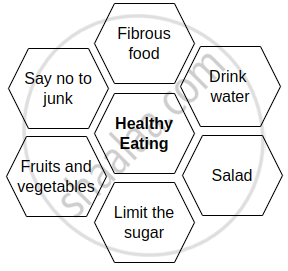
Non-Verbal to Verbal:
Write the given information in the form of a paragraph:
Distribution of working children by type of work in 2011
| Area of work | Percentage | Number (in millions) |
| Cultivators | 26.0 | 2.63 |
| Agricultural labourers | 32.9 | 3.33 |
| Household workers | 5.2 | 0.52 |
| Other workers | 35.8 | 3.62 |
Non-verbal to verbal:
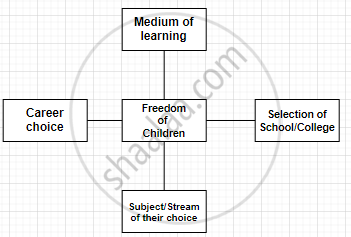
The following diagram shows important factors to be considered while choosing a career. Write a paragraph based on it. Give a suitable title to it:

Verbal to Non-verbal:
Read the following statements and prepare a chart of ‘Dos’ and ‘Don'ts’. Suggest a suitable title for it.
Nature is abode for all of us. It provides us with all our basic needs. However, we must take care of the following things so that our mother nature is not harmed.
- We must plant more trees.
- We should not cut trees.
- We must keep our area neat and clean.
- We should never discharge garbage without proper management.
- We should not pollute air and water.
- We should not use plastic bags.
- We should not hunt birds or animals.
- We should use more of public transport.
- We should spread awareness about the importance of maintaining balance in nature.
A group of enterprising young adults conducted a survey on reopening of educational institutions in the National Capital.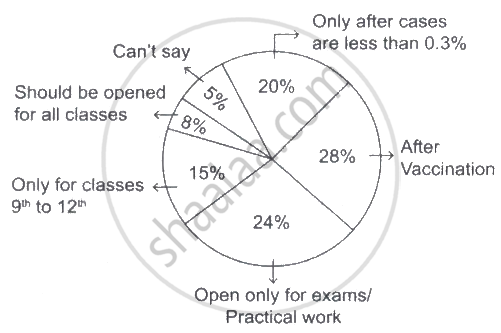
Write a paragraph in about 120 words analysing the listed responses.
Non-Verbal to Verbal
Write a paragraph of 100 words based on the information given in the following table and give a suitable title for it:
| Types of Forests | Plants | Animals | |
| (1) |
Equatorial Evergreen |
Mahogany, Rosewood, Ironwood, Oil palm |
Different types of monkeys, snakes, lizards, bats, tse-tse flies |
| (2) | Marshes |
Mangraove, Creepers, Numerous tall trees like Mahogany |
Different types of insects, snakes, crocodiles, tse-tse and other flies |
Draw a table of comparison (tabular form) between Amir and Anita that includes the information given below. Give a suitable title:
|
Amir and Anita are good neighbours. They are cooperative and have happy families. Amir, an 18-year young chap is in std. 12 and goes to a famous college in the city. Anita, a 16-year charming girl will appear for her 10th class Board Exam this year. Amir’s father a big businessman in the city and Anita’s father is a government officer. Amir’s mother, a housewife, helps his father in their family business also. Anita’s mother is a doctor and has her own clinic. Amir is a good sportsman who likes to play outdoor games on the contrary Anita likes to remain indoors and enjoys indoor games. Amir is strong and dynamic. Though strong Anita is sensitive also. Photography and bird-watching are my interests of Amir. Anita spends her time in her hobbies of singing and painting. Amir after his 12th exam wants to pursue his career in wild-life photography. Anita would like to join Arts stream after her Board Exams. |
| Amir | Anita | |
| (1) Age | ||
| (2) Class | ||
| (3) Father’s occupation | ||
| (4) Mother's occupation | ||
| (5) His/Her qualities | ||
| (6) His/Her hobbies/interest | ||
| (7) His/Her ambitions/future plans |
Non-verbal to Verbal:
Transfer the given information into a paragraph. Suggest a suitable title:
| Caused by Man | Caused by Nature | Solutions | |
| i. | Too many people | Droughts | Stricter laws to control population. |
| ii. | More agricultural land required to meet the needs of the ever growing populations | Floods | Stricter laws and proper execution of laws |
| iii. | Cutting of forests for wood etc. | Forest fires | Use alternative products. |
| iv. | Poaching by hunters. | - | Reduce demand for illegal wildlife parts and products by not purchasing products made from these items. |
Non-verbal to verbal:
Read the information given in the following tree-diagram and write two short paragraphs based on it. Give a suitable title to your write up:
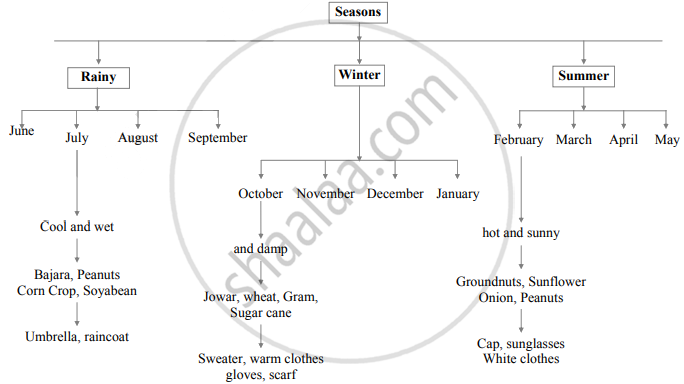
Verbal to Non-verbal:
Read the following information and complete the given table below. Suggest a suitable title to it:
|
Chandrayaan-1 was India's first mission to the moon. It launched on Oct. 22, 2008 from the Satish Dhawan Space Centre in Sriharikota, India. Its scientific goals are to study the chemical, mineralogical and photogeological mapping of the moon. In addition to find out water on the moon. Then to perform high resolution remote sensing of the moon’s surface. The Chandrayaan-2 mission was successfully launched on 22nd July, 2019 from Satish Dhawan Space Centre, Sriharikota. The primary objectives were to demonstrate the ability to soft land and operate a robotic rover on the lunar surface. The mission was arranged to study the lunar topography, mineralogy, elemental abundance and the lunar ecosphere, conduct a detailed search for water and ice in polar region. Chandrayaan 2’s objectives are to find Chandrayaan-1 as reported by the ISRO. The mission targeted the “South Polar region” of the moon which was completely unexplored. The mission focused on the extensive mapping of the lunar surface for studying variations in its composition and tracing the moon's origin and evolution. Chandrayaan-3 launched to the moon on July 14, 2023 from the Satish Dhawan Space Centre in Sriharikota, India, the medium-life launch vehicle Mark-III (LVM3) rocket. The three main objectives of Chandrayaan-3 are to land safely on the surface, to demonstrate rover operations and to perform scientific experiments on site, according to the official website. |
Title: __________________
| Name of Chandrayaan | Date of launching | Objectives of Mission |
| Chandrayaan-1 | ||
| Chandrayaan-2 | ||
| Chandrayaan-3 |
