Advertisements
Advertisements
प्रश्न
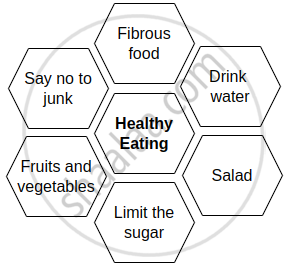
Transfer the information into a paragraph:
Read the following web diagram to transform into a paragraph:

Advertisements
उत्तर
Some students get terrific grades and are star performers in the classroom. But when it comes to admission tests, they take a serious fall. What are some of the most common reasons that students with shiny academic records end up getting low test scores on their entrance exams are watching continuous t.v or films at home., Wasting too much time in playing games.many students are involved in bad company and therefore they do not concentrate on studies., Lack of proper study habits, lack of motivation, etc.No one can give proper guidance to the student.that's way students are not getting high marks in exams.
APPEARS IN
संबंधित प्रश्न
Read the following tree diagram about 'Morphemes' and write a short paragraph on it.

Information Transfer :Non-verbal to Verbal
Read the information on the life history of Kalpana Chawla. On the basis of given points write two short paragraphs on her life history. Suggest a suitable title.
Kalpana Chawla : The first Indian woman in space.
Born : 1961, Karnal, a small town of Haryana.
Schooling : Tagore Bal Niketan, Karnal (1976). B.E from Punjab Engineering College, Chandigarh.
1984 : Master’s degree in Aerospace Engineering – University of Texas
1986 : Ph.D in Aerospace Engineering – University of Colorado
1995 : Picked up for the space programme by NASA.
1997 : Became the first Indian American in space
January 2003 : Went abroad her second space shuttle Columbia to study the outer atmosphere of the sun.
1st February 2003 : Space shuttle lost contact and crashed claiming Kalpana’s life with six fellow astronauts.Read the information on the life history of Kalpana Chawla. On the basis of given points write two short paragraphs on her life history. Suggest a suitable title.
Kalpana Chawla : The first Indian woman in space.
Born : 1961, Karnal, a small town of Haryana.
Schooling : Tagore Bal Niketan, Karnal (1976). B.E from Punjab Engineering College, Chandigarh.
1984 : Master’s degree in Aerospace Engineering – University of Texas
1986 : Ph.D in Aerospace Engineering – University of Colorado
1995 : Picked up for the space programme by NASA.
1997 : Became the first Indian American in space
January 2003 : Went abroad her second space shuttle Columbia to study the outer atmosphere of the sun.
1st February 2003 : Space shuttle lost contact and crashed claiming Kalpana’s life with six fellow astronauts.Read the information on the life history of Kalpana Chawla. On the basis of given points write two short paragraphs on her life history. Suggest a suitable title.
Kalpana Chawla : The first Indian woman in space.
Born : 1961, Karnal, a small town of Haryana.
Schooling : Tagore Bal Niketan, Karnal (1976). B.E from Punjab Engineering College, Chandigarh.
1984 : Master’s degree in Aerospace Engineering – University of Texas
1986 : Ph.D in Aerospace Engineering – University of Colorado
1995 : Picked up for the space programme by NASA.
1997 : Became the first Indian American in space
January 2003 : Went abroad her second space shuttle Columbia to study the outer atmosphere of the sun.
1st February 2003 : Space shuttle lost contact and crashed claiming Kalpana’s life with six fellow astronauts.
Read the following information and prepare a pie diagram for the same.
Annual Water Usage in Maharashtra
Water is life. It is a universal solvent and an important resource. The annual usage of water differs in various sectors of Maharashtra. The major occupation of Maharashtra being agriculture, the maximum amount of available water is used for irrigation that is 86%. The distant following place 7% is contributed by domestic sector including drinking, washing, cooking, etc. There is a close competition of other sectors which is not far away with 6% usage of water. One of the key factors which plays an important role in the development of a nation is industrial sector. The consumption of water by industrial sector is very negligible which is 1%. We know energy sector plays a vital role in the development of a nation.
In this sector, the use of water is almost nil. If we try to observe its place in the chart we do realise that it holds 0% usage and is yet to open its account.
Read the following extract and complete the table given below about 'Types of Diseases':
Health is defined as not simply the absence of disease. It involves a state of feeling well, both in body and in mind.
The diseases may be classified into the following types, Some diseases are present at birth. They are called congenital diseases. They may develop during pregnancy or are inherited, Some of them may be caused by environmental factors. Examples of congenital diseases are Down's syndrome, sickle cell anaemia, cystic fibrosis, haemophilia, etc.
Some diseases are acquired by humans themselves and hence are called Self-Inflicted or Acquired diseases. Examples of acquired diseases are coronary heart diseases, hypertension.
Some diseases are transmitted from one person to another. They are called as Communicable or Infectious diseases. They are caused by biological agents, Examples of communicable diseases are Cholera, Typhoid, Measles, Malaria, etc.
Non- communicable diseases are caused by exogenous factors like physical, chemical, nutritional deficiencies. The examples are Kwashiorkor, Pellagra, Scurvy, and Rickets, etc.
Title
| Sr.No. | Types | Causes |
Examples |
| 1. | Congenital |
o develop during pregnancy o environmental factors |
|
| 2. | Self-Inflicted Acquired | Coronary heart disease. hypertension | |
| 3. | By biological agents | Cholera, typhoid, measles, malaria | |
| 4. | Non-communicable diseases | Kwashiorkor, Pellagra, Scurvy, and Rickets |
Verbal to Non-Verbal:
Read the following information and complete the following table below it:
Chandrayaan-2, India’s second mission to the Moon will, for the first time, unravel secrets around the Moon’s the South Pole. Chandrayaan-2 is a three-part spacecraft - an orbiter, a lander, and a rover. The lander is named Vikram after Vikram Sarabhai, the founder of the Indian space programme. The rover is named Pragyan, meaning ‘wisdom’.
Chandrayaan-2 was launched on 22 July atop ISRO’s GSLV Mk-III at 2:43 p.m. from the Satish Dhawan Space Centre at Sriharikota. Performing as expected, the rocket released Chandrayaan-2 in a highly elliptic orbit around Earth about 17 minutes later. In fact, it was released 6,000 km higher than planned. The solar arrays on Chandrayaan-2 deployed smoothly as the probe began its journey.
| Table | Information | |
| 1. | Name of the Mission | |
| 2. | Date of Launch | |
| 3. | Centre of Launch | |
| 4 | Name of the Rover | |
| 5. | Founder of Indian Space Programme |
Transfer the given information in the form of a paragraph.
THE WATER CYCLE PROCESS

Non-Verbal to Verbal
Transfer the given information in the form of a paragraph.
A survey was conducted in the National Capital in over twenty schools about 40 different activities that interest the children in the age group of 13 years to 15 years. Write a paragraph in not more than 120 words, analyzing the following information.

Given below is a web diagram containing information about the different means of electronic devices of entertainment-some audio, some visual and some audio-visual.
Write a short paragraph based on information from the web. Give a suitable title to it.

Non-verbal to Verbal:
Transfer the given information into a paragraph. Suggest a suitable title:
| Caused by Man | Caused by Nature | Solutions | |
| i. | Too many people | Droughts | Stricter laws to control population. |
| ii. | More agricultural land required to meet the needs of the ever growing populations | Floods | Stricter laws and proper execution of laws |
| iii. | Cutting of forests for wood etc. | Forest fires | Use alternative products. |
| iv. | Poaching by hunters. | - | Reduce demand for illegal wildlife parts and products by not purchasing products made from these items. |
