Advertisements
Advertisements
प्रश्न
Transfer the information into a paragraph:
Read the following web diagram to transform into a paragraph:

Advertisements
उत्तर
Some students get terrific grades and are star performers in the classroom. But when it comes to admission tests, they take a serious fall. What are some of the most common reasons that students with shiny academic records end up getting low test scores on their entrance exams are watching continuous t.v or films at home., Wasting too much time in playing games.many students are involved in bad company and therefore they do not concentrate on studies., Lack of proper study habits, lack of motivation, etc.No one can give proper guidance to the student.that's way students are not getting high marks in exams.
APPEARS IN
संबंधित प्रश्न
Read the following Intros of news items. Choose any ONE of them and write the headline, the dateline and a short continuing paragraph for it.
(i) A shortage of onions in Maharashtra has surged prices by 30 percent. It forced the authorities to import onions from abroad.
(ii) The birth anniversary of the late President Dr. S. Radhakrishnan was celebrated yesterday in Saraswati Kanya Pathshala as Teacher's Day.
Read the following extract and complete the table given below :
Computer Assisted Language Leaming (CALL) materials come in two main formats: CD/DVD RO Ms and Web-based. Some are tailored to the content to be used in the classrooms whereas others can be used independently. CALL materials allow you to work at your own pace.
Multimedia materials offer you the opportunity to take part in other computer-assisted activities, such as text-based gap-filling, multiple-choice and text reconstruction activities. Language teachers often develop such text-based CALL activities to accompany a particular course. CALL materials can be regularly updated.
Because CALL learning activity types are usually designed from a template, they can sometimes be repetitive.
A major advantage of CALL materials is that they offer instant feedback on your spoken or written performance. However, such feedback can be limited. If you are more interested in creating your own responses or elaborating on your ideas, you may find this type of Facebook frustrating. Web-based CALL materials can offer more variety through the use of hyperlinks, but feedback is still limited.
Just as representations of the cultures of the target language offered by courses using books; audio and videotapes can perpetuate stereotypes.
| Computer Assisted Language Learning Material | ||
| Formats | Advantages | Disadvantages |
| ------------and Web-based | (a) content tailored for classroom use |
(i) ------- |
| (b) ----------- | (ii) limited feedback | |
| (c) ----------- | (iii) --------- | |
| (d) offer opportunity to take part in other computer-assisted activities | (iv)-------- | |
| (e) ----------- | ||
| (f) ----------- | ||
| (g) offer variety | ||
Question:
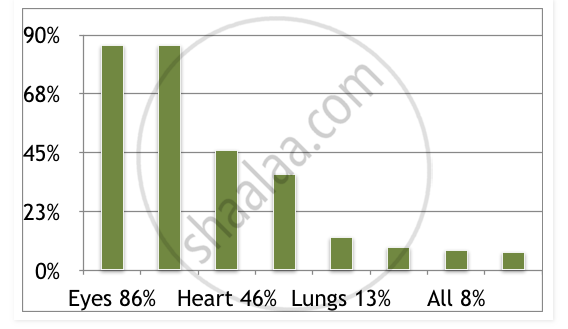
Read the following graph regarding ‘High Awareness but Little Action’ about organ donation. Write a paragraph based on it in about 120 words:
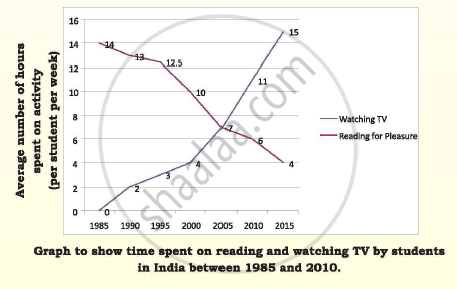
The graph below describes the average number of hours spent by students aged 11-15 years on two activities (per student per week) in India between 1985 and 2010 and gives projections for 2015. Study the information carefully and then write a paragraph interpreting the data. Include the following:
• A comparison of the trends in the two activities
• A comparison of the situation in 1985
• A comparison of the situation between 1985 and 2010
• Predictions for the future
A survey was conducted among the teachers of New Hope High School to find out whether Class X students should be allowed to use mobile phones in the campus. The results of the survey are shown in the pie-chart below.
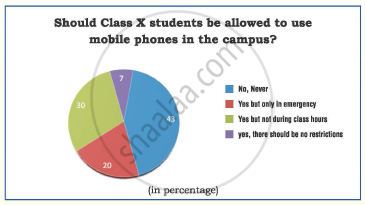
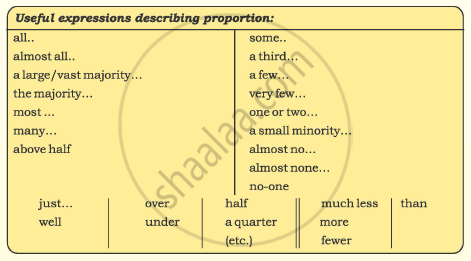
Look at the pie chart and the useful expressions above. Fill in the gaps in the following summary of results.
As can be seen from the above pie-chart, nearly a__________ of the teachers felt that Class X students must not be allowed to use mobile phones in the school campus. However, nearly one____________ believed
the phones should be permitted but not during class hours. About __________were of the opinion that the students may be allowed to use these phones only in times of emergency while a very__________ did not favour any restrictions on their use in the campus.
A school carried out two surveys in Class X. Look at the pie charts below and write short summaries of the results as in the model above.
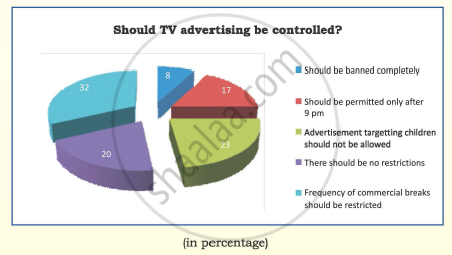
____________________________________________________________________
____________________________________________________________________
____________________________________________________________________
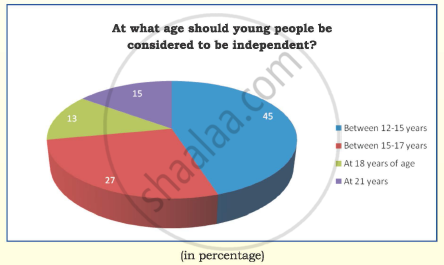
____________________________________________________________________
____________________________________________________________________
____________________________________________________________________
Extend the given extract by adding an imaginary paragraph of your own (about 120 words)
A couple of days later, I was walking around the camp, around the barracks, near the barbed-wire fence where the guards could not easily see. I was alone.
On the other side of the fence, I spotted someone: a little girl with light, almost luminous curls. She was half-hidden behind a birch tree.
I glanced around to make sure no one saw me. I called to her softly in German. 'Do you have something to eat?'
She didn't understand.
I inched closer to the fence and repeated the question in polish. She stepped forward. I was thin and gaunt, with rags wrapped around my feet, but the girl looked unafraid. In her eyes, I saw life.
She pulled an apple from her woollen jacket and threw it over the fence.
I grabbed the fruit and, as I started to run away, I heard her say faintly, 'I'II see you tomorrow."
Non-verbal to verbal:
The following diagram shows important factors to be considered while choosing a career. Write a paragraph based on it. Give a suitable title to it:

Verbal to Non-verbal:
Read the following statements and prepare a chart of ‘Dos’ and ‘Don'ts’. Suggest a suitable title for it.
Nature is abode for all of us. It provides us with all our basic needs. However, we must take care of the following things so that our mother nature is not harmed.
- We must plant more trees.
- We should not cut trees.
- We must keep our area neat and clean.
- We should never discharge garbage without proper management.
- We should not pollute air and water.
- We should not use plastic bags.
- We should not hunt birds or animals.
- We should use more of public transport.
- We should spread awareness about the importance of maintaining balance in nature.
Gurmeet Kaur is an aspiring candidate for a public- funded engineering college in the suburbs. She belongs to a nearby village, has minimal technological skills and exposure, has the required cut-off percentage and is looking for a complete or partial scholarship.
Write a paragraph in about 100-120 words analysing her SWOT notes to support your stand on whether she should /not join the college.
|
STRENGTH
|
WEAKNESS
|
|
OPPORTUNITIES
|
THREAT
|
