Advertisements
Advertisements
प्रश्न
Question:
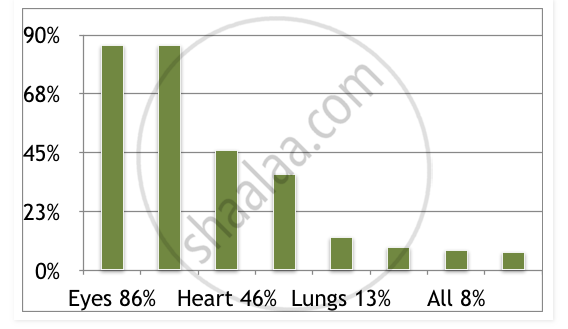
Read the following graph regarding ‘High Awareness but Little Action’ about organ donation. Write a paragraph based on it in about 120 words:
Advertisements
उत्तर
The column graph presented in the question shows the percentage of awareness of people deeming it right to donate organs, some during life and some after life, to the mankind. At the most 86%, in each category, of the people are aware that they should donate eyes and kidney. 46 % of people believe that heart donation is a noble donation, which can take place just before death of a person. 37 % of people believe that they should donate liver. While 9% of people are aware of donating intestine, only 7% are aware of donating pancreas. At the least 8% of people believe that they should donate all the organs to the mankind before or after death. Though there is awareness on it, there is less action on it!
APPEARS IN
संबंधित प्रश्न
Study carefully the following pie-chart about the Income Sources of a City Budget and write a short continuing paragraph based on it in about 120 words :

Read the following extract and extend it by adding an imaginary paragraph of your own in about 120 words :
Rosalind and Orlando were married at once in the forest
and on the same day Oliver who was 110 longer selfish and married Celia. Just as they were going to be married, a mess,enger came to ask Duke senior to go back to his dukedom. Celia s fathcr; Duke Frederick, had mended his wicked ways and asked his brother to return.
Frederick had set out with a11 anny to fight the old Duke, but on his way he had met a wise and holy man, who had persuaded him that it was wrong and wicked to drive his elder brother from the court. So Frederick had given up the dukedom and the good.
Duke could go home again. There was great rejoicing in the forest of Arden, under the greenwood tree. Frederick was forgiven and Duke senior and his followers returned from the forest to live happily in their Own homes.
Read the following extract and extend it by adding an imaginary paragraph of your own in about 120 words:
[You may begin with: Mrs. Green: May I come in.......]
"May I come in?" asked the pink lady.
"Please come in," said my mother. "Do sit down. Do you require a room'?"
"Not today, thank you. I'm staying with Padre Dutt.
He insisted on putting me up. But I may want room for a day or two -- lust for old time's sake."
"You've stayed here before."
''A long time ago. I'm Mrs. Green, you know. The missing
Mrs. Green. The one for whom you put up that handsome tombstone in the cemetery. I was very touched by it. And I'm glad you didn't add 'Beloved wife of Henry Green' because I didn't' love him any more than he loved me.''
''Then - then - you aren't the skeleton?'' stammered my
mother.
''Do I look like a skeleton?''
''No!'' we said together.
· ''But we heard you disappeared,'' I said, ''and when we found that skeleton -''
''You put two and two together.''
''Well, it was Miss Kellner who convinced us,'' said my
mother. ''And you did disappear mysteriously. You were missing for years. And everyone knew Mr. Green was a philanderer!''
''Couldn't wait to get away from him," said the pink lady.
'Couldn't stand him anymore. He was a lady-killer, but not a real killer.''
''But your father ca1ne looking for you. Didn't you get in touch with him?''
Read the following extract and complete the tree – diagram given below:


Information Transfer Non-Verbal to Verbal :
Observe the following web-chart carefully and write two short paragraphs of ‘Advantages of watching Television’ with the help of the points given.
Read the following paragraph about ‘The causes of pollution and the possible solutions’ and tabulate the same information.
|
Pollution is the contamination into the natural environment that causes adverse change. Pollution levels are increasing day by day. There are various reasons for it. Air pollution is caused chiefly by industrial pollutants and by increased levels of RSPM due to higher flow of vehicular traffic. Water pollution is caused to a large extent by industrial effluents and the immersion of POP idols. Sound pollution levels have increased due to blaring loudspeakers during festival time and increased volume of traffic. In order to solve the problems of air pollution, the chief method seems to be tree plantation. More and more citizens and NGO’s should take up green causes with civic authorities. We need to protect our forest and conserve our mangroves. In order to solve the problem of water pollution, we need to develop effective waste management techniques. Also eco-friendly idols should be used during festival time. An awareness in general populace is very necessary to solve the problem of sound pollution. Strict enforcement of decibel levels during occasions and festival time by the police is a must. |
Use the following table for your answer.
| Pollution | Caused by | Solution |
Information Transfer: Verbal to Non-verbal
Read the following paragraph and prepare a tree-digram using the information given in the paragraph.
Quite often it is your family and friends who are the only source of solace in times of tension and confusion. Whether it is the time of exams, results and admission, school issues or a misunderstanding with a dear friend, you will notice
that your family members might want you to share your worries with them. One great advantage about sharing problems with your family members is that they actually care about your happiness. Your problem will not go beyond the people whom you are confiding in and will ensure that you are relieved of the stress and worries besides being the source of practical solutions for your problems.The relief it brings is immense not just for you but also for them as they would be the happiest to see you relaxed and calm. This is what makes family bonding
special. Situations such as these can bring you closer to your siblings and make you realise that such oneness is unique and special.
Look at the following web chart and write a short paragraph based on it in about 120 words. Suggest a suitable title:

The following graph shows the number of visitors (in millions) visiting the famous Salarjung Museum in Hyderabad between 2000 and 2010 as well as the number of visitors expected to visit it in the next ten years.

The chart below shows information on the economics of the Annual
Sports Meet. Study the chart carefully.
| The Economics of the Annual Sports Meet |
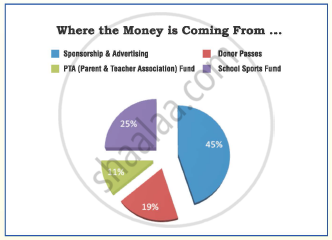
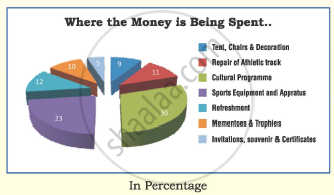
The total cost estimated of the Meet will be~ 11, 00, 000/-
No of athletes : 1250 (750 Girls+ 500 Boys; Category wise: sub-junior: 350, junior: 500 and senior: 400)
Staff on Duty : Teachers: 95 (35 men + 60 women), Support Staff 40 (21 men + 19 women), Staff on Parking and Security duty : 25 (20 men+ 5 women)
No of events : 100 ( 70 Track & Field events and 30 Jumps and Throws)
Medals : 100 Gold, 100Silver& 100Bronze
Best Athlete Trophies : Boys: 3, Girls: 3
Best House Trophies : 4( 1 for each category and 1 over all)
Suppose you are the Prin cipal of the school. Taking information from the chart, prepare an oral presentation for the Management Committee of the school. Use as many expressions of comparison as you can. You have been given some examples.
Look at the graph and the paragraph below which provides an interpretation of the data given in the graph.
Graph to show number of whales caught in Antarctic (1985-2010)

As whalers reduced catching of the large/r whales, they switched to smaller species. This is evident when we compare figures for the Antarctic catch of the larger sei whale with those for small minke whale. In 1985, fifteen times as many sei whales as minke whales were caught. By 1995, catches of both the species were virtually the same (9000). By the 2000, the situation had reversed and the number of minke whales killed more than doubled as compared to sei whales (6000). The graph shows that while the sei catch was reduced by 95% between 1985 and 2010, over the same period the minke whale catch was eight times greater. If these trends continue, the situation for the smaller species will be as bad as it used to be for the larger ones.
Discuss with a partner:
1. What expressions have been used for comparing the data? Underline them.
2. Does the analysis identify the main trends? Has any projection or guess been made based on the available data?
3. Can you spot a sentence that summarizes the data or draws a conclusion based on it?
4. Has the analysis been supported with figures from the given data?
5. Is there any unnecessary repetition?
6. How many times has the verb 'be' in its different forms been used? Some useful expressions :
|
{much ,many, far ,slightly, a little} |
more, greater,higher, less, lower, further, farther |
|
{half, twice, ten times, (etc.)} |
as { adj. adv.} as |
|
10 percent 150 percent |
{more less } than |
| almost the same ____ as | |
| as {adj adv.} as |
A survey was conducted among the teachers of New Hope High School to find out whether Class X students should be allowed to use mobile phones in the campus. The results of the survey are shown in the pie-chart below.
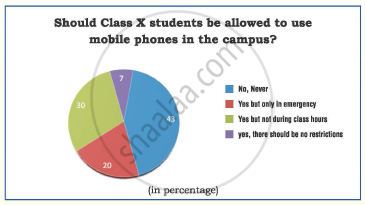
Look at the pie chart and the useful expressions above. Fill in the gaps in the following summary of results.
As can be seen from the above pie-chart, nearly a__________ of the teachers felt that Class X students must not be allowed to use mobile phones in the school campus. However, nearly one____________ believed
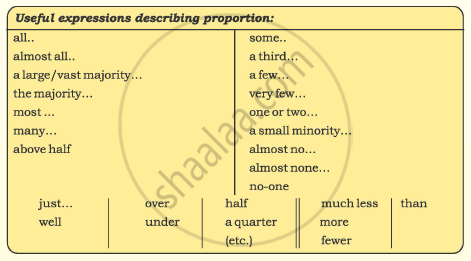
the phones should be permitted but not during class hours. About __________were of the opinion that the students may be allowed to use these phones only in times of emergency while a very__________ did not favour any restrictions on their use in the campus.
A school carried out two surveys in Class X. Look at the pie charts below and write short summaries of the results as in the model above.
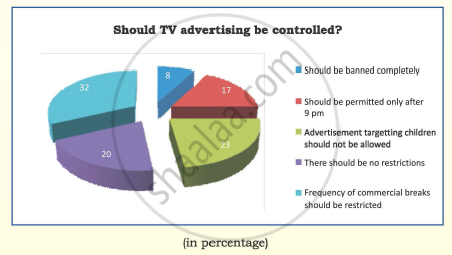
____________________________________________________________________
____________________________________________________________________
____________________________________________________________________
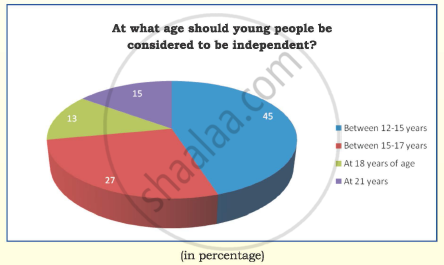
____________________________________________________________________
____________________________________________________________________
____________________________________________________________________
Read the following information and prepare a pie diagram for the same.
Annual Water Usage in Maharashtra
Water is life. It is a universal solvent and an important resource. The annual usage of water differs in various sectors of Maharashtra. The major occupation of Maharashtra being agriculture, the maximum amount of available water is used for irrigation that is 86%. The distant following place 7% is contributed by domestic sector including drinking, washing, cooking, etc. There is a close competition of other sectors which is not far away with 6% usage of water. One of the key factors which plays an important role in the development of a nation is industrial sector. The consumption of water by industrial sector is very negligible which is 1%. We know energy sector plays a vital role in the development of a nation.
In this sector, the use of water is almost nil. If we try to observe its place in the chart we do realise that it holds 0% usage and is yet to open its account.
Observe the following table and transfer the information into a paragraph:
Statewise Distribution of Urban and Rural Population in India:
| States | Population in Millions | |
| Rural | Urban | |
| Maharashtra | 560 | 410 |
| Gujarat | 320 | 190 |
| Madhya Pradesh | 440 | 160 |
| Chhattisgarh | 170 | 40 |
| Andhra Pradesh | 550 | 210 |
| Karnataka | 350 | 180 |
Extend the given extract by adding an imaginary paragraph of your own (about 120 words)
A couple of days later, I was walking around the camp, around the barracks, near the barbed-wire fence where the guards could not easily see. I was alone.
On the other side of the fence, I spotted someone: a little girl with light, almost luminous curls. She was half-hidden behind a birch tree.
I glanced around to make sure no one saw me. I called to her softly in German. 'Do you have something to eat?'
She didn't understand.
I inched closer to the fence and repeated the question in polish. She stepped forward. I was thin and gaunt, with rags wrapped around my feet, but the girl looked unafraid. In her eyes, I saw life.
She pulled an apple from her woollen jacket and threw it over the fence.
I grabbed the fruit and, as I started to run away, I heard her say faintly, 'I'II see you tomorrow."
Read the following tree-diagram and prepare a short paragraph regarding 'Soil Erosion'.

Information Transfer (Non-verbal to Verbal):
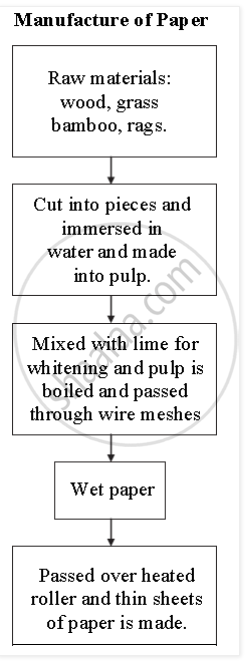
Do anyone of the following activities.
Transfer the given information into a paragraph.
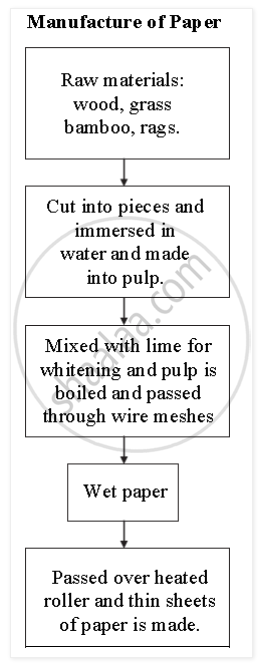
Read the following passage and complete the table
Dialect is a form of a language spoken in one area which may be different from other forms of the same language. Each language has dialects which change every few kilometers. India is a multi-lingual country. Each state follows its own language as official language. For example, Marathi is the official language of Maharashtra, while Ahirani, Wharadi, Konkani and Malwani are its dialects. Several languages in India are spoken but do not have any script. In Karnataka, Kannada is the official language. Tulu is spoken in Karnataka but has no script. In England, English is the official language while Scottish, spoken in Scotland and Welsh spoken in Wales are dialects of English.
| State | Official language | Dialects | Spoken/ Without script |
| Maharashtra | Marathi | ||
| Karnataka | |||
| England |
Look at the table given below and write a short paragraph based on it in about 120 words :
The following table shows irregular rainfall causing low groundwater level in Nashik district, and Talukawise its worst hit villages.
| Drop in water level | Talukas | |||
| 0 to 1 meter | Nashik, Igatpuri, Niphad, Chandwad, Kalwan, Deola, Tryambakeshwar | |||
| 1 to 2 meters | Sinnar, Yeola, Nandgaon, Satana, Malegaon | |||
| Worst Hit Areas | ||||
| Talukas | Situation over coming months | |||
| Oct.-Dec. | Jan-Mar. | Apr.-June | Total | |
| Igatpuri | 01 | 06 | 49 | 56 |
| Malegaon | 31 | 54 | 37 | 122 |
| Nandgaon | 08 | 17 | 37 | 62 |
| Niphad | 01 | 04 | 47 | 52 |
| Source: Times of India, Nashik Times, City Edn. Date: Oct. 18, 2018 |
||||
Read the following text and present the information in a tabular form:
Raja Ram Mohan Roy was a zealous social worker holding modern and progressive views. He firmly stood against social bigotry, conservation, and superstition and advocated English and Western Education for his fellowmen. He knew many languages viz English, Persian, Arabic, Latin, French, and even Hebrew. He was born in 1772 in West Bengal. He joined East India Company in 1805. The title ‘Raja’ was conferred on Ram Mohan Roy by the Mogul Emperor. In 1814 he founded the Atmiya Sabha and in 1828 the ‘Brahmo Samaj’. He abolished ‘sati’, child marriage and the purdah. He is rightly called the ‘father of Indian Renaissance’ or the ‘Father of Indian Nationalism’. He died on 27 Sept. 1833 in England.
| Name: | |
| Date of Birth: | |
| III practices abolished: | |
| Institutions launched: | |
| Languages Known: |
Transfer the information into a paragraph about ‘Average Annual Tea Consumption Per Person’ as shown in the table given below :
| Nation | Turkey | Ireland | United Kingdom | Russia | Morocco | China | India |
| Tea consumption per person ( in Kg) | 3.15 | 2.19 | 1.94 | 1.38 | 1.21 | 0.57 | 0.32 |
Read the following paragraph and transfer the information in the form of a tree diagram:
The United Nations was established at the end of the second world war to maintain international peace and security.
In the central system of the UN, there are 15 members of the Security Council. The Economic and Social Council has 54 members. The Secretariat of the United Nations is headed by Secretary-General.
The UN has several specialized agencies such as the World Health Organisation (WHO), the Food and Agricultural Organisation (FAO), the International Labour Organization (ILO), the United Nations Educational, Scientific and Cultural Organisation (UNESCO).
Views :
Develop a paragraph on the view by using the points given below :
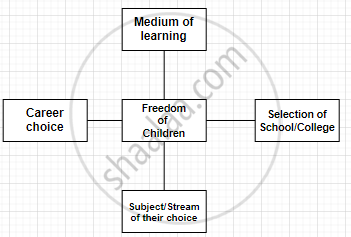
Read the following paragraph and transfer the information in the form of a tree diagram:
|
The United Nations was established at the end of the second world war to maintain international peace and security. The UN has several specialized agencies such as the World Health Organisation (WHO), the Food and Agricultural Organisation (FAO), the International Labour Organization (ILO), the United Nations Educational, Scientific and Cultural Organisation (UNESCO). |
Observe the following web diagram carefully and convert it into a paragraph.

Read the given extract carefully and transfer the following into a flow chart:
Garbage disposal has become a great problem in urban areas. A lot of garbage is being collected from every household. Some cities have come up with innovative ideas to tackle this problem. First of all, the garbage in trucks is segregated into organic waste from recyclable waste. Then it is put in separate containers.
Earthworm culture is added to this organic waste. After a few weeks the conversion process is complete and what we can get is vermicompost which is a very good quality compost that can be mixed with soil and used for better yields.
Verbal to Non-Verbal:
Read the following information and complete the following table below it:
Chandrayaan-2, India’s second mission to the Moon will, for the first time, unravel secrets around the Moon’s the South Pole. Chandrayaan-2 is a three-part spacecraft - an orbiter, a lander, and a rover. The lander is named Vikram after Vikram Sarabhai, the founder of the Indian space programme. The rover is named Pragyan, meaning ‘wisdom’.
Chandrayaan-2 was launched on 22 July atop ISRO’s GSLV Mk-III at 2:43 p.m. from the Satish Dhawan Space Centre at Sriharikota. Performing as expected, the rocket released Chandrayaan-2 in a highly elliptic orbit around Earth about 17 minutes later. In fact, it was released 6,000 km higher than planned. The solar arrays on Chandrayaan-2 deployed smoothly as the probe began its journey.
| Table | Information | |
| 1. | Name of the Mission | |
| 2. | Date of Launch | |
| 3. | Centre of Launch | |
| 4 | Name of the Rover | |
| 5. | Founder of Indian Space Programme |
Non-verbal to Verbal:
Transfer the information into a paragraph:
Observe the tree diagram of types of disease and write a paragraph on it. Suggest a suitable title.

Verbal to Non-verbal:
Write Do’s and Don’ts for ‘In the Examination Hall’. Suggest a suitable title.
You should carry all necessary materials for exam such as pens, pencils, erasers, scale, geometrical box etc. You should not forget your identity card and hall tickets. After you enter the examination hall, keep all required things on your desk. You should follow the instructions given by the invigilator. You must read the question paper carefully. You should avoid observing other students because their tension might disturb you. You need not feel upset even if you notice other students writing very speedily. You stay calm. In any case do not talk to any of the students during the exam. It’s advisable to drink sufficient water before you enter the exam hall. Last but not the least, don’t forget to check all answers in last 10 minutes, before submitting your answer sheet to the invigilator.
Non-verbal to verbal:
Transfer the information into a paragraph.
Observe the web diagram and write a paragraph on it. Suggest a suitable title.

Non-verbal to Verbal
Study the table given below and prepare a paragraph on it.
| Alligators | Crocodiles | |
| 1. | U shaped round snout | V shaped round snout |
| 2. | Live in fresh water | Live in fresh water and saline water |
| 3. | Have wide jaws; upper jaw is wider than the lower jaw | Have narrow jaws; both the jaws are of the same size |
| 4. | Only upper teeth are visible when the mouth is closed | Both the teeth are visible when the mouth is closed. |
| 5. | No functioning salt glands | Very functional salt glands |
| 6. | Sensory pits on scales near the jaw | Sensory pits in every scale of the body |
Read the following information and complete the table given below. Give a suitable title:
|
Turtles and tortoises are closely related. They are both reptiles from the same family (Testudines or Chelonian). The main difference between the two is that turtle is the name given to water-dwellers and tortoise is the name given to land-dwellers. They are easily identified by the presence of a shell, from which their head and limbs protrude. Turtles are found in Africa and America. Its shell is lighter and more streamlined than that of a tortoise. To enable swimming, it has webbed feet with long claws. Turtles are omnivores, eating both vegetation and meat. Their lifespan is shorter than that of the tortoise with an average of 20-40 years and a maximum of 86 years. Tortoises are found mainly in Asia and Africa, but also in America. It has a rounder, bumpier, heavier shell than a turtle. Its bent legs are short and sturdy. Tortoises are usually herbivores, but some eat meat, their lifespan is longer than that of the turtle with an average of 80-150 years and a maximum of 188 years. |
| FEATURES | TURTLES | TORTOISE |
| (i) Habitat | ||
| (ii) Places found in | ||
| (iii) Shell | ||
| (iv) Lifespan |
Verbal to Non-Verbal
Read the following information and complete the table given below:
| Basically industries are broadly classified on the basis of raw material, the scale of production and the volume of investment made. Further they are classified as per the source of raw material, example, agro-based industries such as sugar, cotton, etc. Forest based such as paper, lac, and mineral based such as iron, steel and chemicals, etc. The scale of the production determines whether they are small scales, such as food processing, leather goods, etc., or large scale, automobile, shipbuilding, etc. Similarly, there are industries which are set up by the government, called Public Sector. Those industries which are set up by the Private entrepreneur are called Private Sector and those which are run collectively by a group of people are called Co-operative Sector. |
| Table | Information |
| (1) Examples of forest-based industries. | |
| (2) Examples of small scale industries. | |
| (3) Examples of large scale industries. | |
| (4) Industries setup by private entrepreneur. | |
| (5) Industries run by a group of people. |
Non-verbal to verbal
Read the information from the given bar graph and write it in paragraph form.
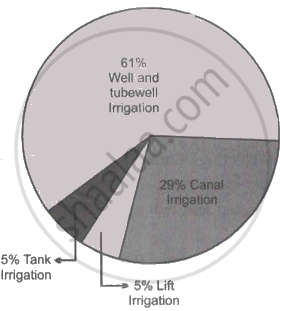
Non-verbal to verbal:
The following diagram shows important factors to be considered while choosing a career. Write a paragraph based on it. Give a suitable title to it:

Gurmeet Kaur is an aspiring candidate for a public- funded engineering college in the suburbs. She belongs to a nearby village, has minimal technological skills and exposure, has the required cut-off percentage and is looking for a complete or partial scholarship.
Write a paragraph in about 100-120 words analysing her SWOT notes to support your stand on whether she should /not join the college.
|
STRENGTH
|
WEAKNESS
|
|
OPPORTUNITIES
|
THREAT
|
A group of enterprising young adults conducted a survey on reopening of educational institutions in the National Capital.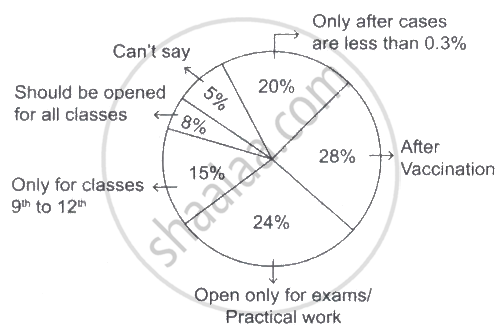
Write a paragraph in about 120 words analysing the listed responses.
Verbal to Non - Verbal
Read the following information and write it into Do's and Don'ts. Give a suitable title for it:
Outside "The Central Library" there is a board displaying some rules and regulations for the members.
They are as follows:
- You should enter your name and registered number in the register, before entering in the library.
- You should pay your monthly/annual membership on time.
- You are not allowed to write anything in the book/magazine you have taken.
- You should not take any book or magazine out of the library without prior permission and registration.
- You should maintain pin-drop silence in the library.
- You are not allowed to eat, drink, chat or smoke inside the library.
- You should return the books or magazines you have taken on time.
- You should not disturb other members and the librarian when you are in the library.
Given below is a web diagram containing information about the different means of electronic devices of entertainment-some audio, some visual and some audio-visual.
Write a short paragraph based on information from the web. Give a suitable title to it.

(A1) Verbal to Non-Verbal:
Read the following information and complete the flowchart for the same, and give a suitable title.
|
Sugar beet grows through the summer and is harvested in autumn and winter. When it arrives on site, the sugar beet is washed. The sugar beet is sliced into thin strips called cossettes.‘These thin strips are mixed with hot water to extract the sugar and a lime solution is added to the raw juice to remove any impurities. |
Non-verbal to Verbal:
Transfer the given information into a paragraph. Suggest a suitable title:
| Caused by Man | Caused by Nature | Solutions | |
| i. | Too many people | Droughts | Stricter laws to control population. |
| ii. | More agricultural land required to meet the needs of the ever growing populations | Floods | Stricter laws and proper execution of laws |
| iii. | Cutting of forests for wood etc. | Forest fires | Use alternative products. |
| iv. | Poaching by hunters. | - | Reduce demand for illegal wildlife parts and products by not purchasing products made from these items. |
Verbal to Non-verbal:
Read the following information and complete the given table below. Suggest a suitable title to it:
|
Chandrayaan-1 was India's first mission to the moon. It launched on Oct. 22, 2008 from the Satish Dhawan Space Centre in Sriharikota, India. Its scientific goals are to study the chemical, mineralogical and photogeological mapping of the moon. In addition to find out water on the moon. Then to perform high resolution remote sensing of the moon’s surface. The Chandrayaan-2 mission was successfully launched on 22nd July, 2019 from Satish Dhawan Space Centre, Sriharikota. The primary objectives were to demonstrate the ability to soft land and operate a robotic rover on the lunar surface. The mission was arranged to study the lunar topography, mineralogy, elemental abundance and the lunar ecosphere, conduct a detailed search for water and ice in polar region. Chandrayaan 2’s objectives are to find Chandrayaan-1 as reported by the ISRO. The mission targeted the “South Polar region” of the moon which was completely unexplored. The mission focused on the extensive mapping of the lunar surface for studying variations in its composition and tracing the moon's origin and evolution. Chandrayaan-3 launched to the moon on July 14, 2023 from the Satish Dhawan Space Centre in Sriharikota, India, the medium-life launch vehicle Mark-III (LVM3) rocket. The three main objectives of Chandrayaan-3 are to land safely on the surface, to demonstrate rover operations and to perform scientific experiments on site, according to the official website. |
Title: __________________
| Name of Chandrayaan | Date of launching | Objectives of Mission |
| Chandrayaan-1 | ||
| Chandrayaan-2 | ||
| Chandrayaan-3 |
