हिंदी

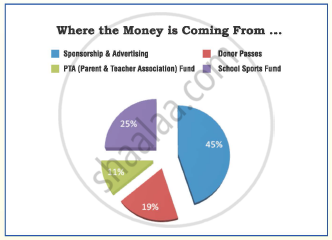
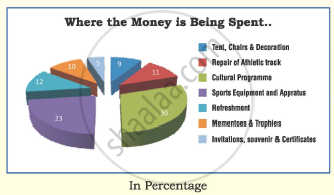
The Chart Below Shows Information on the Economics of the Annual Sports Meet. Study the Chart Carefully.

Advertisements
Advertisements

प्रश्न

The chart below shows information on the economics of the Annual
Sports Meet. Study the chart carefully.

The Economics of the Annual Sports Meet


The total cost estimated of the Meet will be~ 11, 00, 000/-

No of athletes : 1250 (750 Girls+ 500 Boys; Category wise: sub-junior:                                    350, junior: 500 and senior: 400)

Staff on Duty :    Teachers: 95 (35 men + 60 women), Support Staff 40                               (21 men + 19 women), Staff on Parking and Security                                  duty : 25 (20 men+ 5 women)

No of events :    100 ( 70 Track & Field events and 30 Jumps and                                          Throws)

Medals           : 100 Gold, 100Silver& 100Bronze

Best Athlete Trophies :  Boys: 3, Girls: 3

Best House Trophies :  4( 1 for each category and 1 over all)

Suppose you are the Prin cipal of the school. Taking information from the chart, prepare an oral presentation for the Management Committee of the school. Use as many expressions of comparison as you can. You have been given some examples.

संक्षेप में उत्तर
Advertisements

उत्तर

The Economics of the Annual Sports Meet

                                  Oral Presentation

This is to apprise the honourable members of the Management Committee that as much as a quarter of the total money has been earmarked for organising the Cultural Extravaganza. Fortunately, the participation of the girls will be more than that of the boys. The expenses on procuring sports equipment and tentage will be twice as much as was previously estimated. Even the number of mementoes, trophies and certificates will be about three times more than that of the last year’s sum total. As far as the budget for refreshments is concerned, it is going to be far more than what was planned. However, the financial support from different sources is as encouraging as it was the last year.

shaalaa.com
Information Transfer
  क्या इस प्रश्न या उत्तर में कोई त्रुटि है?
अध्याय 8: Comparison (Integrated Grammar practice 4) - Exercise A [पृष्ठ १३८]

APPEARS IN

सीबीएसई English Workbook [English] Class 10
अध्याय 8 Comparison (Integrated Grammar practice 4)
Exercise A | Q 7 | पृष्ठ १३८

संबंधित प्रश्न

A1.Books have the power to inspire and do many more things. Observe the web diagram and convert the information into a paragraph. Add a few more points to the given information:

A2. Read the given information and fill the table provided:
Acclaimed in Indian classics as the Kalpavriksha, the all giving tree the coconut palm grows in several states in India. The coconut palm is member of the plant family Arecaceae popularly known as palm family. It flourishes on sandy soils requiring high humidity abundant sunlight and high rainfall for optimal growth. All parts of the palm are used in some way or another in the daily life of the people. Coconut water provides a refreshing and nutritious drink. The firm kernel that line the inside is high in calories and the white milk extracted from it is used in many different ways. Oil extracted from dried mature coconuts is used as cooking oil. The leaves are braided to make thatched roof and mats. The mid ribs of the leaves are dried and tied together to make brooms. The coconut shell and husk are good sources of efficient fuel. During religious ceremonies married women are often presented with a coconut along with a few grains of rice as a symbol of fertility and prosperity.

Name :  
Scientific name :  
Place where grown :  
Climate required :  
Uses :  
(a) Liquid  
(b) Kernel  
(c) Leaves  
(d) Shell  
Symbolises :  


Read the following tree diagram about 'Morphemes' and write a short paragraph on it.


Study carefully the following pie-chart about the Income Sources of a City Budget and write a short continuing paragraph based on it in about 120 words :


Information Transfer Non-Verbal to Verbal :
Observe the following web-chart carefully and write two short paragraphs of ‘Advantages of watching Television’ with the help of the points given.


Information Transfer: Verbal to Non-verbal
Read the following paragraph and prepare a tree-digram using the information given in the paragraph.
Quite often it is your family and friends who are the only source of solace in times of tension and confusion. Whether it is the time of exams, results and admission, school issues or a misunderstanding with a dear friend, you will notice
that your family members might want you to share your worries with them. One great advantage about sharing problems with your family members is that they actually care about your happiness. Your problem will not go beyond the people whom you are confiding in and will ensure that you are relieved of the stress and worries besides being the source of practical solutions for your problems.The relief it brings is immense not just for you but also for them as they would be the happiest to see you relaxed and calm. This is what makes family bonding
special. Situations such as these can bring you closer to your siblings and make you realise that such oneness is unique and special.


The following graph shows the number of visitors (in millions) visiting the famous Salarjung Museum in Hyderabad between 2000 and 2010 as well  as the number of visitors expected to visit it in the next ten years.


Read the following extract and complete the table given below about 'Types of Diseases':

         Health is defined as not simply the absence of disease. It involves a state of feeling well, both in body and in mind. 

      The diseases may be classified into the following types, Some diseases are present at birth. They are called congenital diseases. They may develop during pregnancy or are inherited, Some of them may be caused by environmental factors. Examples of congenital diseases are Down's syndrome, sickle cell anaemia, cystic fibrosis, haemophilia, etc.

      Some diseases are acquired by humans themselves and hence are called Self-Inflicted or Acquired diseases. Examples of acquired diseases are coronary heart diseases, hypertension.

      Some diseases are transmitted from one person to another. They are called as Communicable or Infectious diseases. They are caused by biological agents, Examples of communicable diseases are Cholera, Typhoid, Measles, Malaria, etc.

      Non- communicable diseases are caused by exogenous factors like physical, chemical, nutritional deficiencies. The examples are Kwashiorkor, Pellagra, Scurvy, and Rickets, etc.  

                                                Title

Sr.No. Types  Causes

Examples

1. Congenital

o

develop during pregnancy

o environmental factors 

 
2. Self-Inflicted Acquired   Coronary heart disease. hypertension
3.   By biological agents Cholera, typhoid, measles, malaria
4.  Non-communicable diseases   Kwashiorkor, Pellagra, Scurvy, and Rickets

Information Transfer (Non-verbal to Verbal):

Transfer the given information into a paragraph.


Read the following passage and complete the table

Dialect is a form of a language spoken in one area which may be different from other forms of the same language. Each language has dialects which change every few kilometers. India is a multi-lingual country. Each state follows its own language as official language. For example, Marathi is the official language of Maharashtra, while Ahirani, Wharadi, Konkani and Malwani are its dialects. Several languages in India are spoken but do not have any script. In Karnataka, Kannada is the official language. Tulu is spoken in Karnataka but has no script. In England, English is the official language while Scottish, spoken in Scotland and Welsh spoken in Wales are dialects of English.

State Official language Dialects Spoken/
Without script
Maharashtra Marathi    
Karnataka      
England      

 Transfer the information into a paragraph about ‘Average Annual Tea Consumption Per Person’ as shown in the table given below : 

Nation Turkey Ireland United Kingdom Russia Morocco China India
Tea consumption per person ( in Kg) 3.15 2.19 1.94 1.38 1.21 0.57 0.32


Non-verbal to Verbal:

Transfer the information into a paragraph:
Observe the tree diagram of types of disease and write a paragraph on it. Suggest a suitable title.


Non-verbal to Verbal

Study the table given below and prepare a paragraph on it.

  Alligators Crocodiles
1. U shaped round snout V shaped round snout
2. Live in fresh water Live in fresh water and saline water
3. Have wide jaws; upper jaw is wider than the lower jaw Have narrow jaws; both the jaws are of the same size
4. Only upper teeth are visible when the mouth is closed Both the teeth are visible when the mouth is closed.
5. No functioning salt glands Very functional salt glands
6. Sensory pits on scales near the jaw Sensory pits in every scale of the body

Verbal to Non-Verbal

Read the following information and complete the table given below:

Basically industries are broadly classified on the basis of raw material, the scale of production and the volume of investment made. Further they are classified as per the source of raw material, example, agro-based industries such as sugar, cotton, etc. Forest based such as paper, lac, and mineral based such as iron, steel and chemicals, etc. The scale of the production determines whether they are small scales, such as food processing, leather goods, etc., or large scale, automobile, shipbuilding, etc. Similarly, there are industries which are set up by the government, called Public Sector. Those industries which are set up by the Private entrepreneur are called Private Sector and those which are run collectively by a group of people are called Co-operative Sector.


Table Information
(1) Examples of forest-based industries.  
(2) Examples of small scale industries.  
(3) Examples of large scale industries.  
(4) Industries setup by private entrepreneur.  
(5) Industries run by a group of people.  

Non-verbal to verbal

Read the information from the given bar graph and write it in paragraph form.


Non-Verbal to Verbal

Transfer the given information in the form of a paragraph.


Gurmeet Kaur is an aspiring candidate for a public- funded engineering college in the suburbs. She belongs to a nearby village, has minimal technological skills and exposure, has the required cut-off percentage and is looking for a complete or partial scholarship.

Write a paragraph in about 100-120 words analysing her SWOT notes to support your stand on whether she should /not join the college.

STRENGTH

  • Strong Curriculum
  • Quality faculty
  • Vibrant Activity Clubs
  • Green location
  • Close proximity to residential areas

WEAKNESS

  • Lack of diversity
  • Students’ behavioural problems
  • No hostel facility
  • Slow repair and maintenance work
  • Underutilization of IT Services
  • Lack of targeted advertisements to out-state students

OPPORTUNITIES

  • Practice based research
  • Partnership with professional organisations
  • Strong alumni
  • Acclaimed Student Exchange
    Programme with European countries

THREAT

  • Lack of publicity in areas of excellence
  • Public perception towards funded colleges
  • Declining students’ interest towards technical subjects
  • Low employee morale due to budget cuts

A survey was conducted in the National Capital in over twenty schools about 40 different activities that interest the children in the age group of 13 years to 15 years. Write a paragraph in not more than 120 words, analyzing the following information.


Verbal to Non - Verbal

Read the following information and write it into Do's and Don'ts. Give a suitable title for it:

Outside "The Central Library" there is a board displaying some rules and regulations for the members.

They are as follows:

  1. You should enter your name and registered number in the register, before entering in the library. 
  2. You should pay your monthly/annual membership on time. 
  3. You are not allowed to write anything in the book/magazine you have taken.
  4. You should not take any book or magazine out of the library without prior permission and registration. 
  5. You should maintain pin-drop silence in the library. 
  6. You are not allowed to eat, drink, chat or smoke inside the library. 
  7. You should return the books or magazines you have taken on time.
  8. You should not disturb other members and the librarian when you are in the library.

Share
Notifications

Englishहिंदीमराठी


      Forgot password?
Use app×