Advertisements
Advertisements
प्रश्न
Read the following passage and complete the table
Dialect is a form of a language spoken in one area which may be different from other forms of the same language. Each language has dialects which change every few kilometers. India is a multi-lingual country. Each state follows its own language as official language. For example, Marathi is the official language of Maharashtra, while Ahirani, Wharadi, Konkani and Malwani are its dialects. Several languages in India are spoken but do not have any script. In Karnataka, Kannada is the official language. Tulu is spoken in Karnataka but has no script. In England, English is the official language while Scottish, spoken in Scotland and Welsh spoken in Wales are dialects of English.
| State | Official language | Dialects | Spoken/ Without script |
| Maharashtra | Marathi | ||
| Karnataka | |||
| England |
Advertisements
उत्तर
| State | Official language | Dialects | Spoken/Without script |
| Maharashtra | Marathi |
Ahirani,
Wharadi, Konkani,
Malwani |
- |
| Karnataka | Kannada | Tulu | No script |
| England | English |
Scottish,
Welsh |
- |
APPEARS IN
संबंधित प्रश्न
The chart below shows information on the economics of the Annual
Sports Meet. Study the chart carefully.
| The Economics of the Annual Sports Meet |
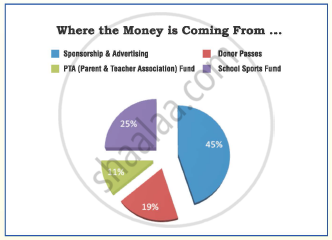
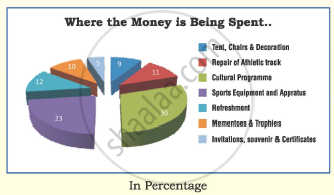
The total cost estimated of the Meet will be~ 11, 00, 000/-
No of athletes : 1250 (750 Girls+ 500 Boys; Category wise: sub-junior: 350, junior: 500 and senior: 400)
Staff on Duty : Teachers: 95 (35 men + 60 women), Support Staff 40 (21 men + 19 women), Staff on Parking and Security duty : 25 (20 men+ 5 women)
No of events : 100 ( 70 Track & Field events and 30 Jumps and Throws)
Medals : 100 Gold, 100Silver& 100Bronze
Best Athlete Trophies : Boys: 3, Girls: 3
Best House Trophies : 4( 1 for each category and 1 over all)
Suppose you are the Prin cipal of the school. Taking information from the chart, prepare an oral presentation for the Management Committee of the school. Use as many expressions of comparison as you can. You have been given some examples.
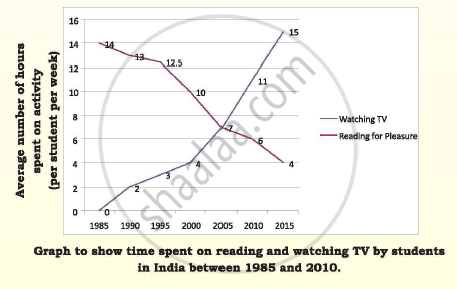
The graph below describes the average number of hours spent by students aged 11-15 years on two activities (per student per week) in India between 1985 and 2010 and gives projections for 2015. Study the information carefully and then write a paragraph interpreting the data. Include the following:
• A comparison of the trends in the two activities
• A comparison of the situation in 1985
• A comparison of the situation between 1985 and 2010
• Predictions for the future
Read the following extract and complete the table given below about 'Types of Diseases':
Health is defined as not simply the absence of disease. It involves a state of feeling well, both in body and in mind.
The diseases may be classified into the following types, Some diseases are present at birth. They are called congenital diseases. They may develop during pregnancy or are inherited, Some of them may be caused by environmental factors. Examples of congenital diseases are Down's syndrome, sickle cell anaemia, cystic fibrosis, haemophilia, etc.
Some diseases are acquired by humans themselves and hence are called Self-Inflicted or Acquired diseases. Examples of acquired diseases are coronary heart diseases, hypertension.
Some diseases are transmitted from one person to another. They are called as Communicable or Infectious diseases. They are caused by biological agents, Examples of communicable diseases are Cholera, Typhoid, Measles, Malaria, etc.
Non- communicable diseases are caused by exogenous factors like physical, chemical, nutritional deficiencies. The examples are Kwashiorkor, Pellagra, Scurvy, and Rickets, etc.
Title
| Sr.No. | Types | Causes |
Examples |
| 1. | Congenital |
o develop during pregnancy o environmental factors |
|
| 2. | Self-Inflicted Acquired | Coronary heart disease. hypertension | |
| 3. | By biological agents | Cholera, typhoid, measles, malaria | |
| 4. | Non-communicable diseases | Kwashiorkor, Pellagra, Scurvy, and Rickets |
Look at the table given below and write a short paragraph based on it in about 120 words :
The following table shows irregular rainfall causing low groundwater level in Nashik district, and Talukawise its worst hit villages.
| Drop in water level | Talukas | |||
| 0 to 1 meter | Nashik, Igatpuri, Niphad, Chandwad, Kalwan, Deola, Tryambakeshwar | |||
| 1 to 2 meters | Sinnar, Yeola, Nandgaon, Satana, Malegaon | |||
| Worst Hit Areas | ||||
| Talukas | Situation over coming months | |||
| Oct.-Dec. | Jan-Mar. | Apr.-June | Total | |
| Igatpuri | 01 | 06 | 49 | 56 |
| Malegaon | 31 | 54 | 37 | 122 |
| Nandgaon | 08 | 17 | 37 | 62 |
| Niphad | 01 | 04 | 47 | 52 |
| Source: Times of India, Nashik Times, City Edn. Date: Oct. 18, 2018 |
||||
Read the information given in the following tree diagram regarding “Types of vitamins” Write a paragraph with the given points and give a suitable title to it.
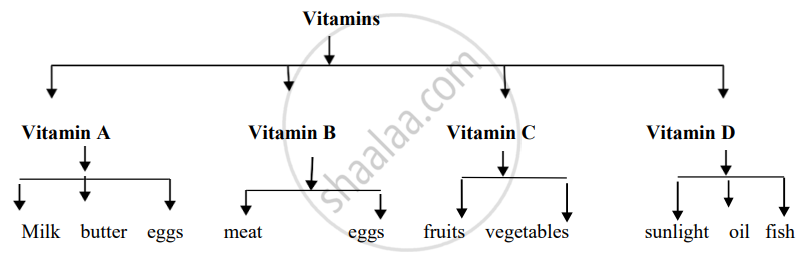
Non-verbal to verbal:
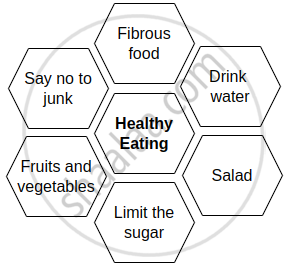
Transfer the information into a paragraph.
Observe the web diagram and write a paragraph on it. Suggest a suitable title.

Verbal to Non-verbal
Read the information from the given paragraph and write it into a tree diagram.
| There are different kinds of musical instruments. They are divided into three main classes according to the way that they are played. Some instruments are played by blowing air into them. These are called wind instruments. Some of these are said to be of the wood wind family. Examples of woodwind instruments are the flute, the clarinet and the horn. There are also various other wind instruments such as the mouth organ and the bagpipes. Some instruments are played by banging or striking them. Instruments like this are called percussion instruments. The last big group of musical instruments have strings. There are two kinds of stringed instruments. Examples are the harp and the guitar, the violin and the cello. |
Non-Verbal to Verbal
Transfer the given information in the form of a paragraph.
A group of enterprising young adults conducted a survey on reopening of educational institutions in the National Capital.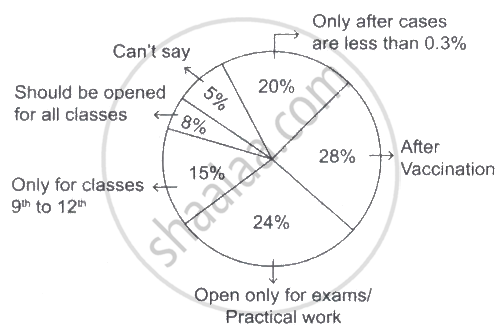
Write a paragraph in about 120 words analysing the listed responses.
Verbal to Non - Verbal
Read the following information and write it into Do's and Don'ts. Give a suitable title for it:
Outside "The Central Library" there is a board displaying some rules and regulations for the members.
They are as follows:
- You should enter your name and registered number in the register, before entering in the library.
- You should pay your monthly/annual membership on time.
- You are not allowed to write anything in the book/magazine you have taken.
- You should not take any book or magazine out of the library without prior permission and registration.
- You should maintain pin-drop silence in the library.
- You are not allowed to eat, drink, chat or smoke inside the library.
- You should return the books or magazines you have taken on time.
- You should not disturb other members and the librarian when you are in the library.
