Advertisements
Advertisements
प्रश्न
Non-verbal to Verbal:
Transfer the information into a paragraph:
Observe the tree diagram of types of disease and write a paragraph on it. Suggest a suitable title.

Advertisements
उत्तर
Types of Diseases
Diseases are broadly classified into two types, viz. communicable diseases and non – communicable or lifestyle diseases. Communicable diseases spread through various mediums of infection. This includes air (e.g. influenza), food (e.g. dysentery), and water (e.g. typhoid). On the other hand, the major causes of non – communicable or lifestyle diseases are either faulty eating habits or faulty living habits. Faulty eating habits generally result in diseases like obesity and diabetes, while faulty living habits are associated with stress and hypertension. Public awareness regarding different types of infection and their causes is essential to prevent and control the spread of diseases in society.
APPEARS IN
संबंधित प्रश्न
Read the following tree diagram about 'Morphemes' and write a short paragraph on it.

Read the following Intros of news items. Choose any ONE of them and write the headline, the dateline and a short continuing paragraph for it.
(i) A shortage of onions in Maharashtra has surged prices by 30 percent. It forced the authorities to import onions from abroad.
(ii) The birth anniversary of the late President Dr. S. Radhakrishnan was celebrated yesterday in Saraswati Kanya Pathshala as Teacher's Day.
Information Transfer: Verbal to Non-verbal
Read the following paragraph and prepare a tree-digram using the information given in the paragraph.
Quite often it is your family and friends who are the only source of solace in times of tension and confusion. Whether it is the time of exams, results and admission, school issues or a misunderstanding with a dear friend, you will notice
that your family members might want you to share your worries with them. One great advantage about sharing problems with your family members is that they actually care about your happiness. Your problem will not go beyond the people whom you are confiding in and will ensure that you are relieved of the stress and worries besides being the source of practical solutions for your problems.The relief it brings is immense not just for you but also for them as they would be the happiest to see you relaxed and calm. This is what makes family bonding
special. Situations such as these can bring you closer to your siblings and make you realise that such oneness is unique and special.
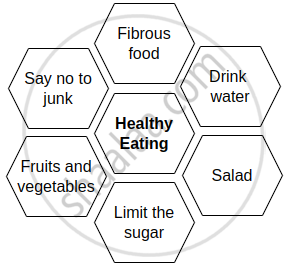
Look at the following web chart and write a short paragraph based on it in about 120 words. Suggest a suitable title:

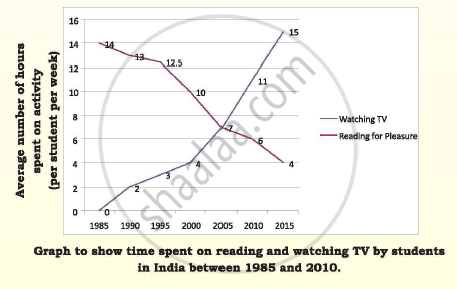
The graph below describes the average number of hours spent by students aged 11-15 years on two activities (per student per week) in India between 1985 and 2010 and gives projections for 2015. Study the information carefully and then write a paragraph interpreting the data. Include the following:
• A comparison of the trends in the two activities
• A comparison of the situation in 1985
• A comparison of the situation between 1985 and 2010
• Predictions for the future
Read the following extract and complete the table given below about 'Types of Diseases':
Health is defined as not simply the absence of disease. It involves a state of feeling well, both in body and in mind.
The diseases may be classified into the following types, Some diseases are present at birth. They are called congenital diseases. They may develop during pregnancy or are inherited, Some of them may be caused by environmental factors. Examples of congenital diseases are Down's syndrome, sickle cell anaemia, cystic fibrosis, haemophilia, etc.
Some diseases are acquired by humans themselves and hence are called Self-Inflicted or Acquired diseases. Examples of acquired diseases are coronary heart diseases, hypertension.
Some diseases are transmitted from one person to another. They are called as Communicable or Infectious diseases. They are caused by biological agents, Examples of communicable diseases are Cholera, Typhoid, Measles, Malaria, etc.
Non- communicable diseases are caused by exogenous factors like physical, chemical, nutritional deficiencies. The examples are Kwashiorkor, Pellagra, Scurvy, and Rickets, etc.
Title
| Sr.No. | Types | Causes |
Examples |
| 1. | Congenital |
o develop during pregnancy o environmental factors |
|
| 2. | Self-Inflicted Acquired | Coronary heart disease. hypertension | |
| 3. | By biological agents | Cholera, typhoid, measles, malaria | |
| 4. | Non-communicable diseases | Kwashiorkor, Pellagra, Scurvy, and Rickets |
Read the following tree-diagram and prepare a short paragraph regarding 'Soil Erosion'.

Look at the table given below and write a short paragraph based on it in about 120 words :
The following table shows irregular rainfall causing low groundwater level in Nashik district, and Talukawise its worst hit villages.
| Drop in water level | Talukas | |||
| 0 to 1 meter | Nashik, Igatpuri, Niphad, Chandwad, Kalwan, Deola, Tryambakeshwar | |||
| 1 to 2 meters | Sinnar, Yeola, Nandgaon, Satana, Malegaon | |||
| Worst Hit Areas | ||||
| Talukas | Situation over coming months | |||
| Oct.-Dec. | Jan-Mar. | Apr.-June | Total | |
| Igatpuri | 01 | 06 | 49 | 56 |
| Malegaon | 31 | 54 | 37 | 122 |
| Nandgaon | 08 | 17 | 37 | 62 |
| Niphad | 01 | 04 | 47 | 52 |
| Source: Times of India, Nashik Times, City Edn. Date: Oct. 18, 2018 |
||||
Read the given extract carefully and transfer the following into a flow chart:
Garbage disposal has become a great problem in urban areas. A lot of garbage is being collected from every household. Some cities have come up with innovative ideas to tackle this problem. First of all, the garbage in trucks is segregated into organic waste from recyclable waste. Then it is put in separate containers.
Earthworm culture is added to this organic waste. After a few weeks the conversion process is complete and what we can get is vermicompost which is a very good quality compost that can be mixed with soil and used for better yields.
Non-Verbal to Verbal
Transfer the given information in the form of a paragraph.