Advertisements
Advertisements
प्रश्न
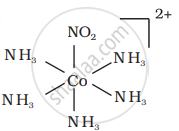
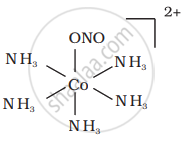
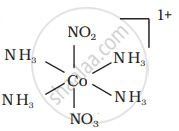
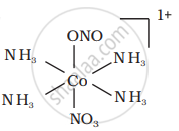
Indicate the type of isomerism exhibited by the following complex and draw the structure for the isomer:
[Co(NH3)5(NO2)](NO3)2
Advertisements
उत्तर
There are 10 possible isomers. (Geometrical, ionisation and linkage isomers)
 |
 |
 |
 |
 |
 |
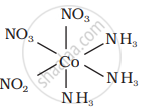 |
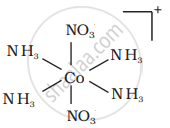 |
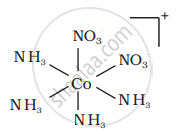 |
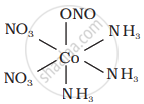 |
It can also show linkage isomerism.
[Co(NH3)5(NO2)](NO3)2 and [Co(NH3)5(ONO)](NO3)2
It can also show ionization isomerism.
[Co(NH3)5(NO2)](NO3)2 and [CO(NH3)5(NO3)](NO3)(NO2)
APPEARS IN
संबंधित प्रश्न
Draw the geometrical isomers of complex \[\ce{[Co(en)2Cl2]+}\].
Draw the geometrical isomers of complex [Pt(NH3)2Cl2].
What type of isomerism is exhibited by the complex [Co(en)3]3+?
(en = ethane-1,2-diamine)
Indicate the type of isomerism exhibited by the following complex and draw the structure for the isomer:
K[Cr(H2O)2(C2O4)2]
How many geometrical isomers are possible in the following coordination entity?
[Cr(C2O4)3]3−
How many geometrical isomers are possible in the following coordination entity?
[Co(NH3)3Cl3]
Draw the structure of optical isomers of [Cr(C2O4)3]3−.
Draw the structure of optical isomers of [Cr(NH3)2Cl2(en)]+.
Draw all the isomers (geometrical and optical) of [CoCl2(en)2]+.
Draw all the isomers (geometrical and optical) of [Co(NH3)2Cl2(en)]+.
Write all the geometrical isomers of [Pt(NH3)(Br)(Cl)(py)] and how many of these will exhibit optical isomers?
Name the type of isomerism shown by the following pair of compounds:
[CoCl(H2O)(NH3)4]Cl2 and [CoCl2(NH3)4]Cl.H2O
Answer the following question.
Write IUPAC name of the complex [Pt(en)2CI2]. Draw structures of geometrical isomers for this complex.
Name the type of isomerism shown by the following pair of compounds:
[Cr(NH3)5Br]SO4 and [Cr(NH3)5SO4]Br
Draw the geometrical isomers of [Co(en)2Cl2]2+. Which geometrical isomer of [Co(en)2Cl2]2+ is not optically active and why?
Which of the following molecules has a chiral centre correctly labelled with an asterisk (*)?
Indicate the types of isomerism exhibited by the following complexes and draw the structures for these isomers:
[Pt(NH3)(H2O)Cl2 ]
Indicate the type of isomerism exhibited by the following complex and draw the structure for this isomer:
[Pt(NH3)(H2O)Cl2]
Indicate the types of isomerism exhibited by the following complexes and draw the structure for these isomer:
\[\ce{[Pt(NH3)(H2O)Cl2]}\]
