Advertisements
Advertisements
प्रश्न
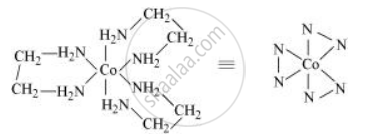
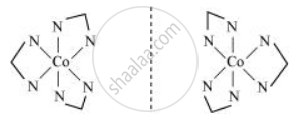
Indicate the type of isomerism exhibited by the following complex and draw the structure for the isomer:
[Co(en)3]Cl3
Advertisements
उत्तर १
Two optical isomers for [Co(en)3]Cl3 exits.
उत्तर २
It may have two optical isomers.

APPEARS IN
संबंधित प्रश्न
When a coordination compound CoCl3.6NH3 is mixed with AgNO3, 3 moles of AgCl are precipitated per mole of the compound. Write the structural formula of the coordination compound.
Draw the geometrical isomers of complex \[\ce{[Co(en)2Cl2]+}\].
Draw one of the geometrical isomers of the complex [Pt(en)2Cl2]2+ which is optically active.
What type of isomerism is exhibited by the complex [Co(en)3]3+?
(en = ethane-1,2-diamine)
Define the following term:
Anomers
Indicate the type of isomerism exhibited by the following complex and draw the structure for the isomer:
[Pt(NH3)(H2O)Cl2]
How many geometrical isomers are possible in the following coordination entity?
[Cr(C2O4)3]3−
Draw all the isomers (geometrical and optical) of [CoCl2(en)2]+.
Draw all the isomers (geometrical and optical) of [Co(NH3)Cl(en)2]2+.
What type of isomers are `[Co(NH_3)_5Br]SO_4`and `[Co(NH_3)_5SO_4]Br`?. Give a chemical test to distinguish between them.
Draw the geometrical isomers of complex [Pt(en)2Cl2]2+.
Name the type of isomerism that the compound with molecular formula C3H6O2 exhibits. Represent the isomers.
Answer the following question.
Write IUPAC name of the complex [Pt(en)2CI2]. Draw structures of geometrical isomers for this complex.
Indicate the types of isomerism exhibited by the following complexes and draw the structures for these isomers:
[Pt(NH3)(H2O)Cl2 ]
Assertion: Addition of bromine water to 1-butene gives two optical isomers.
Reason: The product formed contains two asymmetric carbon atoms.
Indicate the type of isomerism exhibited by the following complex and draw the structure for this isomer: \[\ce{[Pt(NH3)(H2O)Cl2]}\]
Indicate the types of isomerism exhibited by the following complex and draw the structure for this isomer:
\[\ce{[Pt(NH3)(H2O)Cl2]}\]
Indicate the types of isomerism exhibited by the following complex and draw the structure for this isomer:
\[\ce{[Pt(NH3)(H2O)Cl2]}\]
Indicate the type of isomerism exhibited by the following complex and draw the structure for the isomer:
\[\ce{[Pt(NH3 )(H2O)Cl2]}\]
