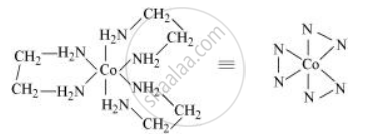
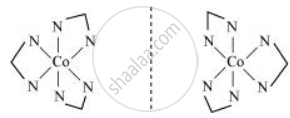
Indicate the type of isomerism exhibited by the following complex and draw the structure for the isomer: [Co(en)3]Cl3
Advertisements
प्रश्न
Indicate the type of isomerism exhibited by the following complex and draw the structure for the isomer:
[Co(en)3]Cl3
Advertisements
उत्तर १
Two optical isomers for [Co(en)3]Cl3 exits.
उत्तर २
It may have two optical isomers.

APPEARS IN
संबंधित प्रश्न
When a coordination compound CoCl3.6NH3 is mixed with AgNO3, 3 moles of AgCl are precipitated per mole of the compound. Write the structural formula of the coordination compound.
Draw the geometrical isomers of complex \[\ce{[Co(en)2Cl2]+}\].
Draw one of the geometrical isomers of the complex [Pt(en)2Cl2]2+ which is optically active.
Define the following term:
Anomers
Indicate the type of isomerism exhibited by the following complex and draw the structure for the isomer:
K[Cr(H2O)2(C2O4)2]
Indicate the type of isomerism exhibited by the following complex and draw the structure for the isomer:
[Co(NH3)5(NO2)](NO3)2
Draw the structure of optical isomers of [Cr(C2O4)3]3−.
Draw all the isomers (geometrical and optical) of [Co(NH3)Cl(en)2]2+.
Name the type of isomerism exhibited by the following pairs of compound:
(1) (C2H5)2NH and CH3-NH-C3H7
(2) 1 – butanol and 2 methyl-1 -propanol.
Name the type of isomerism that the compound with molecular formula C3H6O2 exhibits. Represent the isomers.
Name the type of isomerism shown by the following pair of compounds:
[CoCl(H2O)(NH3)4]Cl2 and [CoCl2(NH3)4]Cl.H2O
Write the IUPAC name of [Co(en)2Cl2]+ ion.
Identify the optically active compounds from the following:
(i) \[\ce{[Co(en)3]^{3+}}\]
(ii) \[\ce{[trans - [Co(en)2Cl2]^+}\]
(iii) \[\ce{cis - [Co(en)2Cl2]^+}\]
(iv) \[\ce{[Cr(NH3)5Cl]}\]
Which one of the following complexes shows optical isomerism? (en = ethylenediamine)
Draw the geometrical isomers of [Co(en)2Cl2]2+. Which geometrical isomer of [Co(en)2Cl2]2+ is not optically active and why?
Assertion (A): Trans [CrCl2(ox)2]3− shows optical isomerism.
Reason (R): Optical isomerism is common in octahedral complexes involving didentate ligands.
Assertion: Addition of bromine water to 1-butene gives two optical isomers.
Reason: The product formed contains two asymmetric carbon atoms.
