Advertisements
Advertisements
प्रश्न
Identify the optically active compounds from the following:
(i) \[\ce{[Co(en)3]^{3+}}\]
(ii) \[\ce{[trans - [Co(en)2Cl2]^+}\]
(iii) \[\ce{cis - [Co(en)2Cl2]^+}\]
(iv) \[\ce{[Cr(NH3)5Cl]}\]
Advertisements
उत्तर
(i) \[\ce{[Co(en)3]^{3+}}\]
(iii) \[\ce{cis - [Co(en)2Cl2]^+}\]
Explanation:
\[\ce{[Co(en)3]^{3+}}\] and \[\ce{[Co(en)2Cl2]^{2+}}\] are optically active compounds because their mirror images are non-superimposable isomer.

Non – superimposable isomers of \[\ce{[Co(en)3]^{3+}}\]
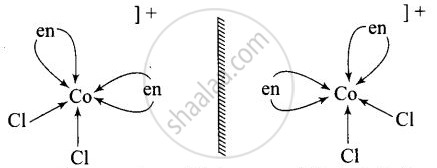
Non – superimosable isomers of \[\ce{[Co(en)2Cl2]^+}\]
APPEARS IN
संबंधित प्रश्न
Explain cationic complexes and anionic complexes of co-ordination compounds.
When a coordination compound CoCl3.6NH3 is mixed with AgNO3, 3 moles of AgCl are precipitated per mole of the compound. Write the structural formula of the coordination compound.
Draw one of the geometrical isomers of the complex [Pt (en)2Cl2] +2 which is optically inactive
Draw the geometrical isomers of complex \[\ce{[Co(en)2Cl2]+}\].
Define the following term:
Anomers
Indicate the type of isomerism exhibited by the following complex and draw the structure for the isomer:
K[Cr(H2O)2(C2O4)2]
Indicate the type of isomerism exhibited by the following complex and draw the structure for the isomer:
[Co(en)3]Cl3
How many geometrical isomers are possible in the following coordination entity?
[Cr(C2O4)3]3−
How many geometrical isomers are possible in the following coordination entity?
[Co(NH3)3Cl3]
Draw the structure of optical isomers of [Cr(NH3)2Cl2(en)]+.
Draw all the isomers (geometrical and optical) of [Co(NH3)2Cl2(en)]+.
Answer the following question.
Write IUPAC name of the complex [Pt(en)2CI2]. Draw structures of geometrical isomers for this complex.
The IUPAC name for [CoCl(NO2)(en)2]Cl is ____________.
Name the type of isomerism shown by the following pair of compounds:
[Cr(NH3)5Br]SO4 and [Cr(NH3)5SO4]Br
Which one of the following complexes shows optical isomerism? (en = ethylenediamine)
Indicate the types of isomerism exhibited by the following complexes and draw the structures for these isomers:
[Pt(NH3)(H2O)Cl2 ]
Indicate the types of isomerism exhibited by the following complexes and draw the structure for isomers:
\[\ce{[Pt(NH3)(H2O)Cl2]}\]
