Advertisements
Advertisements
Question
Identify the optically active compounds from the following:
(i) \[\ce{[Co(en)3]^{3+}}\]
(ii) \[\ce{[trans - [Co(en)2Cl2]^+}\]
(iii) \[\ce{cis - [Co(en)2Cl2]^+}\]
(iv) \[\ce{[Cr(NH3)5Cl]}\]
Advertisements
Solution
(i) \[\ce{[Co(en)3]^{3+}}\]
(iii) \[\ce{cis - [Co(en)2Cl2]^+}\]
Explanation:
\[\ce{[Co(en)3]^{3+}}\] and \[\ce{[Co(en)2Cl2]^{2+}}\] are optically active compounds because their mirror images are non-superimposable isomer.

Non – superimposable isomers of \[\ce{[Co(en)3]^{3+}}\]
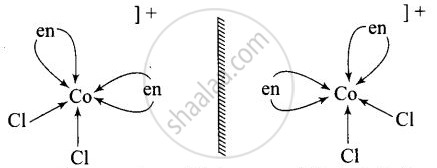
Non – superimosable isomers of \[\ce{[Co(en)2Cl2]^+}\]
APPEARS IN
RELATED QUESTIONS
Draw one of the geometrical isomers of the complex [Pt(en)2Cl2]2+ which is optically active.
Define the following term:
Anomers
Indicate the type of isomerism exhibited by the following complex and draw the structure for the isomer:
[Co(en)3]Cl3
Draw the structure of optical isomers of [Cr(C2O4)3]3−.
Draw the structure of optical isomers of [PtCl2(en)2]2+.
Draw the structure of optical isomers of [Cr(NH3)2Cl2(en)]+.
Draw all the isomers (geometrical and optical) of [CoCl2(en)2]+.
Draw all the isomers (geometrical and optical) of [Co(NH3)Cl(en)2]2+.
Write the structures of optical isomers of the complex ion [Co(en)2Cl2]+.
Draw the geometrical isomers of complex [Pt(en)2Cl2]2+.
Name the type of isomerism shown by the following pair of compounds:
[CoCl(H2O)(NH3)4]Cl2 and [CoCl2(NH3)4]Cl.H2O
Write the IUPAC name of [Co(en)2Cl2]+ ion.
The IUPAC name for [CoCl(NO2)(en)2]Cl is ____________.
The complex [(Pt(Py)(NH3)BrCl] will have how many geometrical isomers?
Which of the following molecules has a chiral centre correctly labelled with an asterisk (*)?
Assertion (A): Trans [CrCl2(ox)2]3− shows optical isomerism.
Reason (R): Optical isomerism is common in octahedral complexes involving didentate ligands.
Indicate the types of isomerism exhibited by the following complexes and draw the structures for these isomers:
[Pt(NH3)(H2O)Cl2 ]
Indicate the types of isomerism exhibited by the following complex and draw the structure for these isomer: \[\ce{[Pt(NH3)(H2O)Cl2]}\]
Indicate the types of isomerism exhibited by the following complex and draw the structure for this isomer:
\[\ce{[Pt(NH3)(H2O)Cl2]}\]
