Advertisements
Advertisements
प्रश्न
Can you suggest a method to remove oil (hydrocarbon) from seeds based on your understanding of rDNA technology and the chemistry of oil?
Advertisements
उत्तर
rDNA technology is a genetic engineering approach that combines DNA from two separate sources to create recombined or recombinant DNA (rDNA). Oils consist of glycerol and fatty acids. To make oil-free seeds, genes coding for glycerol or fatty acids should be discovered, and nucleotide sequences complementary to their sequences should be introduced close to these genes in the endosperm’s early cells. During transcription, these complementary sequences produce antisense RNAs similar to those made by the glycerol or fatty acid genes, which effectively turn off these genes. This will result in the creation of oil-free seeds. Since glycerol is a common component of all oils and diverse fatty acids interact with glycerol to form oils, it will be easier to silence the glycerol production gene.
APPEARS IN
संबंधित प्रश्न
Why do children cured by enzyme-replacement therapy adenosine deaminase deficiency need periodic treatment?
Expand the Given and mention one application of each:
PCR
Consult the internet and find out how to make orally active protein pharmaceuticals. What is the major problem to be encountered?
State the cause of ADA deficiency in humans.Mention a possible cure for an ADA deficiency patient.
Explain how insulin can be produced using recombinant DNA technology.
Answer the following question.
Describe the roles of heat, primers, and the bacterium Thermus aquaticus in the process of PCR.
Describe the role of high temperature.
Describe the role of bacterium Thermus aquaticus in carrying the process of polymerase chain reaction.
The first clinical gene therapy was done for the treatment of ________.
How many amino acids are arranged in the two chains of Insulin?
Which one of the following statements is true regarding DNA polymerase used in PCR?
Mention the number of primers required in each cycle of PCR. Write the role of primers and DNA polymerase in PCR. Name the source organism of the DNA polymerase used in PCR.
How was Insulin obtained before the advent of rDNA technology? What were the problems encountered?
Now a days it is possible to detect the mutated gene causing cancer by allowing a radioactive probe to hybridize its complimentary DNA in a clone of cells, followed by its detection using autoradiography because ______
Give the full form of ELISA. Which disease can be detected using it? Discuss the principle underlying the test.
What is a recombinant DNA vaccine? Give two examples.
How is a mature, functional insulin hormone different from its prohormone form?
How is a mature, functional insulin hormone different from its prohormone form?
List the advantages of recombinant insulin.
A cell-free method of amplifying DNA first developed in the mid 1980's revolutionised the field of biotechnology, Name the method and explain the basic steps of the technique involved.
- Assertion: PCR is a powerful technique to identify genetic disorders.
- Reason: PCR can detect mutations in low amounts of DNA.
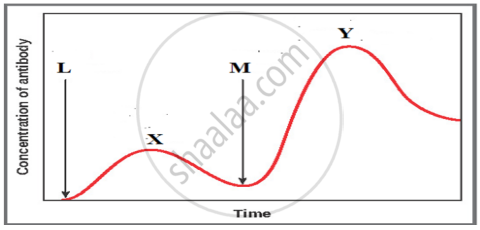
The graph given below indicates the administration of the first (L) and second dose (M) of a vaccine. The corresponding response of the body is indicated by X, and Y. Interpret the graph and explain the reason for such a response shown by the body.
How many cycles of PCR are required to produce 250 molecules of DNA, starting with a single parental strand?
In the recombinant production of humulin using Escherichia coli, which plasmid vector and bacterial gene are fused with the human insulin A and B chain sequences?
The first edible vaccine was developed in tobacco plants to express which specific antigen?
Severe Combined Immunodeficiency Disease (SCID) caused by adenosine deaminase (ADA) deficiency arises due to which pathological mechanism?
Why is the Polymerase Chain Reaction (PCR) preferred over conventional culture and serological methods for early disease diagnosis?
