Advertisements
Advertisements
प्रश्न
Assume that a tunnel is dug along a chord of the earth, at a perpendicular distance R/2 from the earth's centre where R is the radius of the earth. The wall of the tunnel is frictionless. (a) Find the gravitational force exerted by the earth on a particle of mass mplaced in the tunnel at a distance x from the centre of the tunnel. (b) Find the component of this force along the tunnel and perpendicular to the tunnel. (c) Find the normal force exerted by the wall on the particle. (d) Find the resultant force on the particle. (e) Show that the motion of the particle in the tunnel is simple harmonic and find the time period.
Advertisements
उत्तर
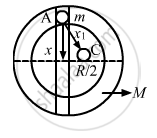
If \[\rho\] is the density of the earth, then mass of the earth \[\left( M \right)\] is given by,
\[M = \frac{4}{3}\pi R^3 \rho\]
\[\text {Similarly, mass} \left( M' \right) \text{ of the part of earth having radius } \left( x \right)\text{ is given by, } \] \[M' = \frac{4}{3}\pi {x_1}^3 \rho\]
\[M' = \left( \frac{M}{R^3} \right) {x_1}^3\]
(a) Let F be the gravitational force exerted by the earth on the particle of mass m. Then, its value is given by,
\[F = \frac{GM'm}{x_1^2}\]
\[\text {Substituting the value of M' in the above equation, we get: }\]
\[F = \frac{GMm}{R^3}\frac{x_1^3}{x_1^2}\]
\[ = \frac{GMm}{R^3} x_1 = \frac{GMm}{R^3}\sqrt{x^2 + \left( \frac{R^2}{4} \right)}\]
(b)
\[F_y = Fcos\theta\]
\[ = \frac{GMm x_1}{R^3}\frac{x}{x_1} = \frac{GMmx}{R^3}\]
\[ F_x = F\sin \theta\]
\[ = \frac{GMm x_1}{R^3}\frac{R}{2 x_1} = \frac{GMm}{2 R^2}\]
(c) 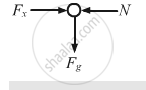
\[F_x = \frac{GMm}{R^2}\]
\[\because\] Normal force exerted by the wall N = Fx
(d)The resultant force is \[\frac{GMmx}{R^3}\]
(e) Acceleration = Driving force/mass
\[= \frac{GMmx}{R^3 m}\]
\[ = \frac{GMx}{R^3}\]
\[\Rightarrow\] a \[\propto\] x (the body executes S.H.M.)
\[\frac{a}{x} = \omega^2 = \frac{GM}{R^3}\]
\[ \Rightarrow \omega = \sqrt{\frac{Gm}{R^3}}\]
\[ \Rightarrow T = 2\pi\sqrt{\frac{R^3}{GM}}\]
APPEARS IN
संबंधित प्रश्न
A particle executes simple harmonic motion Let P be a point near the mean position and Q be a point near an extreme. The speed of the particle at P is larger than the speed at Q. Still the particle crosses Pand Q equal number of times in a given time interval. Does it make you unhappy?
The distance moved by a particle in simple harmonic motion in one time period is
The displacement of a particle is given by \[\overrightarrow{r} = A\left( \overrightarrow{i} \cos\omega t + \overrightarrow{j} \sin\omega t \right) .\] The motion of the particle is
A particle moves in a circular path with a continuously increasing speed. Its motion is
Which of the following quantities are always negative in a simple harmonic motion?
(a) \[\vec{F} . \vec{a} .\]
(b) \[\vec{v} . \vec{r} .\]
(c) \[\vec{a} . \vec{r} .\]
(d)\[\vec{F} . \vec{r} .\]
Suppose a tunnel is dug along a diameter of the earth. A particle is dropped from a point, a distance h directly above the tunnel. The motion of the particle as seen from the earth is
(a) simple harmonic
(b) parabolic
(c) on a straight line
(d) periodic
A particle moves in the X-Y plane according to the equation \[\overrightarrow{r} = \left( \overrightarrow{i} + 2 \overrightarrow{j} \right)A\cos\omega t .\]
The motion of the particle is
(a) on a straight line
(b) on an ellipse
(c) periodic
(d) simple harmonic
Which of the following will change the time period as they are taken to moon?
(a) A simple pendulum
(b) A physical pendulum
(c) A torsional pendulum
(d) A spring-mass system
The angle made by the string of a simple pendulum with the vertical depends on time as \[\theta = \frac{\pi}{90} \sin \left[ \left( \pi s^{- 1} \right)t \right]\] .Find the length of the pendulum if g = π2 m2.
Assume that a tunnel is dug across the earth (radius = R) passing through its centre. Find the time a particle takes to cover the length of the tunnel if (a) it is projected into the tunnel with a speed of \[\sqrt{gR}\] (b) it is released from a height R above the tunnel (c) it is thrown vertically upward along the length of tunnel with a speed of \[\sqrt{gR}\]
In a simple harmonic oscillation, the acceleration against displacement for one complete oscillation will be __________.
The length of a second’s pendulum on the surface of the Earth is 0.9 m. The length of the same pendulum on the surface of planet X such that the acceleration of the planet X is n times greater than the Earth is
A simple pendulum is suspended from the roof of a school bus which moves in a horizontal direction with an acceleration a, then the time period is
A simple pendulum has a time period T1. When its point of suspension is moved vertically upwards according to as y = kt2, where y is the vertical distance covered and k = 1 ms−2, its time period becomes T2. Then, T `"T"_1^2/"T"_2^2` is (g = 10 ms−2)
Write short notes on two springs connected in series.
Describe Simple Harmonic Motion as a projection of uniform circular motion.
Consider a simple pendulum of length l = 0.9 m which is properly placed on a trolley rolling down on a inclined plane which is at θ = 45° with the horizontal. Assuming that the inclined plane is frictionless, calculate the time period of oscillation of the simple pendulum.
A simple harmonic motion is given by, x = 2.4 sin ( 4πt). If distances are expressed in cm and time in seconds, the amplitude and frequency of S.H.M. are respectively,
Motion of a ball bearing inside a smooth curved bowl, when released from a point slightly above the lower point is ______.
- simple harmonic motion.
- non-periodic motion.
- periodic motion.
- periodic but not S.H.M.
