Advertisements
Advertisements
प्रश्न
Consider the Earth as a homogeneous sphere of radius R and a straight hole is bored in it through its centre. Show that a particle dropped into the hole will execute a simple harmonic motion such that its time period is
T = `2π sqrt("R"/"g")`
Advertisements
उत्तर
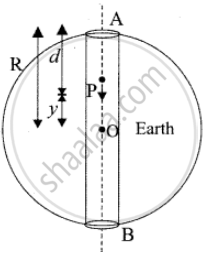
Oscillations of a particle dropped in a tunnel along the diameter of the earth.
Consider earth to be a sphere of radius R and centre O. A straight tunnel is dug along the diameter of the earth. Let ‘g’ be the value of acceleration due to gravity at the surface of the earth.
Suppose a body of mass ‘m’ is dropped into the tunnel and it is at point R i.e., at a depth d below the surface of the earth at any instant.
If g’ is the acceleration due to gravity at P.
then R − d = y
∴ g’ = `"g"("y"/"R")`
Force acting on the body a point P is
F = − mg’ = `-"mg"/"R""y"` i.e., `"F" ∝ "y"`
Negative sign indicates that the force acts in the opposite direction of displacement.
Thus the body will execute SHM with force constant, k = `"mg"/"R"`
The period of oscillation of the body will be T = `2π sqrt("m"/"k") = 2π sqrt ("m"/("mg"//"R"))`
T = `2π sqrt("R"/"g")`
APPEARS IN
संबंधित प्रश्न
Show variation of displacement, velocity, and acceleration with phase for a particle performing linear S.H.M. graphically, when it starts from the extreme position.
The time period of a particle in simple harmonic motion is equal to the time between consecutive appearances of the particle at a particular point in its motion. This point is
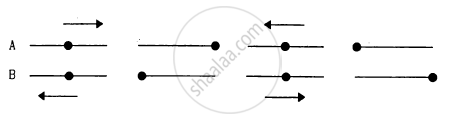
Figure represents two simple harmonic motions.
The parameter which has different values in the two motions is
The average energy in one time period in simple harmonic motion is
A wall clock uses a vertical spring-mass system to measure the time. Each time the mass reaches an extreme position, the clock advances by a second. The clock gives correct time at the equator. If the clock is taken to the poles it will
The angle made by the string of a simple pendulum with the vertical depends on time as \[\theta = \frac{\pi}{90} \sin \left[ \left( \pi s^{- 1} \right)t \right]\] .Find the length of the pendulum if g = π2 m2.
A simple pendulum of length l is suspended through the ceiling of an elevator. Find the time period of small oscillations if the elevator (a) is going up with and acceleration a0(b) is going down with an acceleration a0 and (c) is moving with a uniform velocity.
A hollow sphere of radius 2 cm is attached to an 18 cm long thread to make a pendulum. Find the time period of oscillation of this pendulum. How does it differ from the time period calculated using the formula for a simple pendulum?
Three simple harmonic motions of equal amplitude A and equal time periods in the same direction combine. The phase of the second motion is 60° ahead of the first and the phase of the third motion is 60° ahead of the second. Find the amplitude of the resultant motion.
Write short notes on two springs connected in series.
