Advertisements
Advertisements
Question
Consider the Earth as a homogeneous sphere of radius R and a straight hole is bored in it through its centre. Show that a particle dropped into the hole will execute a simple harmonic motion such that its time period is
T = `2π sqrt("R"/"g")`
Advertisements
Solution
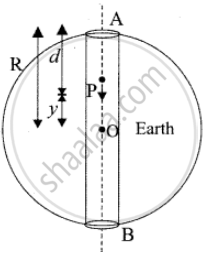
Oscillations of a particle dropped in a tunnel along the diameter of the earth.
Consider earth to be a sphere of radius R and centre O. A straight tunnel is dug along the diameter of the earth. Let ‘g’ be the value of acceleration due to gravity at the surface of the earth.
Suppose a body of mass ‘m’ is dropped into the tunnel and it is at point R i.e., at a depth d below the surface of the earth at any instant.
If g’ is the acceleration due to gravity at P.
then R − d = y
∴ g’ = `"g"("y"/"R")`
Force acting on the body a point P is
F = − mg’ = `-"mg"/"R""y"` i.e., `"F" ∝ "y"`
Negative sign indicates that the force acts in the opposite direction of displacement.
Thus the body will execute SHM with force constant, k = `"mg"/"R"`
The period of oscillation of the body will be T = `2π sqrt("m"/"k") = 2π sqrt ("m"/("mg"//"R"))`
T = `2π sqrt("R"/"g")`
APPEARS IN
RELATED QUESTIONS
Can simple harmonic motion take place in a non-inertial frame? If yes, should the ratio of the force applied with the displacement be constant?
A particle executes simple harmonic motion Let P be a point near the mean position and Q be a point near an extreme. The speed of the particle at P is larger than the speed at Q. Still the particle crosses Pand Q equal number of times in a given time interval. Does it make you unhappy?
The time period of a particle in simple harmonic motion is equal to the time between consecutive appearances of the particle at a particular point in its motion. This point is
The time period of a particle in simple harmonic motion is equal to the smallest time between the particle acquiring a particular velocity \[\vec{v}\] . The value of v is
A simple pendulum is constructed by hanging a heavy ball by a 5.0 m long string. It undergoes small oscillations. (a) How many oscillations does it make per second? (b) What will be the frequency if the system is taken on the moon where acceleration due to gravitation of the moon is 1.67 m/s2?
If the inertial mass and gravitational mass of the simple pendulum of length l are not equal, then the time period of the simple pendulum is
Define the time period of simple harmonic motion.
Define the frequency of simple harmonic motion.
The displacement of a particle varies with time according to the relation y = a sin ωt + b cos ωt.
Motion of a ball bearing inside a smooth curved bowl, when released from a point slightly above the lower point is ______.
- simple harmonic motion.
- non-periodic motion.
- periodic motion.
- periodic but not S.H.M.
