Advertisements
Advertisements
प्रश्न
A simple pendulum is constructed by hanging a heavy ball by a 5.0 m long string. It undergoes small oscillations. (a) How many oscillations does it make per second? (b) What will be the frequency if the system is taken on the moon where acceleration due to gravitation of the moon is 1.67 m/s2?
Advertisements
उत्तर
It is given that:
Length of the pendulum, l = 5 m
Acceleration due to gravity, g = 9.8 ms-2
Acceleration due to gravity at the moon, g' = 1.67 ms-2
(a) Time period \[\left( T \right)\] is given by,
\[T = 2\pi\sqrt{\frac{l}{g}}\]
\[= 2\pi\sqrt{\frac{5}{9 . 8}}\]
\[ = 2\pi\sqrt{0 . 510} = 2\pi \left( 0 . 71 \right) s\]
i.e. the body will take 2 \[\pi\](0.7) seconds to complete an oscillation.
Now, frequency \[\left( f \right)\]is given by,
\[f = \frac{1}{T}\]
\[\therefore f = \frac{1}{2\pi\left( 0 . 71 \right)} \]
\[ = \frac{0 . 70}{\pi} Hz\]
(b) Let
\[g'\] be the value of acceleration due to gravity at moon. Time period of simple pendulum at moon \[\left( T' \right)\],is given as:
\[T' = 2\pi\sqrt{\left( \frac{l}{g'} \right)}\]
On substituting the respective values in the above formula, we get:
\[ = \frac{1}{2\pi}\sqrt{\frac{1 . 67}{5}} = \frac{1}{2\pi}\left( 0 . 577 \right)\]
\[ = \frac{1}{2\pi\sqrt{3}} Hz\]
APPEARS IN
संबंधित प्रश्न
In measuring time period of a pendulum, it is advised to measure the time between consecutive passage through the mean position in the same direction. This is said to result in better accuracy than measuring time between consecutive passage through an extreme position. Explain.
Can a pendulum clock be used in an earth-satellite?
The distance moved by a particle in simple harmonic motion in one time period is
The motion of a particle is given by x = A sin ωt + B cos ωt. The motion of the particle is
The displacement of a particle is given by \[\overrightarrow{r} = A\left( \overrightarrow{i} \cos\omega t + \overrightarrow{j} \sin\omega t \right) .\] The motion of the particle is
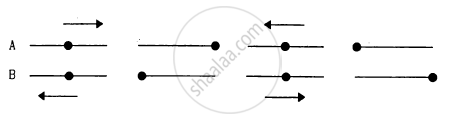
Figure represents two simple harmonic motions.
The parameter which has different values in the two motions is
Which of the following quantities are always positive in a simple harmonic motion?
Suppose a tunnel is dug along a diameter of the earth. A particle is dropped from a point, a distance h directly above the tunnel. The motion of the particle as seen from the earth is
(a) simple harmonic
(b) parabolic
(c) on a straight line
(d) periodic
Assume that a tunnel is dug across the earth (radius = R) passing through its centre. Find the time a particle takes to cover the length of the tunnel if (a) it is projected into the tunnel with a speed of \[\sqrt{gR}\] (b) it is released from a height R above the tunnel (c) it is thrown vertically upward along the length of tunnel with a speed of \[\sqrt{gR}\]
A simple pendulum fixed in a car has a time period of 4 seconds when the car is moving uniformly on a horizontal road. When the accelerator is pressed, the time period changes to 3.99 seconds. Making an approximate analysis, find the acceleration of the car.
A uniform rod of length l is suspended by an end and is made to undergo small oscillations. Find the length of the simple pendulum having the time period equal to that of the road.
A particle executing SHM crosses points A and B with the same velocity. Having taken 3 s in passing from A to B, it returns to B after another 3 s. The time period is ____________.
Define the time period of simple harmonic motion.
State the laws of the simple pendulum?
A spring is stretched by 5 cm by a force of 10 N. The time period of the oscillations when a mass of 2 kg is suspended by it is ______
The velocities of a particle in SHM at positions x1 and x2 are v1 and v2 respectively, its time period will be ______.
A container consist of hemispherical shell of radius 'r ' and cylindrical shell of height 'h' radius of same material and thickness. The maximum value h/r so that container remain stable equilibrium in the position shown (neglect friction) is ______.

