Advertisements
Advertisements
प्रश्न
Consider two simple harmonic motion along the x and y-axis having the same frequencies but different amplitudes as x = A sin (ωt + φ) (along x-axis) and y = B sin ωt (along y-axis). Then show that
`"x"^2/"A"^2 + "y"^2/"B"^2 - (2"xy")/"AB" cos φ = sin^2 φ`
and also discuss the special cases when
- φ = 0
- φ = π
- φ = `π/2`
- φ = `π/2` and A = B
- φ = `π/4`
Note: when a particle is subjected to two simple harmonic motions at right angle to each other the particle may move along different paths. Such paths are called Lissajous figures.
Advertisements
उत्तर
Given: x = A sin (ωt + φ) ..................(1)
y = B sin ωt .............(2)
In equation (1) use,
sin (A – B) – sin A cos B + cos A sin B
x – A sin ωt. cos (φ) + A cos ωt. sin φ
x – A sin cot. cos φ = A cos cot sin φ
squaring on both sides we get,
(x – A sin cot. cos φ)2 = A2 cos2 cot sin2 φ ........(3)
In equation (3) sin at can be re-written as, `"y"/"B"` .............[from equation (2)]
Also, use
cos2 cot = 1 – sin2 ωt in equation (3)
∴ Equation (3) becomes on expansion
`("x" - "A""y"/"B". cos Φ)^2 = "A"^2 (1 - "y"^2/"B"^2) sin^2 Φ`
`"x"^2 + ("A"^2"y"^2)/"B"^2 cos^2 Φ - (2"xAy")/"B" cos Φ`
= `"A"^2 sin^2 Φ - ("A"^2"y"^2)/"B"^2 sin^2 Φ` ......(4)
`"x"^2 + ("A"^2"y"^2)/"B"^2 (sin^2 Φ + cos^2 Φ) - (2"xyA")/"B" cos Φ`
= A2 sin2 Φ ......(÷ by A2)
We get,
`"x"^2/"A"^2 + "y"^2/"B"^2. 1 - (2"xy")/"AB" cos Φ = sin^2 Φ` ......(5)
Hence proved.
Special cases:
a. φ = 0 in equation (5) we get,
`"x"^2/"A"^2 + "y"^2/"B"^2 - (2"xy")/"AB".1 = 0`
or `("x"/"A" - "y"/"B")^2` = 0
or `"x"/"A" = "y"/"B"`
y = `"B"/"A"."x"`
The above equation resembles the equation of a straight line passing through origin with a positive slope.
b. φ = π in equation (5)
`"x"^2/"A"^2 + "y"^2/"B"^2 + (2"xy")/"AB" = 0`
or `("x"/"A" + "y"/"B")^2` = 0
or `"x"/"A" = -"y"/"B"`
y = `-"B"/"A"."x"`
The above equation is an equation of a straight line passing through origin with a negative slope.
c. φ = `π/2` in equation (5)
The above equation of an ellipse whose centre is origin.
d. φ = `π/2` and A = B n equation (5)
`"x"^2/"A"^2 + "y"^2/"A"^2` = 1
x2 + y2 = A2
The above equation of a circle whose centre is origin.
e. φ = `π/4, cos π/4 = 1/sqrt2 = 1/sqrt2` equation (5) we get,
`"x"^2/"A"^2 + "y"^2/"A"^2 - (sqrt(2)"xy")/"AB" = 1/2`
The above equation is an equation of tilted ellipse.
APPEARS IN
संबंधित प्रश्न
Assuming the expression for displacement of a particle starting from extreme position, explain graphically the variation of velocity and acceleration w.r.t. time.
Show variation of displacement, velocity, and acceleration with phase for a particle performing linear S.H.M. graphically, when it starts from the extreme position.
The energy of system in simple harmonic motion is given by \[E = \frac{1}{2}m \omega^2 A^2 .\] Which of the following two statements is more appropriate?
(A) The energy is increased because the amplitude is increased.
(B) The amplitude is increased because the energy is increased.
The time period of a particle in simple harmonic motion is equal to the time between consecutive appearances of the particle at a particular point in its motion. This point is
The time period of a particle in simple harmonic motion is equal to the smallest time between the particle acquiring a particular velocity \[\vec{v}\] . The value of v is
Suppose a tunnel is dug along a diameter of the earth. A particle is dropped from a point, a distance h directly above the tunnel. The motion of the particle as seen from the earth is
(a) simple harmonic
(b) parabolic
(c) on a straight line
(d) periodic
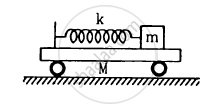
All the surfaces shown in figure are frictionless. The mass of the care is M, that of the block is m and the spring has spring constant k. Initially the car and the block are at rest and the spring is stretched through a length x0 when the system is released. (a) Find the amplitudes of the simple harmonic motion of the block and of the care as seen from the road. (b) Find the time period(s) of the two simple harmonic motions.
The pendulum of a certain clock has time period 2.04 s. How fast or slow does the clock run during 24 hours?
A small block oscillates back and forth on a smooth concave surface of radius R in Figure. Find the time period of small oscillation.

A simple pendulum has a time period T1. When its point of suspension is moved vertically upwards according to as y = kt2, where y is the vertical distance covered and k = 1 ms−2, its time period becomes T2. Then, T `"T"_1^2/"T"_2^2` is (g = 10 ms−2)
