Advertisements
Advertisements
प्रश्न
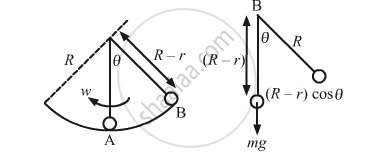
A spherical ball of mass m and radius r rolls without slipping on a rough concave surface of large radius R. It makes small oscillations about the lowest point. Find the time period.
Advertisements
उत्तर
Let ω be the angular velocity of the system about the point of suspension at any time.
Velocity of the ball rolling on a rough concave surface \[\left( v_C \right)\] is given by,
vc = (R − r)ω
Also, vc = rω1
where ω1 is the rotational velocity of the sphere.
\[\Rightarrow \omega_1 = \frac{v_c}{r} = \left( \frac{R - r}{r} \right)\omega \cdots\left( 1 \right)\]
As total energy of a particle in S.H.M. remains constant,
\[mg\left( R - r \right) \left( 1 - \cos \theta \right) + \frac{1}{2}m v_c^2 + \frac{1}{2}I \omega_1^2 = constant\] \[\text { Substituting the values of v_c and } \omega_1 \text { in the above equation, we get: }\] \[mg \left( R - r \right) \left( 1 - \cos \theta \right) + \frac{1}{2}m \left( R - r \right)^2 \omega^2 + \frac{1}{2}m r^2 \left( \frac{R - r}{r} \right) \omega^2 = \text { constant } \left( \because I = m r^2 \right)\] \[mg\left( R - r \right) \left( 1 - \cos \theta \right) + \frac{1}{2}m \left( R - r \right)^2 \omega^2 + \frac{1}{5}m r^2 \left( \frac{R - r}{r} \right) \omega^2 = \text { constant }\]\[ \Rightarrow g\left( R - r \right) \left( 1 - \cos \theta \right) + \left( R - r \right)^2 \omega^2 \left[ \frac{1}{2} + \frac{1}{5} \right] = \text { constant }\]
Taking derivative on both sides, we get:
\[\text {g}\left( \text{R - r} \right)\text { sin }\theta\frac{\text{d}\theta}{\text{dt}} = \frac{7}{10} \left(\text{ R - r }\right)^2 2\omega\frac{d\omega}{\text{dt}}\]
\[ \Rightarrow \text { g sin }\theta = 2 \times \left( \frac{7}{10} \right)\left(\text{ R - r }\right)\alpha \left( \because a = \frac{\text{d}\omega}{\text{dt}} \right)\]
\[ \Rightarrow \text{ g sin}\theta = \left( \frac{7}{5} \right)\left( \text{R - r} \right)\alpha\]
\[ \Rightarrow \alpha = \frac{5\text{g sin }\theta}{7\left( \text{R - r} \right)}\]
\[ = \frac{\text{5g}\theta}{7\left(\text{ R - r }\right)}\]
\[ \therefore \frac{\alpha}{\theta} = \omega^2 = \frac{\text{5g}}{7\left( \text{R - r} \right)} = \text { constant }\]
Therefore, the motion is S.H.M.
\[\omega = \sqrt{\frac{5g}{7\left( R - r \right)}}\]
\[\text { Time period is given by, } \]
\[ \Rightarrow T = 2\pi\sqrt{\frac{7\left( R - r \right)}{5g}}\]
APPEARS IN
संबंधित प्रश्न
The average displacement over a period of S.H.M. is ______.
(A = amplitude of S.H.M.)
Define phase of S.H.M.
A body of mass 1 kg is made to oscillate on a spring of force constant 16 N/m. Calculate:
a) Angular frequency
b) frequency of vibration.
A particle executes simple harmonic motion Let P be a point near the mean position and Q be a point near an extreme. The speed of the particle at P is larger than the speed at Q. Still the particle crosses Pand Q equal number of times in a given time interval. Does it make you unhappy?
In measuring time period of a pendulum, it is advised to measure the time between consecutive passage through the mean position in the same direction. This is said to result in better accuracy than measuring time between consecutive passage through an extreme position. Explain.
The average energy in one time period in simple harmonic motion is
A pendulum clock that keeps correct time on the earth is taken to the moon. It will run
A pendulum clock keeping correct time is taken to high altitudes,
The motion of a torsional pendulum is
(a) periodic
(b) oscillatory
(c) simple harmonic
(d) angular simple harmonic
Which of the following quantities are always positive in a simple harmonic motion?
A particle moves on the X-axis according to the equation x = x0 sin2 ωt. The motion is simple harmonic
A particle executes simple harmonic motion with an amplitude of 10 cm and time period 6 s. At t = 0 it is at position x = 5 cm going towards positive x-direction. Write the equation for the displacement x at time t. Find the magnitude of the acceleration of the particle at t = 4 s.
Assume that a tunnel is dug across the earth (radius = R) passing through its centre. Find the time a particle takes to cover the length of the tunnel if (a) it is projected into the tunnel with a speed of \[\sqrt{gR}\] (b) it is released from a height R above the tunnel (c) it is thrown vertically upward along the length of tunnel with a speed of \[\sqrt{gR}\]
A simple pendulum of length 1 feet suspended from the ceiling of an elevator takes π/3 seconds to complete one oscillation. Find the acceleration of the elevator.
A uniform rod of length l is suspended by an end and is made to undergo small oscillations. Find the length of the simple pendulum having the time period equal to that of the road.
State the laws of the simple pendulum?
A body oscillates with SHM according to the equation x = 5 cos `(2π"t" + π/4)`. Its instantaneous displacement at t = 1 sec is:
A spring is stretched by 5 cm by a force of 10 N. The time period of the oscillations when a mass of 2 kg is suspended by it is ______
