Advertisements
Advertisements
प्रश्न
The motion of a particle is given by x = A sin ωt + B cos ωt. The motion of the particle is
पर्याय
not simple harmonic
simple harmonic with amplitude A + B
simple harmonic with amplitude (A + B)/2
simple harmonic with amplitude
Advertisements
उत्तर
simple harmonic with amplitude \[\sqrt{A^2 + B^2}\]
x = A sin ωt + B cos ωt ...(1)
\[\text { Acceleration }, \]
\[ a = \frac{\text {d}^2 x}{\text {dt}^2} = \frac{\text {d}^2}{\text{dt}^2}(\text {A}\sin\omega t + \text {B} \cos \omega t)\]
\[ = \frac{\text{d}}{\text {dt}}(\text { A }\omega \cos \omega t - \text { B }\omega \sin \omega t) \]
\[ = - \text { A } \omega^2 \text { sin }\omega t - \text { B }\omega^2 \cos \omega t \]
\[ = - \omega^2 (\text { A }\sin \omega t + \text { B }\cos \omega t )\]
\[ = - \omega^2 x\]
For a body to undergo simple harmonic motion,
acceleration, a =\[-\] kx. ...(2)
Therefore, from the equations (1) and (2), it can be seen that the given body undergoes simple harmonic motion with amplitude, A
\[= \sqrt{A^2 + B^2}\]
APPEARS IN
संबंधित प्रश्न
A particle executes S.H.M. with a period of 10 seconds. Find the time in which its potential energy will be half of its total energy.
State the differential equation of linear simple harmonic motion.
A particle executes simple harmonic motion Let P be a point near the mean position and Q be a point near an extreme. The speed of the particle at P is larger than the speed at Q. Still the particle crosses Pand Q equal number of times in a given time interval. Does it make you unhappy?
Can a pendulum clock be used in an earth-satellite?
A platoon of soldiers marches on a road in steps according to the sound of a marching band. The band is stopped and the soldiers are ordered to break the steps while crossing a bridge. Why?
The distance moved by a particle in simple harmonic motion in one time period is
A pendulum clock that keeps correct time on the earth is taken to the moon. It will run
A particle moves in a circular path with a continuously increasing speed. Its motion is
Suppose a tunnel is dug along a diameter of the earth. A particle is dropped from a point, a distance h directly above the tunnel. The motion of the particle as seen from the earth is
(a) simple harmonic
(b) parabolic
(c) on a straight line
(d) periodic
In a simple harmonic motion
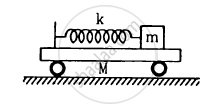
All the surfaces shown in figure are frictionless. The mass of the care is M, that of the block is m and the spring has spring constant k. Initially the car and the block are at rest and the spring is stretched through a length x0 when the system is released. (a) Find the amplitudes of the simple harmonic motion of the block and of the care as seen from the road. (b) Find the time period(s) of the two simple harmonic motions.
A pendulum clock giving correct time at a place where g = 9.800 m/s2 is taken to another place where it loses 24 seconds during 24 hours. Find the value of g at this new place.
A small block oscillates back and forth on a smooth concave surface of radius R ib Figure . Find the time period of small oscillation.
A spherical ball of mass m and radius r rolls without slipping on a rough concave surface of large radius R. It makes small oscillations about the lowest point. Find the time period.
A particle executing SHM crosses points A and B with the same velocity. Having taken 3 s in passing from A to B, it returns to B after another 3 s. The time period is ____________.
The length of a second’s pendulum on the surface of the Earth is 0.9 m. The length of the same pendulum on the surface of planet X such that the acceleration of the planet X is n times greater than the Earth is
A spring is stretched by 5 cm by a force of 10 N. The time period of the oscillations when a mass of 2 kg is suspended by it is ______.
A weightless rigid rod with a small iron bob at the end is hinged at point A to the wall so that it can rotate in all directions. The rod is kept in the horizontal position by a vertical inextensible string of length 20 cm, fixed at its midpoint. The bob is displaced slightly, perpendicular to the plane of the rod and string. The period of small oscillations of the system in the form `(pix)/10` is ______ sec. and the value of x is ______.
(g = 10 m/s2)

Which of the following expressions corresponds to simple harmonic motion along a straight line, where x is the displacement and a, b, and c are positive constants?
