Advertisements
Advertisements
प्रश्न
A uniform rod of length l is suspended by an end and is made to undergo small oscillations. Find the length of the simple pendulum having the time period equal to that of the road.
Advertisements
उत्तर
It is given that the length of the rod is l.
Let point A be the suspension point and point B be the centre of gravity.
Separation between the point of suspension and the centre of mass, l' = \[\frac{l}{2}\]
Also, h =\[\frac{l}{2}\]
Using parallel axis theorem, the moment of inertia about A is given as,
\[I = I_{CG} + m h^2 \]
\[ = \frac{m l^2}{12} + \frac{m l^2}{4} = \frac{m l^2}{3}\]
\[\text { the time period }\left( T \right) \text { is given by, }\]
\[T = 2\pi\sqrt{\frac{I}{mgl'}} = 2\pi\sqrt{\frac{I}{mg\frac{l}{2}}}\]
\[ = 2\pi\sqrt{\frac{2m l^2}{3mgl}} = 2\pi\sqrt{\frac{2l}{3g}}\]
Let T' be the time period of simple pendulum of length x.
Time Period \[(T')\] is given by ,\[T' = 2\pi\sqrt{\left( \frac{x}{g} \right)}\] \[\text { As the time period of the simple pendulum is equal to the time period of the rod,} \] \[T' = T\]
\[ \Rightarrow \frac{2l}{3g} = \frac{x}{g}\]
\[ \Rightarrow x = \frac{2l}{3}\]
APPEARS IN
संबंधित प्रश्न
In a damped harmonic oscillator, periodic oscillations have _______ amplitude.
(A) gradually increasing
(B) suddenly increasing
(C) suddenly decreasing
(D) gradually decreasing
A particle executes S.H.M. with a period of 10 seconds. Find the time in which its potential energy will be half of its total energy.
Can the potential energy in a simple harmonic motion be negative? Will it be so if we choose zero potential energy at some point other than the mean position?
A pendulum clock gives correct time at the equator. Will it gain time or loose time as it is taken to the poles?
A platoon of soldiers marches on a road in steps according to the sound of a marching band. The band is stopped and the soldiers are ordered to break the steps while crossing a bridge. Why?
A particle moves on the X-axis according to the equation x = A + B sin ωt. The motion is simple harmonic with amplitude
The average energy in one time period in simple harmonic motion is
A particle moves in a circular path with a continuously increasing speed. Its motion is
An object is released from rest. The time it takes to fall through a distance h and the speed of the object as it falls through this distance are measured with a pendulum clock. The entire apparatus is taken on the moon and the experiment is repeated
(a) the measured times are same
(b) the measured speeds are same
(c) the actual times in the fall are equal
(d) the actual speeds are equal
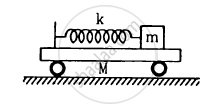
All the surfaces shown in figure are frictionless. The mass of the care is M, that of the block is m and the spring has spring constant k. Initially the car and the block are at rest and the spring is stretched through a length x0 when the system is released. (a) Find the amplitudes of the simple harmonic motion of the block and of the care as seen from the road. (b) Find the time period(s) of the two simple harmonic motions.
Assume that a tunnel is dug along a chord of the earth, at a perpendicular distance R/2 from the earth's centre where R is the radius of the earth. The wall of the tunnel is frictionless. (a) Find the gravitational force exerted by the earth on a particle of mass mplaced in the tunnel at a distance x from the centre of the tunnel. (b) Find the component of this force along the tunnel and perpendicular to the tunnel. (c) Find the normal force exerted by the wall on the particle. (d) Find the resultant force on the particle. (e) Show that the motion of the particle in the tunnel is simple harmonic and find the time period.
A simple pendulum fixed in a car has a time period of 4 seconds when the car is moving uniformly on a horizontal road. When the accelerator is pressed, the time period changes to 3.99 seconds. Making an approximate analysis, find the acceleration of the car.
Write short notes on two springs connected in parallel.
A simple harmonic motion is given by, x = 2.4 sin ( 4πt). If distances are expressed in cm and time in seconds, the amplitude and frequency of S.H.M. are respectively,
A spring is stretched by 5 cm by a force of 10 N. The time period of the oscillations when a mass of 2 kg is suspended by it is ______.
The displacement of a particle is represented by the equation y = sin3ωt. The motion is ______.
What is the ratio of maxmimum acceleration to the maximum velocity of a simple harmonic oscillator?
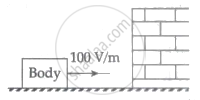
A body having specific charge 8 µC/g is resting on a frictionless plane at a distance 10 cm from the wall (as shown in the figure). It starts moving towards the wall when a uniform electric field of 100 V/m is applied horizontally toward the wall. If the collision of the body with the wall is perfectly elastic, then the time period of the motion will be ______ s.
A weightless rigid rod with a small iron bob at the end is hinged at point A to the wall so that it can rotate in all directions. The rod is kept in the horizontal position by a vertical inextensible string of length 20 cm, fixed at its midpoint. The bob is displaced slightly, perpendicular to the plane of the rod and string. The period of small oscillations of the system in the form `(pix)/10` is ______ sec. and the value of x is ______.
(g = 10 m/s2)

