Advertisements
Advertisements
प्रश्न
A closed circular wire hung on a nail in a wall undergoes small oscillations of amplitude 20 and time period 2 s. Find (a) the radius of the circular wire, (b) the speed of the particle farthest away from the point of suspension as it goes through its mean position, (c) the acceleration of this particle as it goes through its mean position and (d) the acceleration of this particle when it is at an extreme position. Take g = π2 m/s2.
Advertisements
उत्तर
It is given that:
Time period of oscillation, T = 2 s
Acceleration due to gravity, g =\[\pi^2\]ms−2
Let I be the moment of inertia of the circular wire having mass m and radius r.
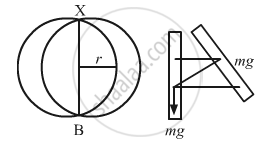
(a) Time period of compound pendulum \[\left( T \right)\] is given by ,
\[T = 2\sqrt{\frac{I}{mgl}} = 2\sqrt{\frac{I}{mgr}}\]
\[\left( \because l = r \right)\] ...(1)
Moment of inertia about the point of suspension is calculated as,
I = mr2 + mr2 = 2mr2
On substituting the value of moment of inertia I in equation (1), we get:
\[T = 2\pi\sqrt{\frac{2m r^2}{mgr}} = 2\pi\sqrt{\frac{2r}{g}}\]
\[ \Rightarrow \frac{2}{2\pi} = \sqrt{\frac{2r}{g}}\]
\[ \Rightarrow \frac{2r}{g} = \frac{1}{\pi^2}\]
\[ \Rightarrow r = \frac{g}{2 \pi^2}\]
\[ = 0 . 5 m = 50 cm\]
(b) From the energy equation, we have:
\[\frac{1}{2}I \omega^2 - 0 = mgr \left( 1 - \cos \theta \right)\]
\[\frac{1}{2}I \omega^2 - 0 = mgr \left( 1 - \cos 2^\circ \right)\]
\[\Rightarrow \left( \frac{1}{2} \right)2m r^2 \cdot \omega^2 = mgr\left( 1 - \cos 2^\circ\right) \left( \because I = 2m r^2 \right)\]
\[ \Rightarrow \omega^2 = \frac{g}{r}\left( 1 - \cos 2^\circ\right)\]
\[\text { On substituing the value of g and r in the above equation, we get:}\] \[\omega = 0 . 11 rad/s\]
\[ \Rightarrow v = \omega \times 2r = 11 {\text { cms }}^{- 1}\]
(c) The acceleration is found to be centripetal at the extreme position.
Centripetal acceleration at the extreme position \[\left( a_n \right)\] is given by,
an = ω2(2r) = (0.11) × 100 = 12 cm/s2
The direction of an is towards the point of suspension.
(d) The particle has zero centripetal acceleration at the extreme position. However, the particle will still have acceleration due to the S.H.M.
Angular frequency \[\left( \omega \right)\] is given by ,
\[\omega = \frac{2\pi}{T}\]
\[ = \frac{2\pi}{2} = 3 . 14\]
\[\therefore\] Angular Accelaration \[\left( a \right)\] at the extrame position is given as ,
\[\alpha = \omega^2 \theta\]
\[\alpha = \omega^2 2^\circ= \pi^2 \times \frac{2\pi}{180}\]
\[ = \frac{2 \pi^3}{180} \left[ 1^\circ= \frac{\pi}{180}\text { radian } \right]\]
Thus , tangential acceleration
\[= \alpha\left( 2r \right) = \left( \frac{2 \pi^3}{180} \right) \times 100\]
= 34 cm/s2
APPEARS IN
संबंधित प्रश्न
Which of the following relationships between the acceleration a and the displacement x of a particle involve simple harmonic motion?
(a) a = 0.7x
(b) a = –200x2
(c) a = –10x
(d) a = 100x3
A body of mass 1 kg is made to oscillate on a spring of force constant 16 N/m. Calculate:
a) Angular frequency
b) frequency of vibration.
Hence obtain the expression for acceleration, velocity and displacement of a particle performing linear S.H.M.
The time period of a particle in simple harmonic motion is equal to the smallest time between the particle acquiring a particular velocity \[\vec{v}\] . The value of v is
A particle moves in a circular path with a continuously increasing speed. Its motion is
Which of the following quantities are always negative in a simple harmonic motion?
(a) \[\vec{F} . \vec{a} .\]
(b) \[\vec{v} . \vec{r} .\]
(c) \[\vec{a} . \vec{r} .\]
(d)\[\vec{F} . \vec{r} .\]
Which of the following quantities are always positive in a simple harmonic motion?
An object is released from rest. The time it takes to fall through a distance h and the speed of the object as it falls through this distance are measured with a pendulum clock. The entire apparatus is taken on the moon and the experiment is repeated
(a) the measured times are same
(b) the measured speeds are same
(c) the actual times in the fall are equal
(d) the actual speeds are equal
Which of the following will change the time period as they are taken to moon?
(a) A simple pendulum
(b) A physical pendulum
(c) A torsional pendulum
(d) A spring-mass system
A pendulum having time period equal to two seconds is called a seconds pendulum. Those used in pendulum clocks are of this type. Find the length of a second pendulum at a place where g = π2 m/s2.
A pendulum clock giving correct time at a place where g = 9.800 m/s2 is taken to another place where it loses 24 seconds during 24 hours. Find the value of g at this new place.
A spherical ball of mass m and radius r rolls without slipping on a rough concave surface of large radius R. It makes small oscillations about the lowest point. Find the time period.
Assume that a tunnel is dug across the earth (radius = R) passing through its centre. Find the time a particle takes to cover the length of the tunnel if (a) it is projected into the tunnel with a speed of \[\sqrt{gR}\] (b) it is released from a height R above the tunnel (c) it is thrown vertically upward along the length of tunnel with a speed of \[\sqrt{gR}\]
A particle is subjected to two simple harmonic motions given by x1 = 2.0 sin (100π t) and x2 = 2.0 sin (120 π t + π/3), where x is in centimeter and t in second. Find the displacement of the particle at (a) t = 0.0125, (b) t = 0.025.
A simple pendulum has a time period T1. When its point of suspension is moved vertically upwards according to as y = kt2, where y is the vertical distance covered and k = 1 ms−2, its time period becomes T2. Then, T `"T"_1^2/"T"_2^2` is (g = 10 ms−2)
What is an epoch?
Consider two simple harmonic motion along the x and y-axis having the same frequencies but different amplitudes as x = A sin (ωt + φ) (along x-axis) and y = B sin ωt (along y-axis). Then show that
`"x"^2/"A"^2 + "y"^2/"B"^2 - (2"xy")/"AB" cos φ = sin^2 φ`
and also discuss the special cases when
- φ = 0
- φ = π
- φ = `π/2`
- φ = `π/2` and A = B
- φ = `π/4`
Note: when a particle is subjected to two simple harmonic motions at right angle to each other the particle may move along different paths. Such paths are called Lissajous figures.
A container consist of hemispherical shell of radius 'r ' and cylindrical shell of height 'h' radius of same material and thickness. The maximum value h/r so that container remain stable equilibrium in the position shown (neglect friction) is ______.

If x = `5 sin (pi t + pi/3) m` represents the motion of a particle executing simple harmonic motion, the amplitude and time period of motion, respectively, are ______.
