Advertisements
Advertisements
प्रश्न
A closed circular wire hung on a nail in a wall undergoes small oscillations of amplitude 20 and time period 2 s. Find (a) the radius of the circular wire, (b) the speed of the particle farthest away from the point of suspension as it goes through its mean position, (c) the acceleration of this particle as it goes through its mean position and (d) the acceleration of this particle when it is at an extreme position. Take g = π2 m/s2.
Advertisements
उत्तर
It is given that:
Time period of oscillation, T = 2 s
Acceleration due to gravity, g =\[\pi^2\]ms−2
Let I be the moment of inertia of the circular wire having mass m and radius r.
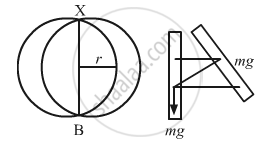
(a) Time period of compound pendulum \[\left( T \right)\] is given by ,
\[T = 2\sqrt{\frac{I}{mgl}} = 2\sqrt{\frac{I}{mgr}}\]
\[\left( \because l = r \right)\] ...(1)
Moment of inertia about the point of suspension is calculated as,
I = mr2 + mr2 = 2mr2
On substituting the value of moment of inertia I in equation (1), we get:
\[T = 2\pi\sqrt{\frac{2m r^2}{mgr}} = 2\pi\sqrt{\frac{2r}{g}}\]
\[ \Rightarrow \frac{2}{2\pi} = \sqrt{\frac{2r}{g}}\]
\[ \Rightarrow \frac{2r}{g} = \frac{1}{\pi^2}\]
\[ \Rightarrow r = \frac{g}{2 \pi^2}\]
\[ = 0 . 5 m = 50 cm\]
(b) From the energy equation, we have:
\[\frac{1}{2}I \omega^2 - 0 = mgr \left( 1 - \cos \theta \right)\]
\[\frac{1}{2}I \omega^2 - 0 = mgr \left( 1 - \cos 2^\circ \right)\]
\[\Rightarrow \left( \frac{1}{2} \right)2m r^2 \cdot \omega^2 = mgr\left( 1 - \cos 2^\circ\right) \left( \because I = 2m r^2 \right)\]
\[ \Rightarrow \omega^2 = \frac{g}{r}\left( 1 - \cos 2^\circ\right)\]
\[\text { On substituing the value of g and r in the above equation, we get:}\] \[\omega = 0 . 11 rad/s\]
\[ \Rightarrow v = \omega \times 2r = 11 {\text { cms }}^{- 1}\]
(c) The acceleration is found to be centripetal at the extreme position.
Centripetal acceleration at the extreme position \[\left( a_n \right)\] is given by,
an = ω2(2r) = (0.11) × 100 = 12 cm/s2
The direction of an is towards the point of suspension.
(d) The particle has zero centripetal acceleration at the extreme position. However, the particle will still have acceleration due to the S.H.M.
Angular frequency \[\left( \omega \right)\] is given by ,
\[\omega = \frac{2\pi}{T}\]
\[ = \frac{2\pi}{2} = 3 . 14\]
\[\therefore\] Angular Accelaration \[\left( a \right)\] at the extrame position is given as ,
\[\alpha = \omega^2 \theta\]
\[\alpha = \omega^2 2^\circ= \pi^2 \times \frac{2\pi}{180}\]
\[ = \frac{2 \pi^3}{180} \left[ 1^\circ= \frac{\pi}{180}\text { radian } \right]\]
Thus , tangential acceleration
\[= \alpha\left( 2r \right) = \left( \frac{2 \pi^3}{180} \right) \times 100\]
= 34 cm/s2
APPEARS IN
संबंधित प्रश्न
Assuming the expression for displacement of a particle starting from extreme position, explain graphically the variation of velocity and acceleration w.r.t. time.
It is proposed to move a particle in simple harmonic motion on a rough horizontal surface by applying an external force along the line of motion. Sketch the graph of the applied force against the position of the particle. Note that the applied force has two values for a given position depending on whether the particle is moving in positive or negative direction.
Can the potential energy in a simple harmonic motion be negative? Will it be so if we choose zero potential energy at some point other than the mean position?
A pendulum clock gives correct time at the equator. Will it gain time or loose time as it is taken to the poles?
The motion of a particle is given by x = A sin ωt + B cos ωt. The motion of the particle is
A particle moves on the X-axis according to the equation x = A + B sin ωt. The motion is simple harmonic with amplitude
The average energy in one time period in simple harmonic motion is
A pendulum clock keeping correct time is taken to high altitudes,
Which of the following quantities are always zero in a simple harmonic motion?
(a) \[\vec{F} \times \vec{a} .\]
(b) \[\vec{v} \times \vec{r} .\]
(c) \[\vec{a} \times \vec{r} .\]
(d) \[\vec{F} \times \vec{r} .\]
The angle made by the string of a simple pendulum with the vertical depends on time as \[\theta = \frac{\pi}{90} \sin \left[ \left( \pi s^{- 1} \right)t \right]\] .Find the length of the pendulum if g = π2 m2.
A simple pendulum of length 1 feet suspended from the ceiling of an elevator takes π/3 seconds to complete one oscillation. Find the acceleration of the elevator.
A particle executing SHM crosses points A and B with the same velocity. Having taken 3 s in passing from A to B, it returns to B after another 3 s. The time period is ____________.
The length of a second’s pendulum on the surface of the Earth is 0.9 m. The length of the same pendulum on the surface of planet X such that the acceleration of the planet X is n times greater than the Earth is
Consider the Earth as a homogeneous sphere of radius R and a straight hole is bored in it through its centre. Show that a particle dropped into the hole will execute a simple harmonic motion such that its time period is
T = `2π sqrt("R"/"g")`
A spring is stretched by 5 cm by a force of 10 N. The time period of the oscillations when a mass of 2 kg is suspended by it is ______.
The displacement of a particle varies with time according to the relation y = a sin ωt + b cos ωt.
The velocities of a particle in SHM at positions x1 and x2 are v1 and v2 respectively, its time period will be ______.
If x = `5 sin (pi t + pi/3) m` represents the motion of a particle executing simple harmonic motion, the amplitude and time period of motion, respectively, are ______.
