Advertisements
Advertisements
प्रश्न
A simple pendulum of length 1 feet suspended from the ceiling of an elevator takes π/3 seconds to complete one oscillation. Find the acceleration of the elevator.
Advertisements
उत्तर
It is given that:
Length of the simple pendulum, l = 1 feet
Time period of simple pendulum, T = \[\frac{\pi}{3} s\] Acceleration due to gravity, g = 32 ft/s2

Let a be the acceleration of the elevator while moving upwards.
Driving force \[\left( f \right)\] is given by,
f = m(g + a)sinθ
Comparing the above equation with the expression, f = ma, we get:
Acceleration, a = (g + a)sinθ = (g +a)θ (For small angle θ, sin θ → θ)
\[= \frac{\left( g + a \right)x}{l} = \omega^2 x\] (From the diagram \[\theta = \frac{x}{l}\])
\[\Rightarrow \omega = \sqrt{\frac{\left( g + a \right)}{l}}\]
Time Period \[\left( T \right)\] is given as,
\[T = 2\pi\sqrt{\frac{l}{g + a}}\]
On substituting the respective values in the above formula, we get:
\[\frac{\pi}{3} = 2\pi\sqrt{\frac{1}{32 + a}}\]
\[\frac{1}{9} = 4\left( \frac{1}{32 + a} \right)\]
\[ \Rightarrow 32 + a = 36\]
\[ \Rightarrow a = 36 - 32 = 4 ft/ s^2\]
APPEARS IN
संबंधित प्रश्न
A particle in S.H.M. has a period of 2 seconds and amplitude of 10 cm. Calculate the acceleration when it is at 4 cm from its positive extreme position.
The average displacement over a period of S.H.M. is ______.
(A = amplitude of S.H.M.)
Which of the following relationships between the acceleration a and the displacement x of a particle involve simple harmonic motion?
(a) a = 0.7x
(b) a = –200x2
(c) a = –10x
(d) a = 100x3
A particle executes simple harmonic motion Let P be a point near the mean position and Q be a point near an extreme. The speed of the particle at P is larger than the speed at Q. Still the particle crosses Pand Q equal number of times in a given time interval. Does it make you unhappy?
A pendulum clock gives correct time at the equator. Will it gain time or loose time as it is taken to the poles?
Can a pendulum clock be used in an earth-satellite?
A student says that he had applied a force \[F = - k\sqrt{x}\] on a particle and the particle moved in simple harmonic motion. He refuses to tell whether k is a constant or not. Assume that he was worked only with positive x and no other force acted on the particle.
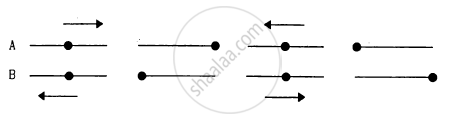
Figure represents two simple harmonic motions.
The parameter which has different values in the two motions is
A pendulum clock that keeps correct time on the earth is taken to the moon. It will run
Which of the following quantities are always positive in a simple harmonic motion?
In a simple harmonic motion
The pendulum of a certain clock has time period 2.04 s. How fast or slow does the clock run during 24 hours?
A simple pendulum of length 40 cm is taken inside a deep mine. Assume for the time being that the mine is 1600 km deep. Calculate the time period of the pendulum there. Radius of the earth = 6400 km.
A simple pendulum of length l is suspended through the ceiling of an elevator. Find the time period of small oscillations if the elevator (a) is going up with and acceleration a0(b) is going down with an acceleration a0 and (c) is moving with a uniform velocity.
A uniform rod of length l is suspended by an end and is made to undergo small oscillations. Find the length of the simple pendulum having the time period equal to that of the road.
Define the time period of simple harmonic motion.
What is the ratio of maxmimum acceleration to the maximum velocity of a simple harmonic oscillator?
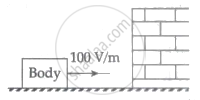
A body having specific charge 8 µC/g is resting on a frictionless plane at a distance 10 cm from the wall (as shown in the figure). It starts moving towards the wall when a uniform electric field of 100 V/m is applied horizontally toward the wall. If the collision of the body with the wall is perfectly elastic, then the time period of the motion will be ______ s.
Which of the following expressions corresponds to simple harmonic motion along a straight line, where x is the displacement and a, b, and c are positive constants?
