Advertisements
Advertisements
प्रश्न
A small block oscillates back and forth on a smooth concave surface of radius R ib Figure . Find the time period of small oscillation.
Advertisements
उत्तर
The maximum tension in the string of an oscillating pendulum is double of the minimum tension. Find the angular amplitude.

Let the speed of bob of the pendulum at an angle \[\theta\] be v.
Using the principle of conservation of energy between the mean and extreme positions, we get:
\[\frac{1}{2}\]mv2 − 0 = mgl(1 − cos θ)
v2 = 2gl(1 − cos θ) ...(1)
In a moving pendulum, the tension is maximum at the mean position, whereas it is minimum at the extreme position.
Maximum tension at the mean position is given by
Tmax = mg + 2mg(1 − cos θ)
Minimum tension at the extreme position is given by
Tmin = m g cosθ
According to the question,
Tmax = 2Tmin
⇒ mg + 2mg − 2m g cosθ = 2m g cosθ
⇒ 3mg = 4 mg cosθ
\[\Rightarrow \cos \theta = \frac{3}{4}\]
\[ \Rightarrow \theta = \cos^{- 1} \frac{3}{4}\]
APPEARS IN
संबंधित प्रश्न
Assuming the expression for displacement of a particle starting from extreme position, explain graphically the variation of velocity and acceleration w.r.t. time.
Show variation of displacement, velocity, and acceleration with phase for a particle performing linear S.H.M. graphically, when it starts from the extreme position.
Can simple harmonic motion take place in a non-inertial frame? If yes, should the ratio of the force applied with the displacement be constant?
A particle executes simple harmonic motion. If you are told that its velocity at this instant is zero, can you say what is its displacement? If you are told that its velocity at this instant is maximum, can you say what is its displacement?
Can the potential energy in a simple harmonic motion be negative? Will it be so if we choose zero potential energy at some point other than the mean position?
A pendulum clock gives correct time at the equator. Will it gain time or loose time as it is taken to the poles?
The distance moved by a particle in simple harmonic motion in one time period is
A pendulum clock keeping correct time is taken to high altitudes,
Which of the following quantities are always negative in a simple harmonic motion?
(a) \[\vec{F} . \vec{a} .\]
(b) \[\vec{v} . \vec{r} .\]
(c) \[\vec{a} . \vec{r} .\]
(d)\[\vec{F} . \vec{r} .\]
Which of the following quantities are always zero in a simple harmonic motion?
(a) \[\vec{F} \times \vec{a} .\]
(b) \[\vec{v} \times \vec{r} .\]
(c) \[\vec{a} \times \vec{r} .\]
(d) \[\vec{F} \times \vec{r} .\]
For a particle executing simple harmonic motion, the acceleration is proportional to
In a simple harmonic motion
A pendulum having time period equal to two seconds is called a seconds pendulum. Those used in pendulum clocks are of this type. Find the length of a second pendulum at a place where g = π2 m/s2.
A spherical ball of mass m and radius r rolls without slipping on a rough concave surface of large radius R. It makes small oscillations about the lowest point. Find the time period.
Three simple harmonic motions of equal amplitude A and equal time periods in the same direction combine. The phase of the second motion is 60° ahead of the first and the phase of the third motion is 60° ahead of the second. Find the amplitude of the resultant motion.
Define the time period of simple harmonic motion.
What is an epoch?
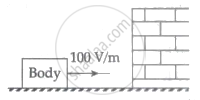
A body having specific charge 8 µC/g is resting on a frictionless plane at a distance 10 cm from the wall (as shown in the figure). It starts moving towards the wall when a uniform electric field of 100 V/m is applied horizontally toward the wall. If the collision of the body with the wall is perfectly elastic, then the time period of the motion will be ______ s.
Assume there are two identical simple pendulum clocks. Clock - 1 is placed on the earth and Clock - 2 is placed on a space station located at a height h above the earth's surface. Clock - 1 and Clock - 2 operate at time periods 4 s and 6 s respectively. Then the value of h is ______.
(consider the radius of earth RE = 6400 km and g on earth 10 m/s2)
