Advertisements
Advertisements
प्रश्न
A particle is subjected to two simple harmonic motions of same time period in the same direction. The amplitude of the first motion is 3.0 cm and that of the second is 4.0 cm. Find the resultant amplitude if the phase difference between the motions is (a) 0°, (b) 60°, (c) 90°.
Advertisements
उत्तर
It is given that a particle is subjected to two S.H.M.s of same time period in the same direction.
Amplitude of first motion, A1 = 3 cm
Amplitude of second motion, A2 = 4 cm
Let ϕ be the phase difference.
The resultant amplitude \[\left( R \right)\] is given by,
\[R = \sqrt{A_1^2 + A_2^2 + 2 A_1 A_2 cos \phi}\]
(a) When ϕ = 0°
\[R = \sqrt{\left( 3^2 + 4^2 + \left( 2 \right)\left( 3 \right)\left( 4 \right) \cos 0^\circ\right)}\]
\[ = 7 \text { cm }\]
(b) When ϕ = 60°
\[R = \sqrt{3^2 + 4^2 + \left( 2 \right)\left( 3 \right)\left( 4 \right) \cos 60^\circ}\]
\[ = \sqrt{37} = 6 . 1 \text { cm }\]
(c) When ϕ = 90°
\[R = \sqrt{\left( 3^2 + 4^2 + \left( 2 \right)\left( 3 \right)\left( 4 \right)\cos 90^\circ\right)}\]
\[ = \sqrt{25} = 5 \text { cm }\]
APPEARS IN
संबंधित प्रश्न
A body of mass 1 kg is made to oscillate on a spring of force constant 16 N/m. Calculate:
a) Angular frequency
b) frequency of vibration.
It is proposed to move a particle in simple harmonic motion on a rough horizontal surface by applying an external force along the line of motion. Sketch the graph of the applied force against the position of the particle. Note that the applied force has two values for a given position depending on whether the particle is moving in positive or negative direction.
A pendulum clock gives correct time at the equator. Will it gain time or loose time as it is taken to the poles?
A platoon of soldiers marches on a road in steps according to the sound of a marching band. The band is stopped and the soldiers are ordered to break the steps while crossing a bridge. Why?
The displacement of a particle is given by \[\overrightarrow{r} = A\left( \overrightarrow{i} \cos\omega t + \overrightarrow{j} \sin\omega t \right) .\] The motion of the particle is
A particle moves on the X-axis according to the equation x = A + B sin ωt. The motion is simple harmonic with amplitude
For a particle executing simple harmonic motion, the acceleration is proportional to
A particle moves in the X-Y plane according to the equation \[\overrightarrow{r} = \left( \overrightarrow{i} + 2 \overrightarrow{j} \right)A\cos\omega t .\]
The motion of the particle is
(a) on a straight line
(b) on an ellipse
(c) periodic
(d) simple harmonic
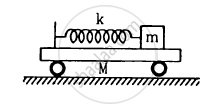
All the surfaces shown in figure are frictionless. The mass of the care is M, that of the block is m and the spring has spring constant k. Initially the car and the block are at rest and the spring is stretched through a length x0 when the system is released. (a) Find the amplitudes of the simple harmonic motion of the block and of the care as seen from the road. (b) Find the time period(s) of the two simple harmonic motions.
A small block oscillates back and forth on a smooth concave surface of radius R ib Figure . Find the time period of small oscillation.
A simple pendulum of length l is suspended through the ceiling of an elevator. Find the time period of small oscillations if the elevator (a) is going up with and acceleration a0(b) is going down with an acceleration a0 and (c) is moving with a uniform velocity.
A closed circular wire hung on a nail in a wall undergoes small oscillations of amplitude 20 and time period 2 s. Find (a) the radius of the circular wire, (b) the speed of the particle farthest away from the point of suspension as it goes through its mean position, (c) the acceleration of this particle as it goes through its mean position and (d) the acceleration of this particle when it is at an extreme position. Take g = π2 m/s2.
A particle is subjected to two simple harmonic motions given by x1 = 2.0 sin (100π t) and x2 = 2.0 sin (120 π t + π/3), where x is in centimeter and t in second. Find the displacement of the particle at (a) t = 0.0125, (b) t = 0.025.
In a simple harmonic oscillation, the acceleration against displacement for one complete oscillation will be __________.
What is meant by simple harmonic oscillation? Give examples and explain why every simple harmonic motion is a periodic motion whereas the converse need not be true.
Describe Simple Harmonic Motion as a projection of uniform circular motion.
A body oscillates with SHM according to the equation x = 5 cos `(2π"t" + π/4)`. Its instantaneous displacement at t = 1 sec is:
Displacement vs. time curve for a particle executing S.H.M. is shown in figure. Choose the correct statements.

- Phase of the oscillator is same at t = 0 s and t = 2s.
- Phase of the oscillator is same at t = 2 s and t = 6s.
- Phase of the oscillator is same at t = 1 s and t = 7s.
- Phase of the oscillator is same at t = 1 s and t = 5s.
What is the ratio of maxmimum acceleration to the maximum velocity of a simple harmonic oscillator?
The velocities of a particle in SHM at positions x1 and x2 are v1 and v2 respectively, its time period will be ______.
