Advertisements
Advertisements
प्रश्न
Assume that a tunnel is dug across the earth (radius = R) passing through its centre. Find the time a particle takes to cover the length of the tunnel if (a) it is projected into the tunnel with a speed of \[\sqrt{gR}\] (b) it is released from a height R above the tunnel (c) it is thrown vertically upward along the length of tunnel with a speed of \[\sqrt{gR}\]
Advertisements
उत्तर
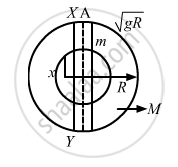
Given:
Radius of the earth is R.
Let M be the total mass of the earth and \[\rho\] be the density.
Let mass of the part of earth having radius x be M.
\[\therefore \frac{M'}{M} = \frac{\rho \times \frac{4}{3}\pi x^3}{\rho \times \frac{4}{3}\pi R^3} = \frac{x^3}{R^3}\]
\[ \Rightarrow M' = \frac{M x^3}{R^3}\]
Force on the particle is calculated as,
\[F_x = \frac{GM'm}{x^2}\]
\[ = \frac{GMm}{R^3}x \ldots\left( 1 \right)\]
Now, acceleration \[\left( a_x \right)\] of mass M' at that position is given by,
\[a_x = \frac{GM}{R^3}x\]
\[ \Rightarrow \frac{a_x}{x} = \omega^2 = \frac{GM}{R^3} = \frac{g}{R} \left( \because g = \frac{GM}{R^2} \right)\]
\[\text{So, Time period of oscillation ,} T = 2\pi\sqrt{\left( \frac{R}{g} \right)}\]
(a) Velocity-displacement equation in S.H.M is written as,
\[V = \omega\sqrt{\left( A^2 - y^2 \right)} \]
where, A is the amplitude; and y is the displacement .
When the particle is at y = R,
The velocity of the particle is \[\sqrt{gR}\] and \[\omega = \sqrt{\frac{g}{R}}\]
On substituting these values in the velocity-displacement equation, we get:
\[\sqrt{gR} = \sqrt{\frac{g}{R}}\sqrt{A^2 - R^2} \]
\[ \Rightarrow R^2 = A^2 - R^2 \]
\[ \Rightarrow A = \sqrt{2R}\]
Let t1 and t2 be the time taken by the particle to reach the positions X and Y.
Now, phase of the particle at point X will be greater than \[\frac{\pi}{2}\] but less than \[\pi\]
Also, the phase of the particle on reaching Y will be greater than \[\pi\] but less than \[\frac{3\pi}{2}\]
Displacement-time relation is given by,
y = A sin ωt
Substituting y = R and A =\[\sqrt{2R}\] , in the above relation , we get :
\[R = \sqrt{2}R \sin \omega t_1\]
\[\Rightarrow \omega t_1 = \frac{3\pi}{4}\]
Also,
\[R = \sqrt{2}R \sin \omega t_2\]
\[\Rightarrow \omega t_2 = \frac{5\pi}{4}\]
\[\text{So}, \omega\left( t_2 - t_1 \right) = \frac{\pi}{2}\]
\[ \Rightarrow t_2 - t_1 = \frac{\pi}{2\omega} = \frac{\pi}{2\left( \sqrt{\frac{g}{R}} \right)}\]
Time taken by the particle to travel from X to Y:
Using the principle of conservation of energy, we get:
Change in P.E. = Gain in K.E.
\[\Rightarrow \frac{GMm}{R} - \frac{GMm}{2R} = \frac{1}{2}m v^2 \]
\[ \Rightarrow v = \sqrt{\left( gR \right)}\]
As the velocity is same as that at X, the body will take the same time to travel XY.
(c) The body is projected vertically upwards from the point X with a velocity \[\sqrt{gR}\].Its velocity becomes zero as it reaches the highest point.
The velocity of the body as it reaches X again will be,
\[v = \sqrt{\left( gR \right)}\]
Hence, the body will take same time i.e.
APPEARS IN
संबंधित प्रश्न
A particle executes simple harmonic motion. If you are told that its velocity at this instant is zero, can you say what is its displacement? If you are told that its velocity at this instant is maximum, can you say what is its displacement?
A hollow sphere filled with water is used as the bob of a pendulum. Assume that the equation for simple pendulum is valid with the distance between the point of suspension and centre of mass of the bob acting as the effective length of the pendulum. If water slowly leaks out of the bob, how will the time period vary?
The motion of a particle is given by x = A sin ωt + B cos ωt. The motion of the particle is
A pendulum clock keeping correct time is taken to high altitudes,
Which of the following will change the time period as they are taken to moon?
(a) A simple pendulum
(b) A physical pendulum
(c) A torsional pendulum
(d) A spring-mass system
A pendulum clock giving correct time at a place where g = 9.800 m/s2 is taken to another place where it loses 24 seconds during 24 hours. Find the value of g at this new place.
A spherical ball of mass m and radius r rolls without slipping on a rough concave surface of large radius R. It makes small oscillations about the lowest point. Find the time period.
A simple pendulum of length l is suspended through the ceiling of an elevator. Find the time period of small oscillations if the elevator (a) is going up with and acceleration a0(b) is going down with an acceleration a0 and (c) is moving with a uniform velocity.
A simple pendulum fixed in a car has a time period of 4 seconds when the car is moving uniformly on a horizontal road. When the accelerator is pressed, the time period changes to 3.99 seconds. Making an approximate analysis, find the acceleration of the car.
In a simple harmonic oscillation, the acceleration against displacement for one complete oscillation will be __________.
A particle executing SHM crosses points A and B with the same velocity. Having taken 3 s in passing from A to B, it returns to B after another 3 s. The time period is ____________.
If the inertial mass and gravitational mass of the simple pendulum of length l are not equal, then the time period of the simple pendulum is
What is an epoch?
Describe Simple Harmonic Motion as a projection of uniform circular motion.
A body oscillates with SHM according to the equation x = 5 cos `(2π"t" + π/4)`. Its instantaneous displacement at t = 1 sec is:
A spring is stretched by 5 cm by a force of 10 N. The time period of the oscillations when a mass of 2 kg is suspended by it is ______
The displacement of a particle is represented by the equation y = sin3ωt. The motion is ______.
The displacement of a particle varies with time according to the relation y = a sin ωt + b cos ωt.
The velocities of a particle in SHM at positions x1 and x2 are v1 and v2 respectively, its time period will be ______.
A container consist of hemispherical shell of radius 'r ' and cylindrical shell of height 'h' radius of same material and thickness. The maximum value h/r so that container remain stable equilibrium in the position shown (neglect friction) is ______.

