Advertisements
Advertisements
प्रश्न
A simple pendulum of length 40 cm is taken inside a deep mine. Assume for the time being that the mine is 1600 km deep. Calculate the time period of the pendulum there. Radius of the earth = 6400 km.
Advertisements
उत्तर
It is given that:
Length of the pendulum, l = 40 cm = 0.4 m
Radius of the earth, R = 6400 km
Acceleration due to gravity on the earth's surface, `g = 9.8 "ms"^(- 2)`
Let
\[g'\] be the acceleration due to gravity at a depth of 1600 km from the surface of the earth.
Its value is given by,
\[g' = g\left( 1 - \frac{d}{R} \right)\] \[\text{where d is the depth from the earth surfce, }\] \[\text { R is the radius of earth, and }\]
\[\text {g is acceleration due to gravity .}\]
\[\text{ On substituting the respective values, we get: }\] \[ g' = 9 . 8\left( 1 - \frac{1600}{6400} \right)\]
\[= 9 . 8\left( 1 - \frac{1}{4} \right)\]
\[= 9 . 8 \times \left( \frac{3}{4} \right) = 7 . 35 {\text{ms}}^{- 2}\]
Time period is given as,
\[\Rightarrow T = 2\pi\sqrt{\left( \frac{0 . 4}{7 . 35} \right)}\]
\[ \Rightarrow T = 2 \times 3 . 14 \times 0 . 23\]
\[ = 1 . 465 \approx 1 . 47 s\]
APPEARS IN
संबंधित प्रश्न
Assuming the expression for displacement of a particle starting from extreme position, explain graphically the variation of velocity and acceleration w.r.t. time.
State the differential equation of linear simple harmonic motion.
Hence obtain the expression for acceleration, velocity and displacement of a particle performing linear S.H.M.
Can simple harmonic motion take place in a non-inertial frame? If yes, should the ratio of the force applied with the displacement be constant?
The force acting on a particle moving along X-axis is F = −k(x − vo t) where k is a positive constant. An observer moving at a constant velocity v0 along the X-axis looks at the particle. What kind of motion does he find for the particle?
The distance moved by a particle in simple harmonic motion in one time period is
A wall clock uses a vertical spring-mass system to measure the time. Each time the mass reaches an extreme position, the clock advances by a second. The clock gives correct time at the equator. If the clock is taken to the poles it will
A pendulum clock keeping correct time is taken to high altitudes,
An object is released from rest. The time it takes to fall through a distance h and the speed of the object as it falls through this distance are measured with a pendulum clock. The entire apparatus is taken on the moon and the experiment is repeated
(a) the measured times are same
(b) the measured speeds are same
(c) the actual times in the fall are equal
(d) the actual speeds are equal
The angle made by the string of a simple pendulum with the vertical depends on time as \[\theta = \frac{\pi}{90} \sin \left[ \left( \pi s^{- 1} \right)t \right]\] .Find the length of the pendulum if g = π2 m2.
A closed circular wire hung on a nail in a wall undergoes small oscillations of amplitude 20 and time period 2 s. Find (a) the radius of the circular wire, (b) the speed of the particle farthest away from the point of suspension as it goes through its mean position, (c) the acceleration of this particle as it goes through its mean position and (d) the acceleration of this particle when it is at an extreme position. Take g = π2 m/s2.
A particle is subjected to two simple harmonic motions given by x1 = 2.0 sin (100π t) and x2 = 2.0 sin (120 π t + π/3), where x is in centimeter and t in second. Find the displacement of the particle at (a) t = 0.0125, (b) t = 0.025.
In a simple harmonic oscillation, the acceleration against displacement for one complete oscillation will be __________.
Write short notes on two springs connected in series.
A simple harmonic motion is given by, x = 2.4 sin ( 4πt). If distances are expressed in cm and time in seconds, the amplitude and frequency of S.H.M. are respectively,
A body oscillates with SHM according to the equation x = 5 cos `(2π"t" + π/4)`. Its instantaneous displacement at t = 1 sec is:
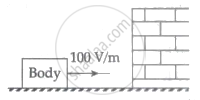
A body having specific charge 8 µC/g is resting on a frictionless plane at a distance 10 cm from the wall (as shown in the figure). It starts moving towards the wall when a uniform electric field of 100 V/m is applied horizontally toward the wall. If the collision of the body with the wall is perfectly elastic, then the time period of the motion will be ______ s.
The velocities of a particle in SHM at positions x1 and x2 are v1 and v2 respectively, its time period will be ______.
A container consist of hemispherical shell of radius 'r ' and cylindrical shell of height 'h' radius of same material and thickness. The maximum value h/r so that container remain stable equilibrium in the position shown (neglect friction) is ______.

