Advertisements
Advertisements
प्रश्न
A pendulum clock giving correct time at a place where g = 9.800 m/s2 is taken to another place where it loses 24 seconds during 24 hours. Find the value of g at this new place.
Advertisements
उत्तर
Let T1 be the time period of pendulum clock at a place where acceleration due to gravity \[\left( g_1 \right)\] is 9.8 ms−2.
Let T1 = 2 s
`g_1 = 9.8"ms"^(-2)`
Let T2 be the time period at the place where the pendulum clock loses 24 seconds during 24 hours.
Acceleration due to gravity at this place is \[\left( g_2 \right)\]
\[T_2 = \frac{24 \times 3600}{\frac{\left( 24 \times 3600 - 24 \right)}{2}}\]
\[ = 2 \times \frac{3600}{3599}\]
As
\[T \propto \frac{1}{\sqrt{g}}\]
\[\therefore \frac{T_1}{T_2} = \sqrt{\left( \frac{g_2}{g_1} \right)}\]
\[\Rightarrow \frac{g_2}{g_1} = \left( \frac{T_1}{T_2} \right)^2 \]
\[ \Rightarrow g_2 = \left( 9 . 8 \right) \left( \frac{3599}{3600} \right)^2 \]
\[ = 9 . 795 \text { m/ s}^2\]
APPEARS IN
संबंधित प्रश्न
Hence obtain the expression for acceleration, velocity and displacement of a particle performing linear S.H.M.
A particle executes simple harmonic motion. If you are told that its velocity at this instant is zero, can you say what is its displacement? If you are told that its velocity at this instant is maximum, can you say what is its displacement?
In measuring time period of a pendulum, it is advised to measure the time between consecutive passage through the mean position in the same direction. This is said to result in better accuracy than measuring time between consecutive passage through an extreme position. Explain.
Can the potential energy in a simple harmonic motion be negative? Will it be so if we choose zero potential energy at some point other than the mean position?
A hollow sphere filled with water is used as the bob of a pendulum. Assume that the equation for simple pendulum is valid with the distance between the point of suspension and centre of mass of the bob acting as the effective length of the pendulum. If water slowly leaks out of the bob, how will the time period vary?
The average energy in one time period in simple harmonic motion is
For a particle executing simple harmonic motion, the acceleration is proportional to
In a simple harmonic motion
In a simple harmonic motion
(a) the maximum potential energy equals the maximum kinetic energy
(b) the minimum potential energy equals the minimum kinetic energy
(c) the minimum potential energy equals the maximum kinetic energy
(d) the maximum potential energy equals the minimum kinetic energy
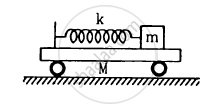
All the surfaces shown in figure are frictionless. The mass of the care is M, that of the block is m and the spring has spring constant k. Initially the car and the block are at rest and the spring is stretched through a length x0 when the system is released. (a) Find the amplitudes of the simple harmonic motion of the block and of the care as seen from the road. (b) Find the time period(s) of the two simple harmonic motions.
Assume that a tunnel is dug across the earth (radius = R) passing through its centre. Find the time a particle takes to cover the length of the tunnel if (a) it is projected into the tunnel with a speed of \[\sqrt{gR}\] (b) it is released from a height R above the tunnel (c) it is thrown vertically upward along the length of tunnel with a speed of \[\sqrt{gR}\]
A simple pendulum of length 1 feet suspended from the ceiling of an elevator takes π/3 seconds to complete one oscillation. Find the acceleration of the elevator.
A hollow sphere of radius 2 cm is attached to an 18 cm long thread to make a pendulum. Find the time period of oscillation of this pendulum. How does it differ from the time period calculated using the formula for a simple pendulum?
The length of a second’s pendulum on the surface of the Earth is 0.9 m. The length of the same pendulum on the surface of planet X such that the acceleration of the planet X is n times greater than the Earth is
Write short notes on two springs connected in series.
Describe Simple Harmonic Motion as a projection of uniform circular motion.
Consider two simple harmonic motion along the x and y-axis having the same frequencies but different amplitudes as x = A sin (ωt + φ) (along x-axis) and y = B sin ωt (along y-axis). Then show that
`"x"^2/"A"^2 + "y"^2/"B"^2 - (2"xy")/"AB" cos φ = sin^2 φ`
and also discuss the special cases when
- φ = 0
- φ = π
- φ = `π/2`
- φ = `π/2` and A = B
- φ = `π/4`
Note: when a particle is subjected to two simple harmonic motions at right angle to each other the particle may move along different paths. Such paths are called Lissajous figures.
A body having specific charge 8 µC/g is resting on a frictionless plane at a distance 10 cm from the wall (as shown in the figure). It starts moving towards the wall when a uniform electric field of 100 V/m is applied horizontally toward the wall. If the collision of the body with the wall is perfectly elastic, then the time period of the motion will be ______ s.

The velocities of a particle in SHM at positions x1 and x2 are v1 and v2 respectively, its time period will be ______.
