Advertisements
Advertisements
प्रश्न
Hence obtain the expression for acceleration, velocity and displacement of a particle performing linear S.H.M.
Advertisements
उत्तर
Hence obtain the expression for acceleration, velocity and displacement of a particle performing linear S.H.M.
The differential equation of linear SHM is `(d^2vecx)/(dt^2) + k/m vecx = 0` where m = mass of the particle performing SHM.
(d^2vecx)/(dt)^2 = acceleration of the particle when its displacement from the mean position is `vecx` and k = force constant. For linear motion, we can write the differential equation in scalar form :
`(d^2x)/(dt^2) + k/m x = 0`
Let `k/m = omega^2` , a constant
`:. (d^2x)/(dt^2) + omega^2x = 0`
∴ Acceleration, a = `(d^2x)/(dt^2) = -omega^2x` ....(1).
The minus sign shows that the acceleration and the displacement have opposite directions. Writing
v = `(dx)/(dt)` as the velocity of the particle.
`a = (d^2x)/(dt^2) = (dv)/(dt) = (dv)/(dx)xx(dx)/(dt) = (dv)/(dx) = v = v (dv)/(dx)`
Hence, Eq. (1) can be written as
`v(dv)/(dx) = -omega^2x`
∴ `vdv = -omega^2x`
Integrating this expression, we get
`v^2/2 = (-omega^2x^2)/2 + C`
where the constant of integration C is found from a boundary condition.
At an extreme position (a turning point of the motion), the velocity of the particle is zero. Thus, v = 0 when x = ±A, where A is the amplitude.
`:. 0 = (-omega^2A^2)/2 + C` `:. C = (omega^2A^2)/2`
`:.v^2/2 = (-omega^2x^2)/2 + (omega^2A^2)/2`
`:. v^2 = omega^2(A^2 -x^2)`
`:.v = +- omegasqrt(A^2 - X^2)` ......(2)
This equation gives the velocity of the particle in terms of the displacement, x. The velocity towards right is taken to be positive and towards left as negative.
Since v = dx/dt we can write Eq. 2 as follows:
`(dx)/(dt) = omegasqrt(A^2 - x^2)`(considering only the plus sign)
`:. (dx)/(sqrt(A^2-x^2)) = omega dt`
Integrating the expression, we get,
`sin^(-1) (x/A) = omegat+x` ....(3)
where the constant of integration, x , is found from the initial conditions, i.e., the displacement and the
velocioty of the particle at time t = 0.
From Eq (3), we have
`x/A= sin(omegat + x)`
∴ Displacement as a function of time is, x = Asin (ωt + x).
APPEARS IN
संबंधित प्रश्न
In a damped harmonic oscillator, periodic oscillations have _______ amplitude.
(A) gradually increasing
(B) suddenly increasing
(C) suddenly decreasing
(D) gradually decreasing
A particle executes S.H.M. with a period of 10 seconds. Find the time in which its potential energy will be half of its total energy.
A body of mass 1 kg is made to oscillate on a spring of force constant 16 N/m. Calculate:
a) Angular frequency
b) frequency of vibration.
Show variation of displacement, velocity, and acceleration with phase for a particle performing linear S.H.M. graphically, when it starts from the extreme position.
A small creature moves with constant speed in a vertical circle on a bright day. Does its shadow formed by the sun on a horizontal plane move in a sample harmonic motion?
It is proposed to move a particle in simple harmonic motion on a rough horizontal surface by applying an external force along the line of motion. Sketch the graph of the applied force against the position of the particle. Note that the applied force has two values for a given position depending on whether the particle is moving in positive or negative direction.
Can the potential energy in a simple harmonic motion be negative? Will it be so if we choose zero potential energy at some point other than the mean position?
A block of known mass is suspended from a fixed support through a light spring. Can you find the time period of vertical oscillation only by measuring the extension of the spring when the block is in equilibrium?
A platoon of soldiers marches on a road in steps according to the sound of a marching band. The band is stopped and the soldiers are ordered to break the steps while crossing a bridge. Why?
The time period of a particle in simple harmonic motion is equal to the smallest time between the particle acquiring a particular velocity \[\vec{v}\] . The value of v is
The displacement of a particle in simple harmonic motion in one time period is
A wall clock uses a vertical spring-mass system to measure the time. Each time the mass reaches an extreme position, the clock advances by a second. The clock gives correct time at the equator. If the clock is taken to the poles it will
A pendulum clock keeping correct time is taken to high altitudes,
A pendulum clock keeping correct time is taken to high altitudes,
A particle moves in a circular path with a continuously increasing speed. Its motion is
Which of the following quantities are always zero in a simple harmonic motion?
(a) \[\vec{F} \times \vec{a} .\]
(b) \[\vec{v} \times \vec{r} .\]
(c) \[\vec{a} \times \vec{r} .\]
(d) \[\vec{F} \times \vec{r} .\]
For a particle executing simple harmonic motion, the acceleration is proportional to
In a simple harmonic motion
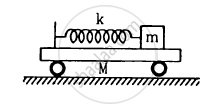
All the surfaces shown in figure are frictionless. The mass of the care is M, that of the block is m and the spring has spring constant k. Initially the car and the block are at rest and the spring is stretched through a length x0 when the system is released. (a) Find the amplitudes of the simple harmonic motion of the block and of the care as seen from the road. (b) Find the time period(s) of the two simple harmonic motions.
A simple pendulum of length 40 cm is taken inside a deep mine. Assume for the time being that the mine is 1600 km deep. Calculate the time period of the pendulum there. Radius of the earth = 6400 km.
Assume that a tunnel is dug across the earth (radius = R) passing through its centre. Find the time a particle takes to cover the length of the tunnel if (a) it is projected into the tunnel with a speed of \[\sqrt{gR}\] (b) it is released from a height R above the tunnel (c) it is thrown vertically upward along the length of tunnel with a speed of \[\sqrt{gR}\]
A uniform rod of length l is suspended by an end and is made to undergo small oscillations. Find the length of the simple pendulum having the time period equal to that of the road.
A simple pendulum of length l is suspended from the ceiling of a car moving with a speed v on a circular horizontal road of radius r. (a) Find the tension in the string when it is at rest with respect to the car. (b) Find the time period of small oscillation.
Three simple harmonic motions of equal amplitude A and equal time periods in the same direction combine. The phase of the second motion is 60° ahead of the first and the phase of the third motion is 60° ahead of the second. Find the amplitude of the resultant motion.
In a simple harmonic oscillation, the acceleration against displacement for one complete oscillation will be __________.
Write short notes on two springs connected in series.
A body oscillates with SHM according to the equation x = 5 cos `(2π"t" + π/4)`. Its instantaneous displacement at t = 1 sec is:
The displacement of a particle is represented by the equation y = sin3ωt. The motion is ______.
Displacement vs. time curve for a particle executing S.H.M. is shown in figure. Choose the correct statements.

- Phase of the oscillator is same at t = 0 s and t = 2s.
- Phase of the oscillator is same at t = 2 s and t = 6s.
- Phase of the oscillator is same at t = 1 s and t = 7s.
- Phase of the oscillator is same at t = 1 s and t = 5s.
