Advertisements
Advertisements
Question
Hence obtain the expression for acceleration, velocity and displacement of a particle performing linear S.H.M.
Advertisements
Solution
Hence obtain the expression for acceleration, velocity and displacement of a particle performing linear S.H.M.
The differential equation of linear SHM is `(d^2vecx)/(dt^2) + k/m vecx = 0` where m = mass of the particle performing SHM.
(d^2vecx)/(dt)^2 = acceleration of the particle when its displacement from the mean position is `vecx` and k = force constant. For linear motion, we can write the differential equation in scalar form :
`(d^2x)/(dt^2) + k/m x = 0`
Let `k/m = omega^2` , a constant
`:. (d^2x)/(dt^2) + omega^2x = 0`
∴ Acceleration, a = `(d^2x)/(dt^2) = -omega^2x` ....(1).
The minus sign shows that the acceleration and the displacement have opposite directions. Writing
v = `(dx)/(dt)` as the velocity of the particle.
`a = (d^2x)/(dt^2) = (dv)/(dt) = (dv)/(dx)xx(dx)/(dt) = (dv)/(dx) = v = v (dv)/(dx)`
Hence, Eq. (1) can be written as
`v(dv)/(dx) = -omega^2x`
∴ `vdv = -omega^2x`
Integrating this expression, we get
`v^2/2 = (-omega^2x^2)/2 + C`
where the constant of integration C is found from a boundary condition.
At an extreme position (a turning point of the motion), the velocity of the particle is zero. Thus, v = 0 when x = ±A, where A is the amplitude.
`:. 0 = (-omega^2A^2)/2 + C` `:. C = (omega^2A^2)/2`
`:.v^2/2 = (-omega^2x^2)/2 + (omega^2A^2)/2`
`:. v^2 = omega^2(A^2 -x^2)`
`:.v = +- omegasqrt(A^2 - X^2)` ......(2)
This equation gives the velocity of the particle in terms of the displacement, x. The velocity towards right is taken to be positive and towards left as negative.
Since v = dx/dt we can write Eq. 2 as follows:
`(dx)/(dt) = omegasqrt(A^2 - x^2)`(considering only the plus sign)
`:. (dx)/(sqrt(A^2-x^2)) = omega dt`
Integrating the expression, we get,
`sin^(-1) (x/A) = omegat+x` ....(3)
where the constant of integration, x , is found from the initial conditions, i.e., the displacement and the
velocioty of the particle at time t = 0.
From Eq (3), we have
`x/A= sin(omegat + x)`
∴ Displacement as a function of time is, x = Asin (ωt + x).
APPEARS IN
RELATED QUESTIONS
Which of the following relationships between the acceleration a and the displacement x of a particle involve simple harmonic motion?
(a) a = 0.7x
(b) a = –200x2
(c) a = –10x
(d) a = 100x3
A particle executes S.H.M. with a period of 10 seconds. Find the time in which its potential energy will be half of its total energy.
Can the potential energy in a simple harmonic motion be negative? Will it be so if we choose zero potential energy at some point other than the mean position?
The energy of system in simple harmonic motion is given by \[E = \frac{1}{2}m \omega^2 A^2 .\] Which of the following two statements is more appropriate?
(A) The energy is increased because the amplitude is increased.
(B) The amplitude is increased because the energy is increased.
A hollow sphere filled with water is used as the bob of a pendulum. Assume that the equation for simple pendulum is valid with the distance between the point of suspension and centre of mass of the bob acting as the effective length of the pendulum. If water slowly leaks out of the bob, how will the time period vary?
The time period of a particle in simple harmonic motion is equal to the smallest time between the particle acquiring a particular velocity \[\vec{v}\] . The value of v is
The motion of a particle is given by x = A sin ωt + B cos ωt. The motion of the particle is
A pendulum clock keeping correct time is taken to high altitudes,
The motion of a torsional pendulum is
(a) periodic
(b) oscillatory
(c) simple harmonic
(d) angular simple harmonic
A particle moves in the X-Y plane according to the equation \[\overrightarrow{r} = \left( \overrightarrow{i} + 2 \overrightarrow{j} \right)A\cos\omega t .\]
The motion of the particle is
(a) on a straight line
(b) on an ellipse
(c) periodic
(d) simple harmonic
A particle moves on the X-axis according to the equation x = x0 sin2 ωt. The motion is simple harmonic
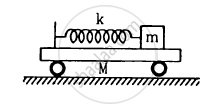
All the surfaces shown in figure are frictionless. The mass of the care is M, that of the block is m and the spring has spring constant k. Initially the car and the block are at rest and the spring is stretched through a length x0 when the system is released. (a) Find the amplitudes of the simple harmonic motion of the block and of the care as seen from the road. (b) Find the time period(s) of the two simple harmonic motions.
The angle made by the string of a simple pendulum with the vertical depends on time as \[\theta = \frac{\pi}{90} \sin \left[ \left( \pi s^{- 1} \right)t \right]\] .Find the length of the pendulum if g = π2 m2.
A small block oscillates back and forth on a smooth concave surface of radius R ib Figure . Find the time period of small oscillation.
A closed circular wire hung on a nail in a wall undergoes small oscillations of amplitude 20 and time period 2 s. Find (a) the radius of the circular wire, (b) the speed of the particle farthest away from the point of suspension as it goes through its mean position, (c) the acceleration of this particle as it goes through its mean position and (d) the acceleration of this particle when it is at an extreme position. Take g = π2 m/s2.
Three simple harmonic motions of equal amplitude A and equal time periods in the same direction combine. The phase of the second motion is 60° ahead of the first and the phase of the third motion is 60° ahead of the second. Find the amplitude of the resultant motion.
A particle is subjected to two simple harmonic motions given by x1 = 2.0 sin (100π t) and x2 = 2.0 sin (120 π t + π/3), where x is in centimeter and t in second. Find the displacement of the particle at (a) t = 0.0125, (b) t = 0.025.
The length of a second’s pendulum on the surface of the Earth is 0.9 m. The length of the same pendulum on the surface of planet X such that the acceleration of the planet X is n times greater than the Earth is
Define the time period of simple harmonic motion.
Define the frequency of simple harmonic motion.
Write short notes on two springs connected in series.
Write short notes on two springs connected in parallel.
Consider two simple harmonic motion along the x and y-axis having the same frequencies but different amplitudes as x = A sin (ωt + φ) (along x-axis) and y = B sin ωt (along y-axis). Then show that
`"x"^2/"A"^2 + "y"^2/"B"^2 - (2"xy")/"AB" cos φ = sin^2 φ`
and also discuss the special cases when
- φ = 0
- φ = π
- φ = `π/2`
- φ = `π/2` and A = B
- φ = `π/4`
Note: when a particle is subjected to two simple harmonic motions at right angle to each other the particle may move along different paths. Such paths are called Lissajous figures.
A simple harmonic motion is given by, x = 2.4 sin ( 4πt). If distances are expressed in cm and time in seconds, the amplitude and frequency of S.H.M. are respectively,
A spring is stretched by 5 cm by a force of 10 N. The time period of the oscillations when a mass of 2 kg is suspended by it is ______.
The displacement of a particle varies with time according to the relation y = a sin ωt + b cos ωt.
