Advertisements
Advertisements
Question
A particle executes simple harmonic motion with an amplitude of 10 cm and time period 6 s. At t = 0 it is at position x = 5 cm going towards positive x-direction. Write the equation for the displacement x at time t. Find the magnitude of the acceleration of the particle at t = 4 s.
Advertisements
Solution
It is given,
Amplitude of the simple harmonic motion, A =10 cm
At t = 0 and x = 5 cm,
Time period of the simple harmonic motion, T = 6 s
Angular frequency (ω) is given by,
\[\omega = \frac{2\pi}{T} = \frac{2\pi}{6} = \frac{\pi}{3} \sec^{- 1}\]
Consider the equation of motion of S.H.M,
Y = Asin \[\left( \omega t + \phi \right)\]...(1)
where Y is displacement of the particle, and \[\phi\] is phase of the particle.
On substituting the values of A, t and ω in equation (1), we get:
5 = 10sin(ω × 0 + ϕ)
\[\Rightarrow\] 5 = 10sin ϕ
\[\sin \phi = \frac{1}{2}\]
\[ \Rightarrow \phi = \frac{\pi}{6}\]
∴ Equation of displacement can be written as,
\[x = \left( 10 \text { cm }\right) \sin \left( \frac{\pi}{3}t + \frac{\pi}{6} \right)\]
(ii) At t = 4 s,
\[x = 10\sin\left[ \frac{\pi}{3}4 + \frac{\pi}{6} \right]\]
\[ = 10\sin\left[ \frac{8\pi + \pi}{6} \right]\]
\[ = 10\sin\left( \frac{9\pi}{6} \right)\]
\[ = 10\sin\left( \frac{3\pi}{2} \right)\]
\[ = 10\sin\left( \pi + \frac{\pi}{2} \right)\]
\[ = - 10\sin\frac{\pi}{2} = - 10\]
Acceleration is given by,
a = −ω2x
\[= \left( \frac{- \pi^2}{9} \right) \times \left( - 10 \right)\]
\[ = 10 . 9 \approx 11 \text { cm }/ \sec^{- 2}\]
APPEARS IN
RELATED QUESTIONS
Which of the following relationships between the acceleration a and the displacement x of a particle involve simple harmonic motion?
(a) a = 0.7x
(b) a = –200x2
(c) a = –10x
(d) a = 100x3
In measuring time period of a pendulum, it is advised to measure the time between consecutive passage through the mean position in the same direction. This is said to result in better accuracy than measuring time between consecutive passage through an extreme position. Explain.
It is proposed to move a particle in simple harmonic motion on a rough horizontal surface by applying an external force along the line of motion. Sketch the graph of the applied force against the position of the particle. Note that the applied force has two values for a given position depending on whether the particle is moving in positive or negative direction.
A pendulum clock gives correct time at the equator. Will it gain time or loose time as it is taken to the poles?
A student says that he had applied a force \[F = - k\sqrt{x}\] on a particle and the particle moved in simple harmonic motion. He refuses to tell whether k is a constant or not. Assume that he was worked only with positive x and no other force acted on the particle.
Which of the following quantities are always positive in a simple harmonic motion?
Which of the following quantities are always zero in a simple harmonic motion?
(a) \[\vec{F} \times \vec{a} .\]
(b) \[\vec{v} \times \vec{r} .\]
(c) \[\vec{a} \times \vec{r} .\]
(d) \[\vec{F} \times \vec{r} .\]
A pendulum clock giving correct time at a place where g = 9.800 m/s2 is taken to another place where it loses 24 seconds during 24 hours. Find the value of g at this new place.
A simple pendulum is constructed by hanging a heavy ball by a 5.0 m long string. It undergoes small oscillations. (a) How many oscillations does it make per second? (b) What will be the frequency if the system is taken on the moon where acceleration due to gravitation of the moon is 1.67 m/s2?
A simple pendulum of length 1 feet suspended from the ceiling of an elevator takes π/3 seconds to complete one oscillation. Find the acceleration of the elevator.
A simple pendulum of length l is suspended from the ceiling of a car moving with a speed v on a circular horizontal road of radius r. (a) Find the tension in the string when it is at rest with respect to the car. (b) Find the time period of small oscillation.
In a simple harmonic oscillation, the acceleration against displacement for one complete oscillation will be __________.
Consider two simple harmonic motion along the x and y-axis having the same frequencies but different amplitudes as x = A sin (ωt + φ) (along x-axis) and y = B sin ωt (along y-axis). Then show that
`"x"^2/"A"^2 + "y"^2/"B"^2 - (2"xy")/"AB" cos φ = sin^2 φ`
and also discuss the special cases when
- φ = 0
- φ = π
- φ = `π/2`
- φ = `π/2` and A = B
- φ = `π/4`
Note: when a particle is subjected to two simple harmonic motions at right angle to each other the particle may move along different paths. Such paths are called Lissajous figures.
The displacement of a particle is represented by the equation y = sin3ωt. The motion is ______.
The displacement of a particle varies with time according to the relation y = a sin ωt + b cos ωt.
Motion of a ball bearing inside a smooth curved bowl, when released from a point slightly above the lower point is ______.
- simple harmonic motion.
- non-periodic motion.
- periodic motion.
- periodic but not S.H.M.
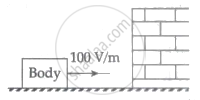
A body having specific charge 8 µC/g is resting on a frictionless plane at a distance 10 cm from the wall (as shown in the figure). It starts moving towards the wall when a uniform electric field of 100 V/m is applied horizontally toward the wall. If the collision of the body with the wall is perfectly elastic, then the time period of the motion will be ______ s.
The velocities of a particle in SHM at positions x1 and x2 are v1 and v2 respectively, its time period will be ______.
A container consist of hemispherical shell of radius 'r ' and cylindrical shell of height 'h' radius of same material and thickness. The maximum value h/r so that container remain stable equilibrium in the position shown (neglect friction) is ______.

