Advertisements
Advertisements
Question
A hollow sphere of radius 2 cm is attached to an 18 cm long thread to make a pendulum. Find the time period of oscillation of this pendulum. How does it differ from the time period calculated using the formula for a simple pendulum?
Advertisements
Solution
\[\frac{18}{100} = 0 . 18 m = 0 . 2 m\]
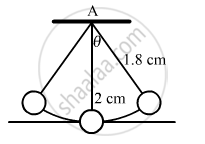
Let I be the moment of inertia and \[\omega\] be the angular speed.
Using the energy equation, we can write:
\[mgl(1 - \cos \theta) + \frac{1}{2}I \omega^2 = \text { constant }\]
\[mg\left( 0 . 20 \right) \left( 1 - \cos \theta \right) + \frac{1}{2}I \omega^2 = C . . . \left( 1 \right)\]
\[\text { Moment of inertia about the point of suspension A is given by, } \]
\[I = \frac{2}{3}m r^2 + m l^2 \]
\[\text { Substituting the value of l in the above equation, we get: }\]
\[I = \frac{2}{3}m \left( 0 . 02 \right)^2 + m \left( 0 . 2 \right)^2 \]
\[ = \frac{2}{3}m\left( 0 . 0004 \right) + m\left( 0 . 04 \right)\]
\[ = m\left[ \frac{0 . 0008}{3} + 0 . 04 \right]\]
\[ = m\left( \frac{0 . 1208}{3} \right)\]
On substituting the value of I in equation (1) and differentiating it, we get:
\[\frac{d}{dt}\left[ mg \left( 0 . 2 \right) \left( 1 - \cos \theta \right) + \frac{1}{2}\frac{0 . 1208}{3}m \omega^2 \right] = \frac{d}{dt}\left( c \right)\]
\[ \Rightarrow mg\left( 0 . 2 \right)\sin\theta\frac{d\theta}{dt} + \frac{1}{2}\left( \frac{0 . 1208}{3} \right)m \times 2\omega\frac{d\omega}{dt} = 0 \]
\[ \Rightarrow 2\sin \theta = \frac{0 . 1208}{3}\alpha \left[ \text { because }, g = 10 m/ s^2 \right]\]
\[ \Rightarrow \frac{\alpha}{\theta} = \frac{6}{0 . 1208}\]
\[ \Rightarrow \omega^2 = 49 . 66\]
\[ \Rightarrow \omega = 7 . 04\]
\[\text { Thus, time period }\left( T \right) \text { will be: }\]
\[T = \frac{2\pi}{\omega} = 0 . 89 s\]
For a simple pendulum, time period (T) is given by,
% change in the value of time period = \[\frac{0 . 89 - 0 . 86}{0 . 89} \times 100 = 0 . 3\]
APPEARS IN
RELATED QUESTIONS
The average displacement over a period of S.H.M. is ______.
(A = amplitude of S.H.M.)
Can simple harmonic motion take place in a non-inertial frame? If yes, should the ratio of the force applied with the displacement be constant?
A small creature moves with constant speed in a vertical circle on a bright day. Does its shadow formed by the sun on a horizontal plane move in a sample harmonic motion?
A particle executes simple harmonic motion Let P be a point near the mean position and Q be a point near an extreme. The speed of the particle at P is larger than the speed at Q. Still the particle crosses Pand Q equal number of times in a given time interval. Does it make you unhappy?
The average energy in one time period in simple harmonic motion is
A pendulum clock keeping correct time is taken to high altitudes,
Which of the following quantities are always zero in a simple harmonic motion?
(a) \[\vec{F} \times \vec{a} .\]
(b) \[\vec{v} \times \vec{r} .\]
(c) \[\vec{a} \times \vec{r} .\]
(d) \[\vec{F} \times \vec{r} .\]
A simple pendulum is constructed by hanging a heavy ball by a 5.0 m long string. It undergoes small oscillations. (a) How many oscillations does it make per second? (b) What will be the frequency if the system is taken on the moon where acceleration due to gravitation of the moon is 1.67 m/s2?
A simple pendulum of length 1 feet suspended from the ceiling of an elevator takes π/3 seconds to complete one oscillation. Find the acceleration of the elevator.
A closed circular wire hung on a nail in a wall undergoes small oscillations of amplitude 20 and time period 2 s. Find (a) the radius of the circular wire, (b) the speed of the particle farthest away from the point of suspension as it goes through its mean position, (c) the acceleration of this particle as it goes through its mean position and (d) the acceleration of this particle when it is at an extreme position. Take g = π2 m/s2.
A particle is subjected to two simple harmonic motions of same time period in the same direction. The amplitude of the first motion is 3.0 cm and that of the second is 4.0 cm. Find the resultant amplitude if the phase difference between the motions is (a) 0°, (b) 60°, (c) 90°.
A particle executing SHM crosses points A and B with the same velocity. Having taken 3 s in passing from A to B, it returns to B after another 3 s. The time period is ____________.
What is an epoch?
Consider the Earth as a homogeneous sphere of radius R and a straight hole is bored in it through its centre. Show that a particle dropped into the hole will execute a simple harmonic motion such that its time period is
T = `2π sqrt("R"/"g")`
A spring is stretched by 5 cm by a force of 10 N. The time period of the oscillations when a mass of 2 kg is suspended by it is ______
Motion of a ball bearing inside a smooth curved bowl, when released from a point slightly above the lower point is ______.
- simple harmonic motion.
- non-periodic motion.
- periodic motion.
- periodic but not S.H.M.
Displacement vs. time curve for a particle executing S.H.M. is shown in figure. Choose the correct statements.

- Phase of the oscillator is same at t = 0 s and t = 2s.
- Phase of the oscillator is same at t = 2 s and t = 6s.
- Phase of the oscillator is same at t = 1 s and t = 7s.
- Phase of the oscillator is same at t = 1 s and t = 5s.
What is the ratio of maxmimum acceleration to the maximum velocity of a simple harmonic oscillator?
