Advertisements
Advertisements
प्रश्न
A hollow sphere of radius 2 cm is attached to an 18 cm long thread to make a pendulum. Find the time period of oscillation of this pendulum. How does it differ from the time period calculated using the formula for a simple pendulum?
Advertisements
उत्तर
\[\frac{18}{100} = 0 . 18 m = 0 . 2 m\]
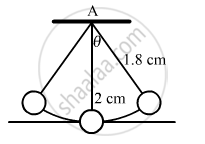
Let I be the moment of inertia and \[\omega\] be the angular speed.
Using the energy equation, we can write:
\[mgl(1 - \cos \theta) + \frac{1}{2}I \omega^2 = \text { constant }\]
\[mg\left( 0 . 20 \right) \left( 1 - \cos \theta \right) + \frac{1}{2}I \omega^2 = C . . . \left( 1 \right)\]
\[\text { Moment of inertia about the point of suspension A is given by, } \]
\[I = \frac{2}{3}m r^2 + m l^2 \]
\[\text { Substituting the value of l in the above equation, we get: }\]
\[I = \frac{2}{3}m \left( 0 . 02 \right)^2 + m \left( 0 . 2 \right)^2 \]
\[ = \frac{2}{3}m\left( 0 . 0004 \right) + m\left( 0 . 04 \right)\]
\[ = m\left[ \frac{0 . 0008}{3} + 0 . 04 \right]\]
\[ = m\left( \frac{0 . 1208}{3} \right)\]
On substituting the value of I in equation (1) and differentiating it, we get:
\[\frac{d}{dt}\left[ mg \left( 0 . 2 \right) \left( 1 - \cos \theta \right) + \frac{1}{2}\frac{0 . 1208}{3}m \omega^2 \right] = \frac{d}{dt}\left( c \right)\]
\[ \Rightarrow mg\left( 0 . 2 \right)\sin\theta\frac{d\theta}{dt} + \frac{1}{2}\left( \frac{0 . 1208}{3} \right)m \times 2\omega\frac{d\omega}{dt} = 0 \]
\[ \Rightarrow 2\sin \theta = \frac{0 . 1208}{3}\alpha \left[ \text { because }, g = 10 m/ s^2 \right]\]
\[ \Rightarrow \frac{\alpha}{\theta} = \frac{6}{0 . 1208}\]
\[ \Rightarrow \omega^2 = 49 . 66\]
\[ \Rightarrow \omega = 7 . 04\]
\[\text { Thus, time period }\left( T \right) \text { will be: }\]
\[T = \frac{2\pi}{\omega} = 0 . 89 s\]
For a simple pendulum, time period (T) is given by,
% change in the value of time period = \[\frac{0 . 89 - 0 . 86}{0 . 89} \times 100 = 0 . 3\]
APPEARS IN
संबंधित प्रश्न
A body of mass 1 kg is made to oscillate on a spring of force constant 16 N/m. Calculate:
a) Angular frequency
b) frequency of vibration.
The force acting on a particle moving along X-axis is F = −k(x − vo t) where k is a positive constant. An observer moving at a constant velocity v0 along the X-axis looks at the particle. What kind of motion does he find for the particle?
The average energy in one time period in simple harmonic motion is
A wall clock uses a vertical spring-mass system to measure the time. Each time the mass reaches an extreme position, the clock advances by a second. The clock gives correct time at the equator. If the clock is taken to the poles it will
A pendulum clock keeping correct time is taken to high altitudes,
Which of the following quantities are always positive in a simple harmonic motion?
For a particle executing simple harmonic motion, the acceleration is proportional to
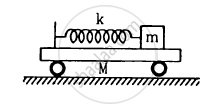
All the surfaces shown in figure are frictionless. The mass of the care is M, that of the block is m and the spring has spring constant k. Initially the car and the block are at rest and the spring is stretched through a length x0 when the system is released. (a) Find the amplitudes of the simple harmonic motion of the block and of the care as seen from the road. (b) Find the time period(s) of the two simple harmonic motions.
The angle made by the string of a simple pendulum with the vertical depends on time as \[\theta = \frac{\pi}{90} \sin \left[ \left( \pi s^{- 1} \right)t \right]\] .Find the length of the pendulum if g = π2 m2.
A simple pendulum of length 40 cm is taken inside a deep mine. Assume for the time being that the mine is 1600 km deep. Calculate the time period of the pendulum there. Radius of the earth = 6400 km.
A simple pendulum fixed in a car has a time period of 4 seconds when the car is moving uniformly on a horizontal road. When the accelerator is pressed, the time period changes to 3.99 seconds. Making an approximate analysis, find the acceleration of the car.
A uniform rod of length l is suspended by an end and is made to undergo small oscillations. Find the length of the simple pendulum having the time period equal to that of the road.
A uniform disc of mass m and radius r is suspended through a wire attached to its centre. If the time period of the torsional oscillations be T, what is the torsional constant of the wire?
A particle executing SHM crosses points A and B with the same velocity. Having taken 3 s in passing from A to B, it returns to B after another 3 s. The time period is ____________.
A simple pendulum is suspended from the roof of a school bus which moves in a horizontal direction with an acceleration a, then the time period is
Define the frequency of simple harmonic motion.
What is meant by simple harmonic oscillation? Give examples and explain why every simple harmonic motion is a periodic motion whereas the converse need not be true.
Consider two simple harmonic motion along the x and y-axis having the same frequencies but different amplitudes as x = A sin (ωt + φ) (along x-axis) and y = B sin ωt (along y-axis). Then show that
`"x"^2/"A"^2 + "y"^2/"B"^2 - (2"xy")/"AB" cos φ = sin^2 φ`
and also discuss the special cases when
- φ = 0
- φ = π
- φ = `π/2`
- φ = `π/2` and A = B
- φ = `π/4`
Note: when a particle is subjected to two simple harmonic motions at right angle to each other the particle may move along different paths. Such paths are called Lissajous figures.
Which of the following expressions corresponds to simple harmonic motion along a straight line, where x is the displacement and a, b, and c are positive constants?
If x = `5 sin (pi t + pi/3) m` represents the motion of a particle executing simple harmonic motion, the amplitude and time period of motion, respectively, are ______.
