Advertisements
Advertisements
प्रश्न
What is meant by simple harmonic oscillation? Give examples and explain why every simple harmonic motion is a periodic motion whereas the converse need not be true.
Advertisements
उत्तर
Simple harmonic motion is a special type of oscillatory motion in which the acceleration or force on the particle is directly proportional to its displacement from a fixed point and is always directed towards that fixed point. In one dimensional case, let x be the displacement of the particle and ax be the acceleration of the particle, then
ax ∝ x .................(1)
ax = −bx ...............(2)
where b is a constant which measures acceleration per unit displacement and dimensionally it is equal to T-2.
By multiplying by the mass of the particle on both sides of equation (1) and from Newton’s second law, the force is
Fx = −kx ….........(3)
where k is a force constant which is defined as force per unit length. The negative sign indicates that displacement and force (or acceleration) are in opposite directions. This means that when the displacement of the particle is taken towards the right of equilibrium position (x takes positive value), the force (or acceleration) will point towards equilibrium (towards left) and similarly, when the displacement of the particle is taken towards left of equilibrium position (x takes negative value), the force (or acceleration) will point towards equilibrium (towards right). This type of force is known as restoring force because it always directs the particle executing simple harmonic motion to restore to its original (equilibrium or mean) position. This force (restoring force) is central and attractive whose center of attraction is the equilibrium position.
In order to represent in two or three dimensions, we can write using vector notation
`vec"F" = -"k"vec("r")` ...(4)
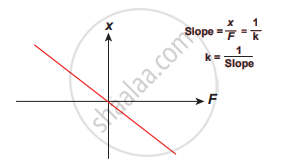
where `vec"r"` is the displacement of the particle from the chosen origin. Note that the force and displacement have a linear relationship. This means that the exponent of force `vec"F"` and the exponent of displacement `vec"r"` are unity. The sketch between cause (magnitude of force `vec|"F"|`) and effect (magnitude of displacement `vec|"r"|`) is a straight line passing through the second and fourth quadrant.
By measuring slope `1/"k"`, one can find the numerical value of force constant k.
APPEARS IN
संबंधित प्रश्न
Define phase of S.H.M.
The energy of system in simple harmonic motion is given by \[E = \frac{1}{2}m \omega^2 A^2 .\] Which of the following two statements is more appropriate?
(A) The energy is increased because the amplitude is increased.
(B) The amplitude is increased because the energy is increased.
For a particle executing simple harmonic motion, the acceleration is proportional to
A particle moves on the X-axis according to the equation x = x0 sin2 ωt. The motion is simple harmonic
A simple pendulum of length 40 cm is taken inside a deep mine. Assume for the time being that the mine is 1600 km deep. Calculate the time period of the pendulum there. Radius of the earth = 6400 km.
A uniform rod of length l is suspended by an end and is made to undergo small oscillations. Find the length of the simple pendulum having the time period equal to that of the road.
A particle is subjected to two simple harmonic motions of same time period in the same direction. The amplitude of the first motion is 3.0 cm and that of the second is 4.0 cm. Find the resultant amplitude if the phase difference between the motions is (a) 0°, (b) 60°, (c) 90°.
In a simple harmonic oscillation, the acceleration against displacement for one complete oscillation will be __________.
If the inertial mass and gravitational mass of the simple pendulum of length l are not equal, then the time period of the simple pendulum is
The displacement of a particle is represented by the equation y = sin3ωt. The motion is ______.
