Advertisements
Advertisements
प्रश्न
What is meant by simple harmonic oscillation? Give examples and explain why every simple harmonic motion is a periodic motion whereas the converse need not be true.
Advertisements
उत्तर
Simple harmonic motion is a special type of oscillatory motion in which the acceleration or force on the particle is directly proportional to its displacement from a fixed point and is always directed towards that fixed point. In one dimensional case, let x be the displacement of the particle and ax be the acceleration of the particle, then
ax ∝ x .................(1)
ax = −bx ...............(2)
where b is a constant which measures acceleration per unit displacement and dimensionally it is equal to T-2.
By multiplying by the mass of the particle on both sides of equation (1) and from Newton’s second law, the force is
Fx = −kx ….........(3)
where k is a force constant which is defined as force per unit length. The negative sign indicates that displacement and force (or acceleration) are in opposite directions. This means that when the displacement of the particle is taken towards the right of equilibrium position (x takes positive value), the force (or acceleration) will point towards equilibrium (towards left) and similarly, when the displacement of the particle is taken towards left of equilibrium position (x takes negative value), the force (or acceleration) will point towards equilibrium (towards right). This type of force is known as restoring force because it always directs the particle executing simple harmonic motion to restore to its original (equilibrium or mean) position. This force (restoring force) is central and attractive whose center of attraction is the equilibrium position.
In order to represent in two or three dimensions, we can write using vector notation
`vec"F" = -"k"vec("r")` ...(4)
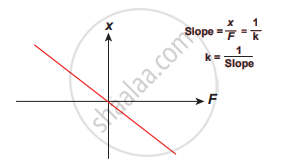
where `vec"r"` is the displacement of the particle from the chosen origin. Note that the force and displacement have a linear relationship. This means that the exponent of force `vec"F"` and the exponent of displacement `vec"r"` are unity. The sketch between cause (magnitude of force `vec|"F"|`) and effect (magnitude of displacement `vec|"r"|`) is a straight line passing through the second and fourth quadrant.
By measuring slope `1/"k"`, one can find the numerical value of force constant k.
APPEARS IN
संबंधित प्रश्न
A body of mass 1 kg is made to oscillate on a spring of force constant 16 N/m. Calculate:
a) Angular frequency
b) frequency of vibration.
Hence obtain the expression for acceleration, velocity and displacement of a particle performing linear S.H.M.
Which of the following quantities are always positive in a simple harmonic motion?
The pendulum of a certain clock has time period 2.04 s. How fast or slow does the clock run during 24 hours?
A pendulum clock giving correct time at a place where g = 9.800 m/s2 is taken to another place where it loses 24 seconds during 24 hours. Find the value of g at this new place.
A simple pendulum is constructed by hanging a heavy ball by a 5.0 m long string. It undergoes small oscillations. (a) How many oscillations does it make per second? (b) What will be the frequency if the system is taken on the moon where acceleration due to gravitation of the moon is 1.67 m/s2?
A particle is subjected to two simple harmonic motions of same time period in the same direction. The amplitude of the first motion is 3.0 cm and that of the second is 4.0 cm. Find the resultant amplitude if the phase difference between the motions is (a) 0°, (b) 60°, (c) 90°.
A simple harmonic motion is given by, x = 2.4 sin ( 4πt). If distances are expressed in cm and time in seconds, the amplitude and frequency of S.H.M. are respectively,
A container consist of hemispherical shell of radius 'r ' and cylindrical shell of height 'h' radius of same material and thickness. The maximum value h/r so that container remain stable equilibrium in the position shown (neglect friction) is ______.

Which of the following expressions corresponds to simple harmonic motion along a straight line, where x is the displacement and a, b, and c are positive constants?
