Advertisements
Advertisements
प्रश्न
The displacement of a particle varies with time according to the relation y = a sin ωt + b cos ωt.
पर्याय
The motion is oscillatory but not S.H.M.
The motion is S.H.M. with amplitude a + b.
The motion is S.H.M. with amplitude a2 + b2.
The motion is S.H.M. with amplitude `sqrt(a^2 + b^2)`.
Advertisements
उत्तर
The motion is S.H.M. with amplitude `sqrt(a^2 + b^2)`.
Explanation:
According to the question, the displacement
y = a sin ωt + b cos ωt
Let a = A sin `phi` and b = A cos `phi`
Now, a2 + b2 = A2 sin2 `phi` + A2 cos2 `phi`
= A2
⇒ A = `sqrt(a^2 + b^2)`
y = A sin `phi` sin ωt + A cos `phi` cos ωt
= A sin (ωt + `phi`)
`(dy)/(dt) = Aω cos (ωt + phi)`
`(d^2y)/(dt^2) = - Aω^2 sin(ωt + phi)`
= `- Ayω^2`
= `(- Aω^2)y`
⇒ `(d^2y)/(dt^2) ∝ (-y)`
Hence, it is an equation of SHM with amplitude A = `sqrt(a^2 + b^2)`.
APPEARS IN
संबंधित प्रश्न
Define phase of S.H.M.
Can simple harmonic motion take place in a non-inertial frame? If yes, should the ratio of the force applied with the displacement be constant?
The force acting on a particle moving along X-axis is F = −k(x − vo t) where k is a positive constant. An observer moving at a constant velocity v0 along the X-axis looks at the particle. What kind of motion does he find for the particle?
The average energy in one time period in simple harmonic motion is
The motion of a torsional pendulum is
(a) periodic
(b) oscillatory
(c) simple harmonic
(d) angular simple harmonic
Which of the following quantities are always zero in a simple harmonic motion?
(a) \[\vec{F} \times \vec{a} .\]
(b) \[\vec{v} \times \vec{r} .\]
(c) \[\vec{a} \times \vec{r} .\]
(d) \[\vec{F} \times \vec{r} .\]
For a particle executing simple harmonic motion, the acceleration is proportional to
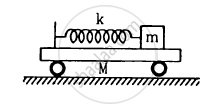
All the surfaces shown in figure are frictionless. The mass of the care is M, that of the block is m and the spring has spring constant k. Initially the car and the block are at rest and the spring is stretched through a length x0 when the system is released. (a) Find the amplitudes of the simple harmonic motion of the block and of the care as seen from the road. (b) Find the time period(s) of the two simple harmonic motions.
A small block oscillates back and forth on a smooth concave surface of radius R ib Figure . Find the time period of small oscillation.
A spherical ball of mass m and radius r rolls without slipping on a rough concave surface of large radius R. It makes small oscillations about the lowest point. Find the time period.
A uniform disc of mass m and radius r is suspended through a wire attached to its centre. If the time period of the torsional oscillations be T, what is the torsional constant of the wire?
A particle is subjected to two simple harmonic motions given by x1 = 2.0 sin (100π t) and x2 = 2.0 sin (120 π t + π/3), where x is in centimeter and t in second. Find the displacement of the particle at (a) t = 0.0125, (b) t = 0.025.
A simple pendulum is suspended from the roof of a school bus which moves in a horizontal direction with an acceleration a, then the time period is
Define the time period of simple harmonic motion.
What is an epoch?
A simple harmonic motion is given by, x = 2.4 sin ( 4πt). If distances are expressed in cm and time in seconds, the amplitude and frequency of S.H.M. are respectively,
Motion of a ball bearing inside a smooth curved bowl, when released from a point slightly above the lower point is ______.
- simple harmonic motion.
- non-periodic motion.
- periodic motion.
- periodic but not S.H.M.
