Advertisements
Advertisements
प्रश्न
The displacement of a particle varies with time according to the relation y = a sin ωt + b cos ωt.
विकल्प
The motion is oscillatory but not S.H.M.
The motion is S.H.M. with amplitude a + b.
The motion is S.H.M. with amplitude a2 + b2.
The motion is S.H.M. with amplitude `sqrt(a^2 + b^2)`.
Advertisements
उत्तर
The motion is S.H.M. with amplitude `sqrt(a^2 + b^2)`.
Explanation:
According to the question, the displacement
y = a sin ωt + b cos ωt
Let a = A sin `phi` and b = A cos `phi`
Now, a2 + b2 = A2 sin2 `phi` + A2 cos2 `phi`
= A2
⇒ A = `sqrt(a^2 + b^2)`
y = A sin `phi` sin ωt + A cos `phi` cos ωt
= A sin (ωt + `phi`)
`(dy)/(dt) = Aω cos (ωt + phi)`
`(d^2y)/(dt^2) = - Aω^2 sin(ωt + phi)`
= `- Ayω^2`
= `(- Aω^2)y`
⇒ `(d^2y)/(dt^2) ∝ (-y)`
Hence, it is an equation of SHM with amplitude A = `sqrt(a^2 + b^2)`.
APPEARS IN
संबंधित प्रश्न
State the differential equation of linear simple harmonic motion.
Hence obtain the expression for acceleration, velocity and displacement of a particle performing linear S.H.M.
A particle executes simple harmonic motion. If you are told that its velocity at this instant is zero, can you say what is its displacement? If you are told that its velocity at this instant is maximum, can you say what is its displacement?
It is proposed to move a particle in simple harmonic motion on a rough horizontal surface by applying an external force along the line of motion. Sketch the graph of the applied force against the position of the particle. Note that the applied force has two values for a given position depending on whether the particle is moving in positive or negative direction.
A block of known mass is suspended from a fixed support through a light spring. Can you find the time period of vertical oscillation only by measuring the extension of the spring when the block is in equilibrium?
The force acting on a particle moving along X-axis is F = −k(x − vo t) where k is a positive constant. An observer moving at a constant velocity v0 along the X-axis looks at the particle. What kind of motion does he find for the particle?
A student says that he had applied a force \[F = - k\sqrt{x}\] on a particle and the particle moved in simple harmonic motion. He refuses to tell whether k is a constant or not. Assume that he was worked only with positive x and no other force acted on the particle.
The motion of a particle is given by x = A sin ωt + B cos ωt. The motion of the particle is
A pendulum clock that keeps correct time on the earth is taken to the moon. It will run
A particle moves on the X-axis according to the equation x = x0 sin2 ωt. The motion is simple harmonic
A small block oscillates back and forth on a smooth concave surface of radius R in Figure. Find the time period of small oscillation.

Assume that a tunnel is dug across the earth (radius = R) passing through its centre. Find the time a particle takes to cover the length of the tunnel if (a) it is projected into the tunnel with a speed of \[\sqrt{gR}\] (b) it is released from a height R above the tunnel (c) it is thrown vertically upward along the length of tunnel with a speed of \[\sqrt{gR}\]
A closed circular wire hung on a nail in a wall undergoes small oscillations of amplitude 20 and time period 2 s. Find (a) the radius of the circular wire, (b) the speed of the particle farthest away from the point of suspension as it goes through its mean position, (c) the acceleration of this particle as it goes through its mean position and (d) the acceleration of this particle when it is at an extreme position. Take g = π2 m/s2.
What is meant by simple harmonic oscillation? Give examples and explain why every simple harmonic motion is a periodic motion whereas the converse need not be true.
Consider two simple harmonic motion along the x and y-axis having the same frequencies but different amplitudes as x = A sin (ωt + φ) (along x-axis) and y = B sin ωt (along y-axis). Then show that
`"x"^2/"A"^2 + "y"^2/"B"^2 - (2"xy")/"AB" cos φ = sin^2 φ`
and also discuss the special cases when
- φ = 0
- φ = π
- φ = `π/2`
- φ = `π/2` and A = B
- φ = `π/4`
Note: when a particle is subjected to two simple harmonic motions at right angle to each other the particle may move along different paths. Such paths are called Lissajous figures.
A simple harmonic motion is given by, x = 2.4 sin ( 4πt). If distances are expressed in cm and time in seconds, the amplitude and frequency of S.H.M. are respectively,
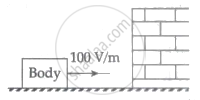
A body having specific charge 8 µC/g is resting on a frictionless plane at a distance 10 cm from the wall (as shown in the figure). It starts moving towards the wall when a uniform electric field of 100 V/m is applied horizontally toward the wall. If the collision of the body with the wall is perfectly elastic, then the time period of the motion will be ______ s.
A container consist of hemispherical shell of radius 'r ' and cylindrical shell of height 'h' radius of same material and thickness. The maximum value h/r so that container remain stable equilibrium in the position shown (neglect friction) is ______.

Which of the following expressions corresponds to simple harmonic motion along a straight line, where x is the displacement and a, b, and c are positive constants?
