Advertisements
Advertisements
प्रश्न
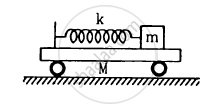
All the surfaces shown in figure are frictionless. The mass of the care is M, that of the block is m and the spring has spring constant k. Initially the car and the block are at rest and the spring is stretched through a length x0 when the system is released. (a) Find the amplitudes of the simple harmonic motion of the block and of the care as seen from the road. (b) Find the time period(s) of the two simple harmonic motions.
Advertisements
उत्तर
Let x1 and x2 be the amplitudes of oscillation of masses m and M respectively.
(a) As the centre of mass should not change during the motion, we can write:
mx1 = Mx2 \[\ldots(1)\]
Let k be the spring constant. By conservation of energy, we have:
\[\frac{1}{2}k x_0^2 = \frac{1}{2}k \left( x_1 + x_2 \right)^2 \ldots(2)\]
where x0 is the length to which spring is stretched.
From equation (2) we have,
\[x_0 = x_1 + x_2 \]
On substituting the value of x2 from equation (1) in equation (2), we get:
\[x_0 = x_1 + \frac{m x_1}{M}\]
\[ \Rightarrow x_0 = \left( 1 + \frac{m}{M} \right) x_1 \]
\[ \Rightarrow x_1 = \left( \frac{M}{M + m} \right) x_0\]
\[\text { Now }, x_2 = x_0 - x_1 \]
On substituting the value of x1 from above equation, we get:
\[\Rightarrow x_2 = x_0 \left[ 1 - \frac{M}{M + m} \right]\]
\[ \Rightarrow x_2 = \frac{m x_0}{M + m}\]
Thus, the amplitude of the simple harmonic motion of a car, as seen from the road is
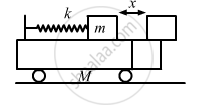
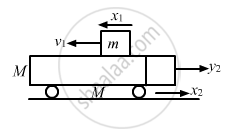
Let v1 and v2 be the velocities.
Using law of conservation of energy we have,
Now, from the principle of conservation of momentum, we have:
Mx2 = mx1
\[\Rightarrow x_1 = \left( \frac{M}{m} \right) x_2 . . . . \left( 4 \right)\]
\[M v_2 = m\left( v_1 - v_2 \right)\]
\[ \Rightarrow \left( v_1 - v_2 \right) = \left( \frac{M}{m} \right) v_2 . . . . \left( 5 \right)\]
Putting the above values in equation (3), we get:
\[\frac{1}{2}M v_2^2 + \frac{1}{2}m\frac{M^2}{m^2} v_2^2 + \frac{1}{2}k x_2^2 \left( 1 + \frac{M}{m} \right)^2 = \text { constant }\]
\[ \therefore M\left( 1 + \frac{M}{m} \right) v_2^2 + k\left( 1 + \frac{M}{m} \right) x_2^2 = \text { constant } \]
\[ \Rightarrow M v_2^2 + k\left( 1 + \frac{M}{m} \right) x_2^2 = \text { constant } \]
Taking derivative of both the sides, we get:
\[M \times 2 v_2 \frac{d v_2}{dt} + k\left( \frac{M + m}{m} \right)2 x_2 \frac{d x_2}{dt} = 0\]
\[ \Rightarrow m a_2 + k\left( \frac{M + m}{m} \right) x_2 = 0 \left[ \text { because }, v_2 = \frac{d x_2}{dt} \right]\]
\[\frac{a_2}{x_2} = \frac{- k\left( M + m \right)}{Mm} = \omega^2 \]
\[ \therefore \omega = \sqrt{\frac{k\left( M + m \right)}{Mm}}\]
\[\text { Therefore, time period }, T = 2\pi\sqrt{\frac{Mm}{k\left( M + m \right)}}\]
APPEARS IN
संबंधित प्रश्न
Define phase of S.H.M.
A particle executes simple harmonic motion. If you are told that its velocity at this instant is zero, can you say what is its displacement? If you are told that its velocity at this instant is maximum, can you say what is its displacement?
A block of known mass is suspended from a fixed support through a light spring. Can you find the time period of vertical oscillation only by measuring the extension of the spring when the block is in equilibrium?
The motion of a particle is given by x = A sin ωt + B cos ωt. The motion of the particle is
The displacement of a particle is given by \[\overrightarrow{r} = A\left( \overrightarrow{i} \cos\omega t + \overrightarrow{j} \sin\omega t \right) .\] The motion of the particle is
A particle moves in a circular path with a continuously increasing speed. Its motion is
In a simple harmonic motion
A pendulum having time period equal to two seconds is called a seconds pendulum. Those used in pendulum clocks are of this type. Find the length of a second pendulum at a place where g = π2 m/s2.
A pendulum clock giving correct time at a place where g = 9.800 m/s2 is taken to another place where it loses 24 seconds during 24 hours. Find the value of g at this new place.
A simple pendulum of length 40 cm is taken inside a deep mine. Assume for the time being that the mine is 1600 km deep. Calculate the time period of the pendulum there. Radius of the earth = 6400 km.
A simple pendulum of length l is suspended through the ceiling of an elevator. Find the time period of small oscillations if the elevator (a) is going up with and acceleration a0(b) is going down with an acceleration a0 and (c) is moving with a uniform velocity.
A uniform rod of length l is suspended by an end and is made to undergo small oscillations. Find the length of the simple pendulum having the time period equal to that of the road.
A particle executing SHM crosses points A and B with the same velocity. Having taken 3 s in passing from A to B, it returns to B after another 3 s. The time period is ____________.
What is an epoch?
Write short notes on two springs connected in parallel.
The displacement of a particle is represented by the equation y = sin3ωt. The motion is ______.
The displacement of a particle varies with time according to the relation y = a sin ωt + b cos ωt.
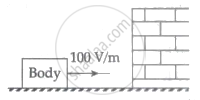
A body having specific charge 8 µC/g is resting on a frictionless plane at a distance 10 cm from the wall (as shown in the figure). It starts moving towards the wall when a uniform electric field of 100 V/m is applied horizontally toward the wall. If the collision of the body with the wall is perfectly elastic, then the time period of the motion will be ______ s.
A weightless rigid rod with a small iron bob at the end is hinged at point A to the wall so that it can rotate in all directions. The rod is kept in the horizontal position by a vertical inextensible string of length 20 cm, fixed at its midpoint. The bob is displaced slightly, perpendicular to the plane of the rod and string. The period of small oscillations of the system in the form `(pix)/10` is ______ sec. and the value of x is ______.
(g = 10 m/s2)

