Advertisements
Advertisements
Question
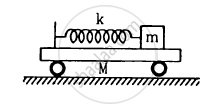
All the surfaces shown in figure are frictionless. The mass of the care is M, that of the block is m and the spring has spring constant k. Initially the car and the block are at rest and the spring is stretched through a length x0 when the system is released. (a) Find the amplitudes of the simple harmonic motion of the block and of the care as seen from the road. (b) Find the time period(s) of the two simple harmonic motions.
Advertisements
Solution
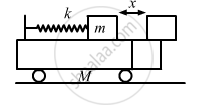
Let x1 and x2 be the amplitudes of oscillation of masses m and M respectively.
(a) As the centre of mass should not change during the motion, we can write:
mx1 = Mx2 \[\ldots(1)\]
Let k be the spring constant. By conservation of energy, we have:
\[\frac{1}{2}k x_0^2 = \frac{1}{2}k \left( x_1 + x_2 \right)^2 \ldots(2)\]
where x0 is the length to which spring is stretched.
From equation (2) we have,
\[x_0 = x_1 + x_2 \]
On substituting the value of x2 from equation (1) in equation (2), we get:
\[x_0 = x_1 + \frac{m x_1}{M}\]
\[ \Rightarrow x_0 = \left( 1 + \frac{m}{M} \right) x_1 \]
\[ \Rightarrow x_1 = \left( \frac{M}{M + m} \right) x_0\]
\[\text { Now }, x_2 = x_0 - x_1 \]
On substituting the value of x1 from above equation, we get:
\[\Rightarrow x_2 = x_0 \left[ 1 - \frac{M}{M + m} \right]\]
\[ \Rightarrow x_2 = \frac{m x_0}{M + m}\]
Thus, the amplitude of the simple harmonic motion of a car, as seen from the road is
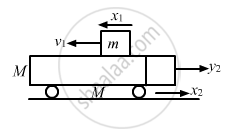
Let v1 and v2 be the velocities.
Using law of conservation of energy we have,
Now, from the principle of conservation of momentum, we have:
Mx2 = mx1
\[\Rightarrow x_1 = \left( \frac{M}{m} \right) x_2 . . . . \left( 4 \right)\]
\[M v_2 = m\left( v_1 - v_2 \right)\]
\[ \Rightarrow \left( v_1 - v_2 \right) = \left( \frac{M}{m} \right) v_2 . . . . \left( 5 \right)\]
Putting the above values in equation (3), we get:
\[\frac{1}{2}M v_2^2 + \frac{1}{2}m\frac{M^2}{m^2} v_2^2 + \frac{1}{2}k x_2^2 \left( 1 + \frac{M}{m} \right)^2 = \text { constant }\]
\[ \therefore M\left( 1 + \frac{M}{m} \right) v_2^2 + k\left( 1 + \frac{M}{m} \right) x_2^2 = \text { constant } \]
\[ \Rightarrow M v_2^2 + k\left( 1 + \frac{M}{m} \right) x_2^2 = \text { constant } \]
Taking derivative of both the sides, we get:
\[M \times 2 v_2 \frac{d v_2}{dt} + k\left( \frac{M + m}{m} \right)2 x_2 \frac{d x_2}{dt} = 0\]
\[ \Rightarrow m a_2 + k\left( \frac{M + m}{m} \right) x_2 = 0 \left[ \text { because }, v_2 = \frac{d x_2}{dt} \right]\]
\[\frac{a_2}{x_2} = \frac{- k\left( M + m \right)}{Mm} = \omega^2 \]
\[ \therefore \omega = \sqrt{\frac{k\left( M + m \right)}{Mm}}\]
\[\text { Therefore, time period }, T = 2\pi\sqrt{\frac{Mm}{k\left( M + m \right)}}\]
APPEARS IN
RELATED QUESTIONS
The average displacement over a period of S.H.M. is ______.
(A = amplitude of S.H.M.)
A body of mass 1 kg is made to oscillate on a spring of force constant 16 N/m. Calculate:
a) Angular frequency
b) frequency of vibration.
Show variation of displacement, velocity, and acceleration with phase for a particle performing linear S.H.M. graphically, when it starts from the extreme position.
A pendulum clock gives correct time at the equator. Will it gain time or loose time as it is taken to the poles?
A hollow sphere filled with water is used as the bob of a pendulum. Assume that the equation for simple pendulum is valid with the distance between the point of suspension and centre of mass of the bob acting as the effective length of the pendulum. If water slowly leaks out of the bob, how will the time period vary?
The force acting on a particle moving along X-axis is F = −k(x − vo t) where k is a positive constant. An observer moving at a constant velocity v0 along the X-axis looks at the particle. What kind of motion does he find for the particle?
The time period of a particle in simple harmonic motion is equal to the time between consecutive appearances of the particle at a particular point in its motion. This point is
The average energy in one time period in simple harmonic motion is
A particle moves in a circular path with a continuously increasing speed. Its motion is
Which of the following quantities are always negative in a simple harmonic motion?
(a) \[\vec{F} . \vec{a} .\]
(b) \[\vec{v} . \vec{r} .\]
(c) \[\vec{a} . \vec{r} .\]
(d)\[\vec{F} . \vec{r} .\]
For a particle executing simple harmonic motion, the acceleration is proportional to
A particle moves in the X-Y plane according to the equation \[\overrightarrow{r} = \left( \overrightarrow{i} + 2 \overrightarrow{j} \right)A\cos\omega t .\]
The motion of the particle is
(a) on a straight line
(b) on an ellipse
(c) periodic
(d) simple harmonic
In a simple harmonic motion
Which of the following will change the time period as they are taken to moon?
(a) A simple pendulum
(b) A physical pendulum
(c) A torsional pendulum
(d) A spring-mass system
A pendulum clock giving correct time at a place where g = 9.800 m/s2 is taken to another place where it loses 24 seconds during 24 hours. Find the value of g at this new place.
A small block oscillates back and forth on a smooth concave surface of radius R in Figure. Find the time period of small oscillation.

Three simple harmonic motions of equal amplitude A and equal time periods in the same direction combine. The phase of the second motion is 60° ahead of the first and the phase of the third motion is 60° ahead of the second. Find the amplitude of the resultant motion.
Define the frequency of simple harmonic motion.
A simple harmonic motion is given by, x = 2.4 sin ( 4πt). If distances are expressed in cm and time in seconds, the amplitude and frequency of S.H.M. are respectively,
A spring is stretched by 5 cm by a force of 10 N. The time period of the oscillations when a mass of 2 kg is suspended by it is ______.
