Advertisements
Advertisements
Question
Assume that a tunnel is dug across the earth (radius = R) passing through its centre. Find the time a particle takes to cover the length of the tunnel if (a) it is projected into the tunnel with a speed of \[\sqrt{gR}\] (b) it is released from a height R above the tunnel (c) it is thrown vertically upward along the length of tunnel with a speed of \[\sqrt{gR}\]
Advertisements
Solution
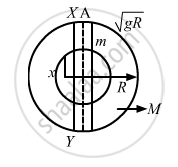
Given:
Radius of the earth is R.
Let M be the total mass of the earth and \[\rho\] be the density.
Let mass of the part of earth having radius x be M.
\[\therefore \frac{M'}{M} = \frac{\rho \times \frac{4}{3}\pi x^3}{\rho \times \frac{4}{3}\pi R^3} = \frac{x^3}{R^3}\]
\[ \Rightarrow M' = \frac{M x^3}{R^3}\]
Force on the particle is calculated as,
\[F_x = \frac{GM'm}{x^2}\]
\[ = \frac{GMm}{R^3}x \ldots\left( 1 \right)\]
Now, acceleration \[\left( a_x \right)\] of mass M' at that position is given by,
\[a_x = \frac{GM}{R^3}x\]
\[ \Rightarrow \frac{a_x}{x} = \omega^2 = \frac{GM}{R^3} = \frac{g}{R} \left( \because g = \frac{GM}{R^2} \right)\]
\[\text{So, Time period of oscillation ,} T = 2\pi\sqrt{\left( \frac{R}{g} \right)}\]
(a) Velocity-displacement equation in S.H.M is written as,
\[V = \omega\sqrt{\left( A^2 - y^2 \right)} \]
where, A is the amplitude; and y is the displacement .
When the particle is at y = R,
The velocity of the particle is \[\sqrt{gR}\] and \[\omega = \sqrt{\frac{g}{R}}\]
On substituting these values in the velocity-displacement equation, we get:
\[\sqrt{gR} = \sqrt{\frac{g}{R}}\sqrt{A^2 - R^2} \]
\[ \Rightarrow R^2 = A^2 - R^2 \]
\[ \Rightarrow A = \sqrt{2R}\]
Let t1 and t2 be the time taken by the particle to reach the positions X and Y.
Now, phase of the particle at point X will be greater than \[\frac{\pi}{2}\] but less than \[\pi\]
Also, the phase of the particle on reaching Y will be greater than \[\pi\] but less than \[\frac{3\pi}{2}\]
Displacement-time relation is given by,
y = A sin ωt
Substituting y = R and A =\[\sqrt{2R}\] , in the above relation , we get :
\[R = \sqrt{2}R \sin \omega t_1\]
\[\Rightarrow \omega t_1 = \frac{3\pi}{4}\]
Also,
\[R = \sqrt{2}R \sin \omega t_2\]
\[\Rightarrow \omega t_2 = \frac{5\pi}{4}\]
\[\text{So}, \omega\left( t_2 - t_1 \right) = \frac{\pi}{2}\]
\[ \Rightarrow t_2 - t_1 = \frac{\pi}{2\omega} = \frac{\pi}{2\left( \sqrt{\frac{g}{R}} \right)}\]
Time taken by the particle to travel from X to Y:
Using the principle of conservation of energy, we get:
Change in P.E. = Gain in K.E.
\[\Rightarrow \frac{GMm}{R} - \frac{GMm}{2R} = \frac{1}{2}m v^2 \]
\[ \Rightarrow v = \sqrt{\left( gR \right)}\]
As the velocity is same as that at X, the body will take the same time to travel XY.
(c) The body is projected vertically upwards from the point X with a velocity \[\sqrt{gR}\].Its velocity becomes zero as it reaches the highest point.
The velocity of the body as it reaches X again will be,
\[v = \sqrt{\left( gR \right)}\]
Hence, the body will take same time i.e.
APPEARS IN
RELATED QUESTIONS
A small creature moves with constant speed in a vertical circle on a bright day. Does its shadow formed by the sun on a horizontal plane move in a sample harmonic motion?
A block of known mass is suspended from a fixed support through a light spring. Can you find the time period of vertical oscillation only by measuring the extension of the spring when the block is in equilibrium?
A student says that he had applied a force \[F = - k\sqrt{x}\] on a particle and the particle moved in simple harmonic motion. He refuses to tell whether k is a constant or not. Assume that he was worked only with positive x and no other force acted on the particle.
The distance moved by a particle in simple harmonic motion in one time period is
The average energy in one time period in simple harmonic motion is
A pendulum clock keeping correct time is taken to high altitudes,
A particle moves in a circular path with a continuously increasing speed. Its motion is
The motion of a torsional pendulum is
(a) periodic
(b) oscillatory
(c) simple harmonic
(d) angular simple harmonic
Suppose a tunnel is dug along a diameter of the earth. A particle is dropped from a point, a distance h directly above the tunnel. The motion of the particle as seen from the earth is
(a) simple harmonic
(b) parabolic
(c) on a straight line
(d) periodic
A simple pendulum of length 1 feet suspended from the ceiling of an elevator takes π/3 seconds to complete one oscillation. Find the acceleration of the elevator.
A hollow sphere of radius 2 cm is attached to an 18 cm long thread to make a pendulum. Find the time period of oscillation of this pendulum. How does it differ from the time period calculated using the formula for a simple pendulum?
A closed circular wire hung on a nail in a wall undergoes small oscillations of amplitude 20 and time period 2 s. Find (a) the radius of the circular wire, (b) the speed of the particle farthest away from the point of suspension as it goes through its mean position, (c) the acceleration of this particle as it goes through its mean position and (d) the acceleration of this particle when it is at an extreme position. Take g = π2 m/s2.
A particle is subjected to two simple harmonic motions of same time period in the same direction. The amplitude of the first motion is 3.0 cm and that of the second is 4.0 cm. Find the resultant amplitude if the phase difference between the motions is (a) 0°, (b) 60°, (c) 90°.
A simple pendulum has a time period T1. When its point of suspension is moved vertically upwards according to as y = kt2, where y is the vertical distance covered and k = 1 ms−2, its time period becomes T2. Then, T `"T"_1^2/"T"_2^2` is (g = 10 ms−2)
Define the time period of simple harmonic motion.
Describe Simple Harmonic Motion as a projection of uniform circular motion.
A spring is stretched by 5 cm by a force of 10 N. The time period of the oscillations when a mass of 2 kg is suspended by it is ______
The displacement of a particle is represented by the equation y = sin3ωt. The motion is ______.
The velocities of a particle in SHM at positions x1 and x2 are v1 and v2 respectively, its time period will be ______.
