Advertisements
Advertisements
Question
Assume that a tunnel is dug along a chord of the earth, at a perpendicular distance R/2 from the earth's centre where R is the radius of the earth. The wall of the tunnel is frictionless. (a) Find the gravitational force exerted by the earth on a particle of mass mplaced in the tunnel at a distance x from the centre of the tunnel. (b) Find the component of this force along the tunnel and perpendicular to the tunnel. (c) Find the normal force exerted by the wall on the particle. (d) Find the resultant force on the particle. (e) Show that the motion of the particle in the tunnel is simple harmonic and find the time period.
Advertisements
Solution
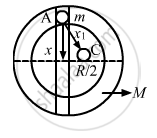
If \[\rho\] is the density of the earth, then mass of the earth \[\left( M \right)\] is given by,
\[M = \frac{4}{3}\pi R^3 \rho\]
\[\text {Similarly, mass} \left( M' \right) \text{ of the part of earth having radius } \left( x \right)\text{ is given by, } \] \[M' = \frac{4}{3}\pi {x_1}^3 \rho\]
\[M' = \left( \frac{M}{R^3} \right) {x_1}^3\]
(a) Let F be the gravitational force exerted by the earth on the particle of mass m. Then, its value is given by,
\[F = \frac{GM'm}{x_1^2}\]
\[\text {Substituting the value of M' in the above equation, we get: }\]
\[F = \frac{GMm}{R^3}\frac{x_1^3}{x_1^2}\]
\[ = \frac{GMm}{R^3} x_1 = \frac{GMm}{R^3}\sqrt{x^2 + \left( \frac{R^2}{4} \right)}\]
(b)
\[F_y = Fcos\theta\]
\[ = \frac{GMm x_1}{R^3}\frac{x}{x_1} = \frac{GMmx}{R^3}\]
\[ F_x = F\sin \theta\]
\[ = \frac{GMm x_1}{R^3}\frac{R}{2 x_1} = \frac{GMm}{2 R^2}\]
(c) 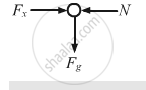
\[F_x = \frac{GMm}{R^2}\]
\[\because\] Normal force exerted by the wall N = Fx
(d)The resultant force is \[\frac{GMmx}{R^3}\]
(e) Acceleration = Driving force/mass
\[= \frac{GMmx}{R^3 m}\]
\[ = \frac{GMx}{R^3}\]
\[\Rightarrow\] a \[\propto\] x (the body executes S.H.M.)
\[\frac{a}{x} = \omega^2 = \frac{GM}{R^3}\]
\[ \Rightarrow \omega = \sqrt{\frac{Gm}{R^3}}\]
\[ \Rightarrow T = 2\pi\sqrt{\frac{R^3}{GM}}\]
APPEARS IN
RELATED QUESTIONS
The average displacement over a period of S.H.M. is ______.
(A = amplitude of S.H.M.)
A particle executing simple harmonic motion comes to rest at the extreme positions. Is the resultant force on the particle zero at these positions according to Newton's first law?
In measuring time period of a pendulum, it is advised to measure the time between consecutive passage through the mean position in the same direction. This is said to result in better accuracy than measuring time between consecutive passage through an extreme position. Explain.
The energy of system in simple harmonic motion is given by \[E = \frac{1}{2}m \omega^2 A^2 .\] Which of the following two statements is more appropriate?
(A) The energy is increased because the amplitude is increased.
(B) The amplitude is increased because the energy is increased.
A student says that he had applied a force \[F = - k\sqrt{x}\] on a particle and the particle moved in simple harmonic motion. He refuses to tell whether k is a constant or not. Assume that he was worked only with positive x and no other force acted on the particle.
The displacement of a particle in simple harmonic motion in one time period is
A pendulum clock that keeps correct time on the earth is taken to the moon. It will run
A wall clock uses a vertical spring-mass system to measure the time. Each time the mass reaches an extreme position, the clock advances by a second. The clock gives correct time at the equator. If the clock is taken to the poles it will
A pendulum clock keeping correct time is taken to high altitudes,
Select the correct statements.
(a) A simple harmonic motion is necessarily periodic.
(b) A simple harmonic motion is necessarily oscillatory.
(c) An oscillatory motion is necessarily periodic.
(d) A periodic motion is necessarily oscillatory.
In a simple harmonic motion
A particle executes simple harmonic motion with an amplitude of 10 cm and time period 6 s. At t = 0 it is at position x = 5 cm going towards positive x-direction. Write the equation for the displacement x at time t. Find the magnitude of the acceleration of the particle at t = 4 s.
A simple pendulum fixed in a car has a time period of 4 seconds when the car is moving uniformly on a horizontal road. When the accelerator is pressed, the time period changes to 3.99 seconds. Making an approximate analysis, find the acceleration of the car.
Three simple harmonic motions of equal amplitude A and equal time periods in the same direction combine. The phase of the second motion is 60° ahead of the first and the phase of the third motion is 60° ahead of the second. Find the amplitude of the resultant motion.
A particle is subjected to two simple harmonic motions, one along the X-axis and the other on a line making an angle of 45° with the X-axis. The two motions are given by x = x0 sin ωt and s = s0 sin ωt. Find the amplitude of the resultant motion.
A simple pendulum has a time period T1. When its point of suspension is moved vertically upwards according to as y = kt2, where y is the vertical distance covered and k = 1 ms−2, its time period becomes T2. Then, T `"T"_1^2/"T"_2^2` is (g = 10 ms−2)
What is meant by simple harmonic oscillation? Give examples and explain why every simple harmonic motion is a periodic motion whereas the converse need not be true.
Describe Simple Harmonic Motion as a projection of uniform circular motion.
A body oscillates with SHM according to the equation x = 5 cos `(2π"t" + π/4)`. Its instantaneous displacement at t = 1 sec is:
Motion of a ball bearing inside a smooth curved bowl, when released from a point slightly above the lower point is ______.
- simple harmonic motion.
- non-periodic motion.
- periodic motion.
- periodic but not S.H.M.
