Advertisements
Advertisements
Question
A simple pendulum of length l is suspended through the ceiling of an elevator. Find the time period of small oscillations if the elevator (a) is going up with and acceleration a0(b) is going down with an acceleration a0 and (c) is moving with a uniform velocity.
Advertisements
Solution
The length of the simple pendulum is l.
Let x be the displacement of the simple pendulum..
(a)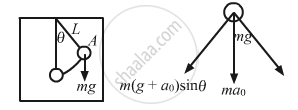
From the diagram, the driving forces f is given by,
f = m(g + a0)sinθ ...(1)
Acceleration (a) of the elevator is given by,
\[a = \frac{f}{m}\]
\[ = \left( g + a_0 \right)\sin\theta\]
\[ = \left( g + a_0 \right)\frac{x}{l} \left( \text{From the diagram } \sin\theta = \frac{x}{l} \right)_{}\]
[ when θ is very small, sin θ → θ = x/l]
\[\therefore a = \left( \frac{g + a_0}{l} \right)x\] ...(2)
As the acceleration is directly proportional to displacement, the pendulum executes S.H.M.
Comparing equation (2) with the expression a =\[\omega^2 x\],we get:
\[\omega^2 = \frac{g + a_0}{l}\]
Thus, time period of small oscillations when elevator is going upward(T) will be:
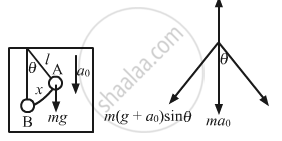
Driving force (F) is given by,
F = m(g − a0)sinθ
On comparing the above equation with the expression, F = ma,\[\text{Acceleration}, a = \left( g - a_0 \right) sin\theta = \frac{\left( g - a_0 \right)x}{l} = \omega^2 x\] \[\text{Time period of elevator when it is moving downward}\left( T' \right) \text{ is given by,} \]
\[T' = \frac{2\pi}{\omega} = 2\pi\sqrt{\frac{l}{g - a_0}}\]
(c) When the elevator moves with uniform velocity, i.e. a0 = 0,
For a simple pendulum, the driving force \[\left( F \right)\] is given by,
\[F = \frac{mgx}{l}\]
\[\text{Comparing the above equation with the expression, F = ma, we get: }\] \[a = \frac{gx}{l}\] \[ \Rightarrow \frac{x}{a} = \frac{l}{g}\] \[T = 2\pi\sqrt{\frac{\text{displacement}}{\text{Acceleration}}}\] \[ = 2\pi\sqrt{\frac{l}{g}}\]
APPEARS IN
RELATED QUESTIONS
State the differential equation of linear simple harmonic motion.
A small creature moves with constant speed in a vertical circle on a bright day. Does its shadow formed by the sun on a horizontal plane move in a sample harmonic motion?
The motion of a particle is given by x = A sin ωt + B cos ωt. The motion of the particle is
A particle moves on the X-axis according to the equation x = A + B sin ωt. The motion is simple harmonic with amplitude
The average energy in one time period in simple harmonic motion is
Suppose a tunnel is dug along a diameter of the earth. A particle is dropped from a point, a distance h directly above the tunnel. The motion of the particle as seen from the earth is
(a) simple harmonic
(b) parabolic
(c) on a straight line
(d) periodic
A particle executes simple harmonic motion with an amplitude of 10 cm and time period 6 s. At t = 0 it is at position x = 5 cm going towards positive x-direction. Write the equation for the displacement x at time t. Find the magnitude of the acceleration of the particle at t = 4 s.
A small block oscillates back and forth on a smooth concave surface of radius R ib Figure . Find the time period of small oscillation.
A spherical ball of mass m and radius r rolls without slipping on a rough concave surface of large radius R. It makes small oscillations about the lowest point. Find the time period.
A simple pendulum of length 40 cm is taken inside a deep mine. Assume for the time being that the mine is 1600 km deep. Calculate the time period of the pendulum there. Radius of the earth = 6400 km.
Assume that a tunnel is dug along a chord of the earth, at a perpendicular distance R/2 from the earth's centre where R is the radius of the earth. The wall of the tunnel is frictionless. (a) Find the gravitational force exerted by the earth on a particle of mass mplaced in the tunnel at a distance x from the centre of the tunnel. (b) Find the component of this force along the tunnel and perpendicular to the tunnel. (c) Find the normal force exerted by the wall on the particle. (d) Find the resultant force on the particle. (e) Show that the motion of the particle in the tunnel is simple harmonic and find the time period.
A simple pendulum fixed in a car has a time period of 4 seconds when the car is moving uniformly on a horizontal road. When the accelerator is pressed, the time period changes to 3.99 seconds. Making an approximate analysis, find the acceleration of the car.
Three simple harmonic motions of equal amplitude A and equal time periods in the same direction combine. The phase of the second motion is 60° ahead of the first and the phase of the third motion is 60° ahead of the second. Find the amplitude of the resultant motion.
A particle is subjected to two simple harmonic motions given by x1 = 2.0 sin (100π t) and x2 = 2.0 sin (120 π t + π/3), where x is in centimeter and t in second. Find the displacement of the particle at (a) t = 0.0125, (b) t = 0.025.
A particle executing SHM crosses points A and B with the same velocity. Having taken 3 s in passing from A to B, it returns to B after another 3 s. The time period is ____________.
The length of a second’s pendulum on the surface of the Earth is 0.9 m. The length of the same pendulum on the surface of planet X such that the acceleration of the planet X is n times greater than the Earth is
Define the time period of simple harmonic motion.
Write short notes on two springs connected in parallel.
Consider a simple pendulum of length l = 0.9 m which is properly placed on a trolley rolling down on a inclined plane which is at θ = 45° with the horizontal. Assuming that the inclined plane is frictionless, calculate the time period of oscillation of the simple pendulum.
A body having specific charge 8 µC/g is resting on a frictionless plane at a distance 10 cm from the wall (as shown in the figure). It starts moving towards the wall when a uniform electric field of 100 V/m is applied horizontally toward the wall. If the collision of the body with the wall is perfectly elastic, then the time period of the motion will be ______ s.