Advertisements
Advertisements
प्रश्न
A simple pendulum of length l is suspended through the ceiling of an elevator. Find the time period of small oscillations if the elevator (a) is going up with and acceleration a0(b) is going down with an acceleration a0 and (c) is moving with a uniform velocity.
Advertisements
उत्तर
The length of the simple pendulum is l.
Let x be the displacement of the simple pendulum..
(a)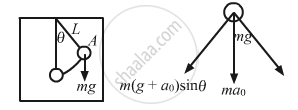
From the diagram, the driving forces f is given by,
f = m(g + a0)sinθ ...(1)
Acceleration (a) of the elevator is given by,
\[a = \frac{f}{m}\]
\[ = \left( g + a_0 \right)\sin\theta\]
\[ = \left( g + a_0 \right)\frac{x}{l} \left( \text{From the diagram } \sin\theta = \frac{x}{l} \right)_{}\]
[ when θ is very small, sin θ → θ = x/l]
\[\therefore a = \left( \frac{g + a_0}{l} \right)x\] ...(2)
As the acceleration is directly proportional to displacement, the pendulum executes S.H.M.
Comparing equation (2) with the expression a =\[\omega^2 x\],we get:
\[\omega^2 = \frac{g + a_0}{l}\]
Thus, time period of small oscillations when elevator is going upward(T) will be:
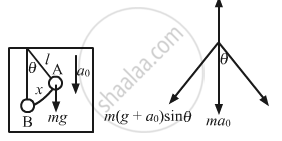
Driving force (F) is given by,
F = m(g − a0)sinθ
On comparing the above equation with the expression, F = ma,\[\text{Acceleration}, a = \left( g - a_0 \right) sin\theta = \frac{\left( g - a_0 \right)x}{l} = \omega^2 x\] \[\text{Time period of elevator when it is moving downward}\left( T' \right) \text{ is given by,} \]
\[T' = \frac{2\pi}{\omega} = 2\pi\sqrt{\frac{l}{g - a_0}}\]
(c) When the elevator moves with uniform velocity, i.e. a0 = 0,
For a simple pendulum, the driving force \[\left( F \right)\] is given by,
\[F = \frac{mgx}{l}\]
\[\text{Comparing the above equation with the expression, F = ma, we get: }\] \[a = \frac{gx}{l}\] \[ \Rightarrow \frac{x}{a} = \frac{l}{g}\] \[T = 2\pi\sqrt{\frac{\text{displacement}}{\text{Acceleration}}}\] \[ = 2\pi\sqrt{\frac{l}{g}}\]
APPEARS IN
संबंधित प्रश्न
A particle executes S.H.M. with a period of 10 seconds. Find the time in which its potential energy will be half of its total energy.
Hence obtain the expression for acceleration, velocity and displacement of a particle performing linear S.H.M.
In measuring time period of a pendulum, it is advised to measure the time between consecutive passage through the mean position in the same direction. This is said to result in better accuracy than measuring time between consecutive passage through an extreme position. Explain.
The energy of system in simple harmonic motion is given by \[E = \frac{1}{2}m \omega^2 A^2 .\] Which of the following two statements is more appropriate?
(A) The energy is increased because the amplitude is increased.
(B) The amplitude is increased because the energy is increased.
A pendulum clock gives correct time at the equator. Will it gain time or loose time as it is taken to the poles?
The time period of a particle in simple harmonic motion is equal to the time between consecutive appearances of the particle at a particular point in its motion. This point is
Which of the following quantities are always zero in a simple harmonic motion?
(a) \[\vec{F} \times \vec{a} .\]
(b) \[\vec{v} \times \vec{r} .\]
(c) \[\vec{a} \times \vec{r} .\]
(d) \[\vec{F} \times \vec{r} .\]
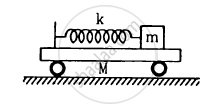
All the surfaces shown in figure are frictionless. The mass of the care is M, that of the block is m and the spring has spring constant k. Initially the car and the block are at rest and the spring is stretched through a length x0 when the system is released. (a) Find the amplitudes of the simple harmonic motion of the block and of the care as seen from the road. (b) Find the time period(s) of the two simple harmonic motions.
Assume that a tunnel is dug across the earth (radius = R) passing through its centre. Find the time a particle takes to cover the length of the tunnel if (a) it is projected into the tunnel with a speed of \[\sqrt{gR}\] (b) it is released from a height R above the tunnel (c) it is thrown vertically upward along the length of tunnel with a speed of \[\sqrt{gR}\]
A closed circular wire hung on a nail in a wall undergoes small oscillations of amplitude 20 and time period 2 s. Find (a) the radius of the circular wire, (b) the speed of the particle farthest away from the point of suspension as it goes through its mean position, (c) the acceleration of this particle as it goes through its mean position and (d) the acceleration of this particle when it is at an extreme position. Take g = π2 m/s2.
A simple pendulum of length l is suspended from the ceiling of a car moving with a speed v on a circular horizontal road of radius r. (a) Find the tension in the string when it is at rest with respect to the car. (b) Find the time period of small oscillation.
A particle is subjected to two simple harmonic motions of same time period in the same direction. The amplitude of the first motion is 3.0 cm and that of the second is 4.0 cm. Find the resultant amplitude if the phase difference between the motions is (a) 0°, (b) 60°, (c) 90°.
A particle is subjected to two simple harmonic motions, one along the X-axis and the other on a line making an angle of 45° with the X-axis. The two motions are given by x = x0 sin ωt and s = s0 sin ωt. Find the amplitude of the resultant motion.
In a simple harmonic oscillation, the acceleration against displacement for one complete oscillation will be __________.
Define the frequency of simple harmonic motion.
Write short notes on two springs connected in series.
The displacement of a particle is represented by the equation y = sin3ωt. The motion is ______.
Displacement vs. time curve for a particle executing S.H.M. is shown in figure. Choose the correct statements.

- Phase of the oscillator is same at t = 0 s and t = 2s.
- Phase of the oscillator is same at t = 2 s and t = 6s.
- Phase of the oscillator is same at t = 1 s and t = 7s.
- Phase of the oscillator is same at t = 1 s and t = 5s.
The velocities of a particle in SHM at positions x1 and x2 are v1 and v2 respectively, its time period will be ______.
If x = `5 sin (pi t + pi/3) m` represents the motion of a particle executing simple harmonic motion, the amplitude and time period of motion, respectively, are ______.
