Advertisements
Advertisements
प्रश्न
The displacement of a particle is represented by the equation y = sin3ωt. The motion is ______.
पर्याय
non-periodic.
periodic but not simple harmonic.
simple harmonic with period 2π/ω.
simple harmonic with period π/ω.
Advertisements
उत्तर
The displacement of a particle is represented by the equation y = sin3ωt. The motion is periodic but not simple harmonic.
Explanation:
Given the equation of motion is y = sin3ωt
= `(3 sin ωt - 4 sin 3 ωt)/4` .....[∵ sin 3θ = 3 sin θ – 4sin3θ]
⇒ `(dy)/(dt) = ([d/(dt) (3sin ωt) - d/(dt) (4sin3ωt)])/4`
⇒ `4 (dy)/(dt) = 3ωcos ωt - 4 xx [3ωcos 3ωt]`
⇒ `4 xx (d^2y)/(dt^2) = - 3ω^2sin ωt + 12 ωsin3ωt`
⇒ `(d^2y)/(dt^2) = - (3ω^2 sinωt + 12ω^2 sin 3ωt)/4`
⇒ `(d^2y)/(dt^2)` is not proportional to y.
Hence, the motion is not SHM.
As the expression is involved in function, hence it will be periodic.
APPEARS IN
संबंधित प्रश्न
Define phase of S.H.M.
A particle executing simple harmonic motion comes to rest at the extreme positions. Is the resultant force on the particle zero at these positions according to Newton's first law?
Can simple harmonic motion take place in a non-inertial frame? If yes, should the ratio of the force applied with the displacement be constant?
A small creature moves with constant speed in a vertical circle on a bright day. Does its shadow formed by the sun on a horizontal plane move in a sample harmonic motion?
A pendulum clock gives correct time at the equator. Will it gain time or loose time as it is taken to the poles?
Can a pendulum clock be used in an earth-satellite?
A block of known mass is suspended from a fixed support through a light spring. Can you find the time period of vertical oscillation only by measuring the extension of the spring when the block is in equilibrium?
The displacement of a particle in simple harmonic motion in one time period is
The distance moved by a particle in simple harmonic motion in one time period is
Which of the following quantities are always negative in a simple harmonic motion?
(a) \[\vec{F} . \vec{a} .\]
(b) \[\vec{v} . \vec{r} .\]
(c) \[\vec{a} . \vec{r} .\]
(d)\[\vec{F} . \vec{r} .\]
Which of the following quantities are always zero in a simple harmonic motion?
(a) \[\vec{F} \times \vec{a} .\]
(b) \[\vec{v} \times \vec{r} .\]
(c) \[\vec{a} \times \vec{r} .\]
(d) \[\vec{F} \times \vec{r} .\]
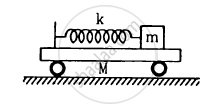
All the surfaces shown in figure are frictionless. The mass of the care is M, that of the block is m and the spring has spring constant k. Initially the car and the block are at rest and the spring is stretched through a length x0 when the system is released. (a) Find the amplitudes of the simple harmonic motion of the block and of the care as seen from the road. (b) Find the time period(s) of the two simple harmonic motions.
A small block oscillates back and forth on a smooth concave surface of radius R in Figure. Find the time period of small oscillation.

The length of a second’s pendulum on the surface of the Earth is 0.9 m. The length of the same pendulum on the surface of planet X such that the acceleration of the planet X is n times greater than the Earth is
A simple pendulum is suspended from the roof of a school bus which moves in a horizontal direction with an acceleration a, then the time period is
A spring is stretched by 5 cm by a force of 10 N. The time period of the oscillations when a mass of 2 kg is suspended by it is ______.
What is the ratio of maxmimum acceleration to the maximum velocity of a simple harmonic oscillator?
A container consist of hemispherical shell of radius 'r ' and cylindrical shell of height 'h' radius of same material and thickness. The maximum value h/r so that container remain stable equilibrium in the position shown (neglect friction) is ______.

Assume there are two identical simple pendulum clocks. Clock - 1 is placed on the earth and Clock - 2 is placed on a space station located at a height h above the earth's surface. Clock - 1 and Clock - 2 operate at time periods 4 s and 6 s respectively. Then the value of h is ______.
(consider the radius of earth RE = 6400 km and g on earth 10 m/s2)
