Advertisements
Advertisements
प्रश्न
Assume that a tunnel is dug along a chord of the earth, at a perpendicular distance R/2 from the earth's centre where R is the radius of the earth. The wall of the tunnel is frictionless. (a) Find the gravitational force exerted by the earth on a particle of mass mplaced in the tunnel at a distance x from the centre of the tunnel. (b) Find the component of this force along the tunnel and perpendicular to the tunnel. (c) Find the normal force exerted by the wall on the particle. (d) Find the resultant force on the particle. (e) Show that the motion of the particle in the tunnel is simple harmonic and find the time period.
Advertisements
उत्तर
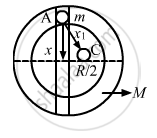
If \[\rho\] is the density of the earth, then mass of the earth \[\left( M \right)\] is given by,
\[M = \frac{4}{3}\pi R^3 \rho\]
\[\text {Similarly, mass} \left( M' \right) \text{ of the part of earth having radius } \left( x \right)\text{ is given by, } \] \[M' = \frac{4}{3}\pi {x_1}^3 \rho\]
\[M' = \left( \frac{M}{R^3} \right) {x_1}^3\]
(a) Let F be the gravitational force exerted by the earth on the particle of mass m. Then, its value is given by,
\[F = \frac{GM'm}{x_1^2}\]
\[\text {Substituting the value of M' in the above equation, we get: }\]
\[F = \frac{GMm}{R^3}\frac{x_1^3}{x_1^2}\]
\[ = \frac{GMm}{R^3} x_1 = \frac{GMm}{R^3}\sqrt{x^2 + \left( \frac{R^2}{4} \right)}\]
(b)
\[F_y = Fcos\theta\]
\[ = \frac{GMm x_1}{R^3}\frac{x}{x_1} = \frac{GMmx}{R^3}\]
\[ F_x = F\sin \theta\]
\[ = \frac{GMm x_1}{R^3}\frac{R}{2 x_1} = \frac{GMm}{2 R^2}\]
(c) 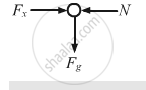
\[F_x = \frac{GMm}{R^2}\]
\[\because\] Normal force exerted by the wall N = Fx
(d)The resultant force is \[\frac{GMmx}{R^3}\]
(e) Acceleration = Driving force/mass
\[= \frac{GMmx}{R^3 m}\]
\[ = \frac{GMx}{R^3}\]
\[\Rightarrow\] a \[\propto\] x (the body executes S.H.M.)
\[\frac{a}{x} = \omega^2 = \frac{GM}{R^3}\]
\[ \Rightarrow \omega = \sqrt{\frac{Gm}{R^3}}\]
\[ \Rightarrow T = 2\pi\sqrt{\frac{R^3}{GM}}\]
APPEARS IN
संबंधित प्रश्न
A body of mass 1 kg is made to oscillate on a spring of force constant 16 N/m. Calculate:
a) Angular frequency
b) frequency of vibration.
Can simple harmonic motion take place in a non-inertial frame? If yes, should the ratio of the force applied with the displacement be constant?
A hollow sphere filled with water is used as the bob of a pendulum. Assume that the equation for simple pendulum is valid with the distance between the point of suspension and centre of mass of the bob acting as the effective length of the pendulum. If water slowly leaks out of the bob, how will the time period vary?
The force acting on a particle moving along X-axis is F = −k(x − vo t) where k is a positive constant. An observer moving at a constant velocity v0 along the X-axis looks at the particle. What kind of motion does he find for the particle?
The motion of a particle is given by x = A sin ωt + B cos ωt. The motion of the particle is
The displacement of a particle is given by \[\overrightarrow{r} = A\left( \overrightarrow{i} \cos\omega t + \overrightarrow{j} \sin\omega t \right) .\] The motion of the particle is
The motion of a torsional pendulum is
(a) periodic
(b) oscillatory
(c) simple harmonic
(d) angular simple harmonic
A particle moves on the X-axis according to the equation x = x0 sin2 ωt. The motion is simple harmonic
The angle made by the string of a simple pendulum with the vertical depends on time as \[\theta = \frac{\pi}{90} \sin \left[ \left( \pi s^{- 1} \right)t \right]\] .Find the length of the pendulum if g = π2 m2.
A pendulum clock giving correct time at a place where g = 9.800 m/s2 is taken to another place where it loses 24 seconds during 24 hours. Find the value of g at this new place.
A simple pendulum is constructed by hanging a heavy ball by a 5.0 m long string. It undergoes small oscillations. (a) How many oscillations does it make per second? (b) What will be the frequency if the system is taken on the moon where acceleration due to gravitation of the moon is 1.67 m/s2?
A small block oscillates back and forth on a smooth concave surface of radius R in Figure. Find the time period of small oscillation.

A simple pendulum of length l is suspended through the ceiling of an elevator. Find the time period of small oscillations if the elevator (a) is going up with and acceleration a0(b) is going down with an acceleration a0 and (c) is moving with a uniform velocity.
A particle is subjected to two simple harmonic motions of same time period in the same direction. The amplitude of the first motion is 3.0 cm and that of the second is 4.0 cm. Find the resultant amplitude if the phase difference between the motions is (a) 0°, (b) 60°, (c) 90°.
A particle is subjected to two simple harmonic motions, one along the X-axis and the other on a line making an angle of 45° with the X-axis. The two motions are given by x = x0 sin ωt and s = s0 sin ωt. Find the amplitude of the resultant motion.
A particle executing SHM crosses points A and B with the same velocity. Having taken 3 s in passing from A to B, it returns to B after another 3 s. The time period is ____________.
Define the time period of simple harmonic motion.
The displacement of a particle is represented by the equation y = sin3ωt. The motion is ______.
Assume there are two identical simple pendulum clocks. Clock - 1 is placed on the earth and Clock - 2 is placed on a space station located at a height h above the earth's surface. Clock - 1 and Clock - 2 operate at time periods 4 s and 6 s respectively. Then the value of h is ______.
(consider the radius of earth RE = 6400 km and g on earth 10 m/s2)
