Advertisements
Advertisements
प्रश्न
A particle is subjected to two simple harmonic motions given by x1 = 2.0 sin (100π t) and x2 = 2.0 sin (120 π t + π/3), where x is in centimeter and t in second. Find the displacement of the particle at (a) t = 0.0125, (b) t = 0.025.
Advertisements
उत्तर
Given are the equations of motion of a particle:
x1 = 2.0sin100 \[\pi\]t
\[x_2 = 2 . 0\sin\left( 120\pi t + \frac{\pi}{3} \right)\]
The Resultant displacement \[\left( x \right)\] will be
x = x1 + x2
\[= 2\left[ \sin\left( 100\pi t \right) + \sin\left( 120\pi t + \frac{\pi}{3} \right) \right]\]
(a) At t = 0.0125 s
\[x = 2\left[ \sin\left( 100\pi \times 0 . 0125 \right) + \sin\left( 120\pi \times 0 . 0125 + \frac{\pi}{3} \right) \right]\]
\[ = 2\left[ \sin \left( \frac{5\pi}{4} \right) + \sin \left( \frac{3\pi}{2} + \frac{\pi}{3} \right) \right]\]
\[ = 2\left[ \left( - 0 . 707 \right) + \left( - 0 . 5 \right) \right]\]
\[ = 2 \times \left( - 1 . 207 \right) = - 2 . 41 cm\]
(b) At t = 0.025 s
\[x = 2\left[ \sin\left( 100 \pi \times 0 . 025 \right) + \sin\left( 120\pi \times 0 . 025 + \frac{\pi}{3} \right) \right]\] \[ = 2\left[ \sin\left( \frac{10\pi}{4} \right) + \sin\left( 3\pi + \frac{\pi}{3} \right) \right]\]
\[ = 2\left[ 1 + \left( - 0 . 866 \right) \right]\]
\[ = 2 \times \left( 0 . 134 \right) = 0 . 27 \text { cm }\]
APPEARS IN
संबंधित प्रश्न
Hence obtain the expression for acceleration, velocity and displacement of a particle performing linear S.H.M.
Can simple harmonic motion take place in a non-inertial frame? If yes, should the ratio of the force applied with the displacement be constant?
Can the potential energy in a simple harmonic motion be negative? Will it be so if we choose zero potential energy at some point other than the mean position?
A pendulum clock gives correct time at the equator. Will it gain time or loose time as it is taken to the poles?
A particle moves on the X-axis according to the equation x = x0 sin2 ωt. The motion is simple harmonic
In a simple harmonic motion
An object is released from rest. The time it takes to fall through a distance h and the speed of the object as it falls through this distance are measured with a pendulum clock. The entire apparatus is taken on the moon and the experiment is repeated
(a) the measured times are same
(b) the measured speeds are same
(c) the actual times in the fall are equal
(d) the actual speeds are equal
A particle executes simple harmonic motion with an amplitude of 10 cm and time period 6 s. At t = 0 it is at position x = 5 cm going towards positive x-direction. Write the equation for the displacement x at time t. Find the magnitude of the acceleration of the particle at t = 4 s.
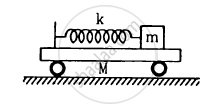
All the surfaces shown in figure are frictionless. The mass of the care is M, that of the block is m and the spring has spring constant k. Initially the car and the block are at rest and the spring is stretched through a length x0 when the system is released. (a) Find the amplitudes of the simple harmonic motion of the block and of the care as seen from the road. (b) Find the time period(s) of the two simple harmonic motions.
The pendulum of a certain clock has time period 2.04 s. How fast or slow does the clock run during 24 hours?
A small block oscillates back and forth on a smooth concave surface of radius R in Figure. Find the time period of small oscillation.

A simple pendulum fixed in a car has a time period of 4 seconds when the car is moving uniformly on a horizontal road. When the accelerator is pressed, the time period changes to 3.99 seconds. Making an approximate analysis, find the acceleration of the car.
A particle is subjected to two simple harmonic motions, one along the X-axis and the other on a line making an angle of 45° with the X-axis. The two motions are given by x = x0 sin ωt and s = s0 sin ωt. Find the amplitude of the resultant motion.
In a simple harmonic oscillation, the acceleration against displacement for one complete oscillation will be __________.
A simple pendulum is suspended from the roof of a school bus which moves in a horizontal direction with an acceleration a, then the time period is
If the inertial mass and gravitational mass of the simple pendulum of length l are not equal, then the time period of the simple pendulum is
What is an epoch?
Write short notes on two springs connected in series.
If x = `5 sin (pi t + pi/3) m` represents the motion of a particle executing simple harmonic motion, the amplitude and time period of motion, respectively, are ______.
