Advertisements
Advertisements
प्रश्न
A particle executes simple harmonic motion with an amplitude of 10 cm and time period 6 s. At t = 0 it is at position x = 5 cm going towards positive x-direction. Write the equation for the displacement x at time t. Find the magnitude of the acceleration of the particle at t = 4 s.
Advertisements
उत्तर
It is given,
Amplitude of the simple harmonic motion, A =10 cm
At t = 0 and x = 5 cm,
Time period of the simple harmonic motion, T = 6 s
Angular frequency (ω) is given by,
\[\omega = \frac{2\pi}{T} = \frac{2\pi}{6} = \frac{\pi}{3} \sec^{- 1}\]
Consider the equation of motion of S.H.M,
Y = Asin \[\left( \omega t + \phi \right)\]...(1)
where Y is displacement of the particle, and \[\phi\] is phase of the particle.
On substituting the values of A, t and ω in equation (1), we get:
5 = 10sin(ω × 0 + ϕ)
\[\Rightarrow\] 5 = 10sin ϕ
\[\sin \phi = \frac{1}{2}\]
\[ \Rightarrow \phi = \frac{\pi}{6}\]
∴ Equation of displacement can be written as,
\[x = \left( 10 \text { cm }\right) \sin \left( \frac{\pi}{3}t + \frac{\pi}{6} \right)\]
(ii) At t = 4 s,
\[x = 10\sin\left[ \frac{\pi}{3}4 + \frac{\pi}{6} \right]\]
\[ = 10\sin\left[ \frac{8\pi + \pi}{6} \right]\]
\[ = 10\sin\left( \frac{9\pi}{6} \right)\]
\[ = 10\sin\left( \frac{3\pi}{2} \right)\]
\[ = 10\sin\left( \pi + \frac{\pi}{2} \right)\]
\[ = - 10\sin\frac{\pi}{2} = - 10\]
Acceleration is given by,
a = −ω2x
\[= \left( \frac{- \pi^2}{9} \right) \times \left( - 10 \right)\]
\[ = 10 . 9 \approx 11 \text { cm }/ \sec^{- 2}\]
APPEARS IN
संबंधित प्रश्न
The average displacement over a period of S.H.M. is ______.
(A = amplitude of S.H.M.)
A body of mass 1 kg is made to oscillate on a spring of force constant 16 N/m. Calculate:
a) Angular frequency
b) frequency of vibration.
A particle executing simple harmonic motion comes to rest at the extreme positions. Is the resultant force on the particle zero at these positions according to Newton's first law?
The time period of a particle in simple harmonic motion is equal to the time between consecutive appearances of the particle at a particular point in its motion. This point is
The time period of a particle in simple harmonic motion is equal to the smallest time between the particle acquiring a particular velocity \[\vec{v}\] . The value of v is
Figure represents two simple harmonic motions.
The parameter which has different values in the two motions is
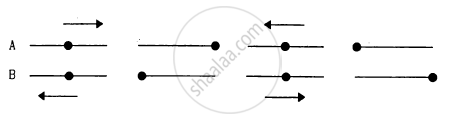
A pendulum clock keeping correct time is taken to high altitudes,
Select the correct statements.
(a) A simple harmonic motion is necessarily periodic.
(b) A simple harmonic motion is necessarily oscillatory.
(c) An oscillatory motion is necessarily periodic.
(d) A periodic motion is necessarily oscillatory.
Which of the following quantities are always zero in a simple harmonic motion?
(a) \[\vec{F} \times \vec{a} .\]
(b) \[\vec{v} \times \vec{r} .\]
(c) \[\vec{a} \times \vec{r} .\]
(d) \[\vec{F} \times \vec{r} .\]
Suppose a tunnel is dug along a diameter of the earth. A particle is dropped from a point, a distance h directly above the tunnel. The motion of the particle as seen from the earth is
(a) simple harmonic
(b) parabolic
(c) on a straight line
(d) periodic
An object is released from rest. The time it takes to fall through a distance h and the speed of the object as it falls through this distance are measured with a pendulum clock. The entire apparatus is taken on the moon and the experiment is repeated
(a) the measured times are same
(b) the measured speeds are same
(c) the actual times in the fall are equal
(d) the actual speeds are equal
A pendulum clock giving correct time at a place where g = 9.800 m/s2 is taken to another place where it loses 24 seconds during 24 hours. Find the value of g at this new place.
Assume that a tunnel is dug across the earth (radius = R) passing through its centre. Find the time a particle takes to cover the length of the tunnel if (a) it is projected into the tunnel with a speed of \[\sqrt{gR}\] (b) it is released from a height R above the tunnel (c) it is thrown vertically upward along the length of tunnel with a speed of \[\sqrt{gR}\]
A uniform disc of mass m and radius r is suspended through a wire attached to its centre. If the time period of the torsional oscillations be T, what is the torsional constant of the wire?
Three simple harmonic motions of equal amplitude A and equal time periods in the same direction combine. The phase of the second motion is 60° ahead of the first and the phase of the third motion is 60° ahead of the second. Find the amplitude of the resultant motion.
The length of a second’s pendulum on the surface of the Earth is 0.9 m. The length of the same pendulum on the surface of planet X such that the acceleration of the planet X is n times greater than the Earth is
If the inertial mass and gravitational mass of the simple pendulum of length l are not equal, then the time period of the simple pendulum is
What is an epoch?
Which of the following expressions corresponds to simple harmonic motion along a straight line, where x is the displacement and a, b, and c are positive constants?
Assume there are two identical simple pendulum clocks. Clock - 1 is placed on the earth and Clock - 2 is placed on a space station located at a height h above the earth's surface. Clock - 1 and Clock - 2 operate at time periods 4 s and 6 s respectively. Then the value of h is ______.
(consider the radius of earth RE = 6400 km and g on earth 10 m/s2)
