Advertisements
Advertisements
प्रश्न
The position, velocity and acceleration of a particle executing simple harmonic motion are found to have magnitude 2 cm, 1 m s−1 and 10 m s−2 at a certain instant. Find the amplitude and the time period of the motion.
Advertisements
उत्तर
It is given that:
Position of the particle, x = 2 cm = 0.02 m
Velocity of the particle, v = 1 ms−1.
Acceleration of the particle, a = 10 ms−2.
Let
\[\omega\] be the angular frequency of the particle.
The acceleration of the particle is given by,
a = ω2x
\[\Rightarrow \omega = \sqrt{\frac{a}{x}} = \sqrt{\frac{10}{0 . 02}}\]
\[ = \sqrt{500} = 10\sqrt{5} Hz\]
\[\text { Time period of the motion is given as, } \]
\[ T = \frac{2\pi}{\omega} = \frac{2\pi}{10\sqrt{5}}\]
\[ = \frac{2 \times 3 . 14}{10 \times 2 . 236}\]
\[ = 0 . 28 s\]
Now, the amplitude A is calculated as,
\[v = \omega\sqrt{A^2 - x^2}\]
\[ \Rightarrow v^2 = \omega^2 \left( A^2 - x^2 \right)\]
\[ 1 = 500\left( A^2 - 0 . 0004 \right)\]
\[ \Rightarrow A = 0 . 0489 = 0 . 049 m\]
\[ \Rightarrow A = 4 . 9 \text { cm }\]
APPEARS IN
संबंधित प्रश्न
Which of the following example represent (nearly) simple harmonic motion and which represent periodic but not simple harmonic motion?
General vibrations of a polyatomic molecule about its equilibrium position.
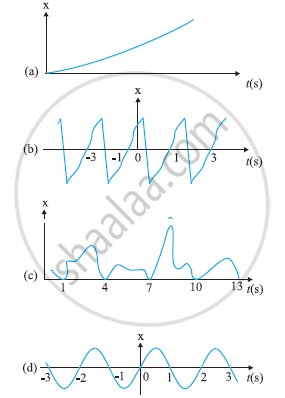
Figure depicts four x-t plots for linear motion of a particle. Which of the plots represent periodic motion? What is the period of motion (in case of periodic motion)?
The total mechanical energy of a spring-mass system in simple harmonic motion is \[E = \frac{1}{2}m \omega^2 A^2 .\] Suppose the oscillating particle is replaced by another particle of double the mass while the amplitude A remains the same. The new mechanical energy will
Two bodies A and B of equal mass are suspended from two separate massless springs of spring constant k1 and k2 respectively. If the bodies oscillate vertically such that their maximum velocities are equal, the ratio of the amplitude of A to that of B is
A particle moves in a circular path with a uniform speed. Its motion is
A particle is fastened at the end of a string and is whirled in a vertical circle with the other end of the string being fixed. The motion of the particle is
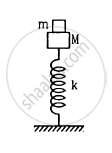
A small block of mass m is kept on a bigger block of mass M which is attached to a vertical spring of spring constant k as shown in the figure. The system oscillates vertically. (a) Find the resultant force on the smaller block when it is displaced through a distance x above its equilibrium position. (b) Find the normal force on the smaller block at this position. When is this force smallest in magnitude? (c) What can be the maximum amplitude with which the two blocks may oscillate together?
The string the spring and the pulley shown in figure are light. Find the time period of the mass m.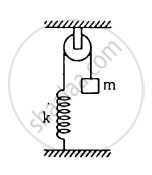
The ear-ring of a lady shown in figure has a 3 cm long light suspension wire. (a) Find the time period of small oscillations if the lady is standing on the ground. (b) The lady now sits in a merry-go-round moving at 4 m/s1 in a circle of radius 2 m. Find the time period of small oscillations of the ear-ring.

A body of mass 1 kg is mafe to oscillate on a spring of force constant 16 N/m. Calculate (a) Angular frequency, (b) Frequency of vibrations.
The period of oscillation of a body of mass m1 suspended from a light spring is T. When a body of mass m2 is tied to the first body and the system is made to oscillate, the period is 2T. Compare the masses m1 and m2
Find the number of oscillations performed per minute by a magnet is vibrating in the plane of a uniform field of 1.6 × 10⁻⁵ Wb/m2. The magnet has a moment of inertia 3 × 10⁻⁶ kg/m2 and magnetic moment 3 A m2.
A simple pendulum is inside a spacecraft. What will be its periodic time?
Which of the following example represent periodic motion?
A swimmer completing one (return) trip from one bank of a river to the other and back.
Which of the following example represent (nearly) simple harmonic motion and which represent periodic but not simple harmonic motion?
The rotation of the earth about its axis.
Which of the following example represent (nearly) simple harmonic motion and which represent periodic but not simple harmonic motion?
The motion of a ball bearing inside a smooth curved bowl, when released from a point slightly above the lowermost point.
The equation of motion of a particle is x = a cos (αt)2. The motion is ______.
When a particle executes Simple Harmonic Motion, the nature of the graph of velocity as a function of displacement will be ______.
